Travel

Edith Piaf in the Andes

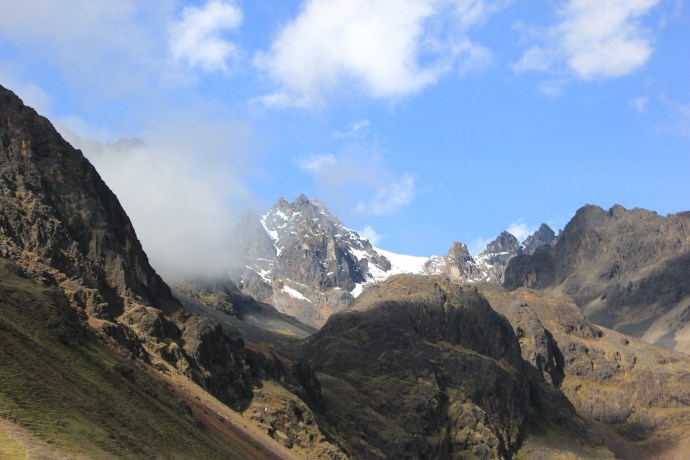
As we drove up and up, from Cusco to Marcapata through the Ausangate Range of the Andes, the air got markedly thinner, and the scenery got wilder and more spectacular. There were five of us in the truck: me; Lidia, the adorable Director of Heifer Cusco; Rosaluz, my Heifer translator; Carlitos, our jovial driver; and Kristen, an enthusiastic American volunteer working in the Cusco office. As we blasted Edith Piaf on the CD player (in complete & wonderful incongruity), they tried to explain to me the intricacies of Heifer’s Alpaca Bio-Diversity in High Andean Communities program. I was trying hard to follow, but I kept getting distracted by the amazing views of llamas, alpacas, glaciers and peaks out the window….and La Vie en Rose.

Beautiful and pristine, this part of the Central Highlands is inhabited almost exclusively by llama and alpaca herding communities in one of the few remaining pastoralist societies in the world. The wet season runs from October – May, when the pastures soak up water like a sponge, and fluffballs of grazing alpacas dot the hillsides. In the dry season, May- October, life gets a lot more challenging, as pastures shrivel and the grazing is sparse. It’s a never-ending struggle for survival, and the 22 Andean communities in Heifer’s program are far-flung, small indigenous villages that are almost exclusively dependent on the alpaca for income, meat and sustenance.
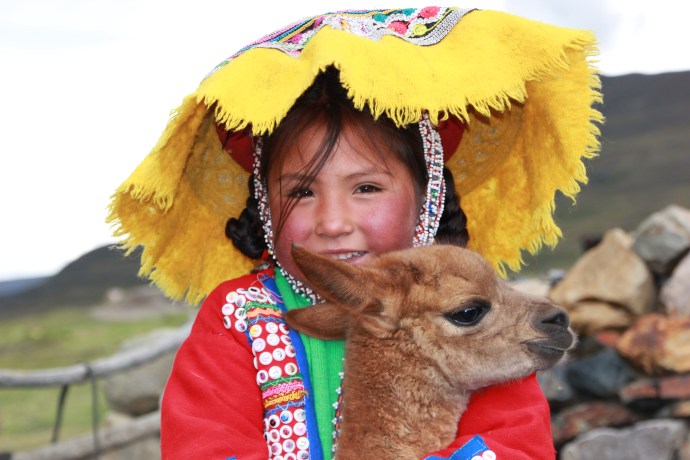
 The Highlanders’ hard-wrung existence is further threatened by climate change, with disappearing glaciers leading to scarcity of water and diminished pasture; food insecurity (only potatoes grow at this rarefied altitude and 45% of children under 5 are malnourished), and the low quality of the alpaca herds.

In past years, white alpaca fur was by far the most valuable, so breeders began to kill their brown, black and tan alpacas. Before you could say “genetic disaster,” the 22 natural shades of alpaca became 90% white, and in-breeding caused a multitude of weaknesses in the animals.

Pretty blue eyes, but that's not a good sign in alpacas.

So Heifer is making an investment in these 4,333 alpaca-raising families to help them not only survive, but thrive. Working in partnership with AMADARES, a local NGO, Heifer is providing robust bulls in non-white alpaca colors, seeds and materials, as well as funding 2 veterinarian/technicians. In monthly workshops in each community, the techs teach the breeders better methods of reproduction, animal care, pasture maintenance, shearing, categorizing the fiber, and making alpaca handicrafts.
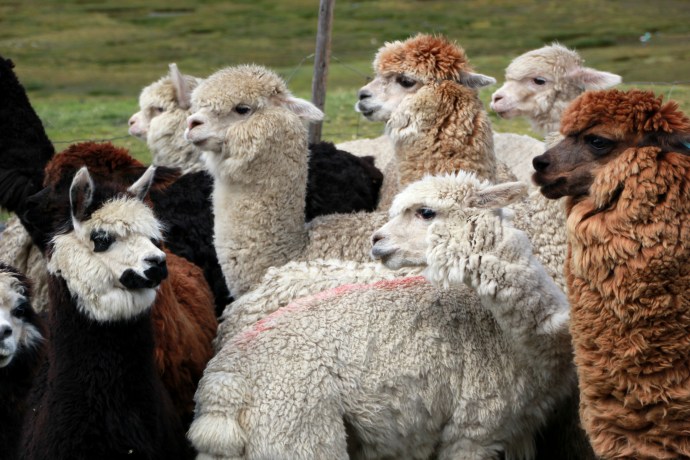
The alpaca rainbow coalition -- how beautiful!!

We met Claudio Pacco, one of the vet/techs, when we finally reached Marcopata at dusk, a sweet little town huddled in a valley between two giant mountains. Claudio lives in Puno and drives 9 hours every month to Marcopata to begin a 20-day stint where he rises daily at 4:30 a.m. to ride his motorcycle (brrrrrr!) to the remote villages so he can get there before 6 a.m. when the alpacas are put out to pasture.

Claudio at work, with a storm coming in.

Claudio is 31 and both his parents and grandparents were alpaca breeders, so he feels it was his destiny to be a vet. “I have a very inner feeling about alpacas,” he tells me shyly, “and I love working with them, even though they have lots of problems.”

Alpacas do have lots of problems – which I’ll be telling you about at length in my next post – but lack of love from Claudio isn’t one of them. I’ve rarely met anyone whom I felt was more committed, gentle and self-effacing (he wouldn’t even translate comments that praised him) – although I worried that he was never going to get married with a killer schedule like he’s keeping.

As we all walked back to our rustic hotel that night, getting ready for a big trip to the communities the next day, I looked up at the Ausangate Range and remembered that in Andean culture, the mountains are considered gods (“apu”), as protector and creator of the people, and source of water. Those sacred beliefs have held fast for six centuries — but now that gold has been found in the Ausangate, the mountains themselves are at risk of being torn apart, as well as the way of life of the alpaca farmers. The Heifer/ADAMARES teachings and trainings in community organization, empowerment, and building a sustainable economy are laying some great groundwork for a different outcome. Let’s just hope it’s in time for the next generation!

She's got her lasso and she's ready to go!

And just in case you’re longing for a bit of La Vie en Rose, here ya go!
Categories: Agriculture, Animals, Heifer International, Peru, Photography, Travel | Tags: , , , , , , , , , , , , , , | 28 Comments

My Cinderella story

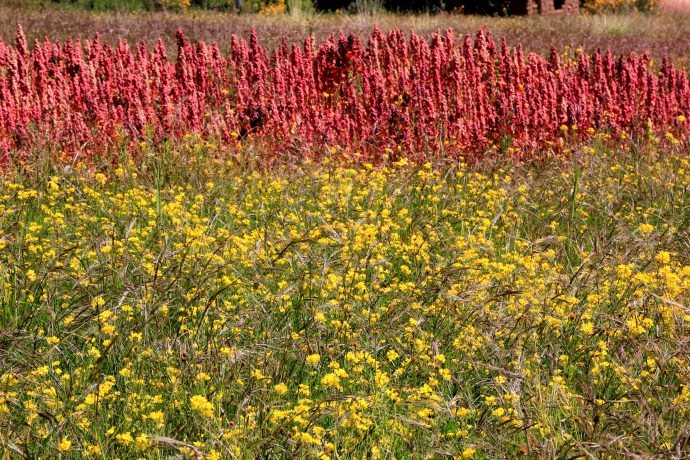
Quinoa and wild turnip, blowing in the Chillcapata wind.

At the end of the beautiful day I spent in Chillcapata, Peru visiting families who’d received animals and trainings through the FEED program of Heifer International... after I’d stuffed myself at the delicious lunch the community had prepared and gone nuts over all the adorable babies… one of the moms, Carmen Calle, asked me to be the godmother of her daughter Leidy.

Which meant I would be responsible for cutting off the long, black braids Leidy had been growing since birth – a rite of passage when Peruvian children reach the age of 6 or 7.

Although I’d been dazzled all afternoon by Leidy’s adorable grin, I was shocked and chagrined at this turn of events, although everybody else in the room seemed pretty much delighted at the idea. I asked Rosaluz Salazar, my Heifer translator, if this was culturally appropriate and what I was committing myself to (like the Catholic sanctity of the child’s soul), and she assured me it was fine, it was a ritual honor, I could snip and go.

So, armed with a scissors and surrounded by dozens of witnesses, I cut through Leidy’s thick black braids – and voila! she was my god-daughter.

Actually, Leidy’s my fourth god-daughter, since I’m the proud (though intermittently present) godmother of three other gorgeous girls: Marie, Maura and Lottie. I fully understand (through the ministrations of my own incredible godmother, Edythe Mendolia) that my responsibilities are to never miss birthdays or Christmas, and to give lavish presents whenever possible.

After the haircut ...what a beautiful girl!

I hope I never let Leidy down in that department. As the fairy godmother, I wouldn’t have it any other way.

p.s. Just a thought for Passover/Easter: Why not give real eggs (via a real chicken!) to a family like Leidy’s?  Click here for a Chick … and here’s a Chillcapata bouquet of thanks!!

Categories: Children, Passover & Easter, Peru, Photography, Travel | Tags: , , , , , , | 21 Comments

Showered with flowers…

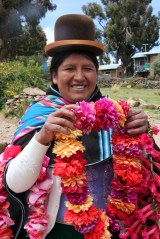
As I walked up the steep road leading to Chillcapata, a rural community outside Puno, Peru something told me I was  going to fall madly in love with the place. First clue: there was a gigantic, beautifully bedecked flower arch to greet me. A cheery welcoming committee was assigned to shower me in flower petals and love-bomb me with hugs. And of course, I got my very own Peruvian garland.

As we headed up the hill to the pretty green house of Maria & Primo Mamami to see Heifer’s FEED program in action, I could easily see why Chillcapata is known as the Garden of Puno; flowers were growing everywhere, while in the distance indigo-blue Lake Titicaca twinkled in the sunlight and llamas pranced in the grass.

Inside her cheerful bright kitchen, Maria proudly showed us her new Ecological Refrigerator (cooled only by a bowl of water), her tidy pantry, her energy stove (uses half the fuel and is vented), and told us about the changes she’d learned to make in her home, and how that had changed her life.

Sounds a bit trite, doesn’t it? Some new shelves, a place to keep things cool and to store utensils and pots, a new roof with translucent panels to bring in light, and an energy stove. But here’s the thing: it makes all the difference in the world to the health, nutrition, and dignity of your family to have a place to cook that is safe and healthy, and a regimen to keep your household clean, hygienic and neat. In fact, I’d argue a tidy house is the first step in gaining control of your life, and feeling competent and valuable. (However, I am a total Type A, or as Lulu calls me, Little Miss OCD.)

Maria's old kitchen

But take a look at the “before” kitchen photo, where the smoke from cooking brought Maria to tears every meal. The family suffered from lung problems and often ate on the floor, where guinea pigs also lived, scratched and ran (they need to be inside and warm to survive). And the rest of the house was just as disorganized and overwhelmed.

Through FEED, Heifer brought the women of Chillcapata a list of simple ideas to improve their lives (no animals in the house/a bed for every child/a biogarden to improve nutrition), offered training workshops, then sent a few emissaries like Maria to other communities to see the ideas in action.

A new hand-made sink

The women came back motivated true believers, and set to work to transform their own homes, and pass their learning on to others. Luckily, these are can-do people who are incredibly clever at building things, working cooperatively, and getting ‘er done.

The Incan ancient tradition of ayni, like an Amish barn-raising where everyone pitches in to cooperatively help each other, is still very much part of Chillcapata culture. Maria’s kitchen was one of the first finished, and quickly, other women signed on to improve their homes.

Julia and Celso Apaza got the materials they needed from Heifer to start kitchen construction, and the couple worked day and night to change every room in the house. “It was like a dream for us,” she told me, “because before I felt ashamed of my house. It was a mess, and I never wanted to welcome visitors. But now my doors are wide open and I even have a bench for my visitors to sit on.”

Julia's old house is now just for guinea pigs.

For two years when they were really struggling, Julia, her husband, their guinea pigs, and four sons lived in one small room and clearly, the memory still haunts her. Like many children of the Highlands, her four sons were sent to Lima to try to make a living at age 12. Three of those boys died of malnutrition and lung disease after working in a wood factory.

Now Julia is a promoter of the Healthy Homes program (which is also supported by Walmart’s Global Women’s Economic Empowerment Initiative) and she proudly keeps the poster on her wall to work her way religiously through every step of the program…and believe me, I’m quite sure she will make it.

“I am very happy because now the young children don’t think about going to Lima anymore; they want to stay here with their parents.”

Driving back to Puno in the long, beautiful light of late afternoon, I thought about these people’s ultimate dream: to make Chillcapata the next New Thing in authentic adventure travel and share with tourists the stunning beauty of their little town. Passing on the gift …It’s contagious!

Categories: Heifer International, Peru, Photography, Travel | Tags: , , , , , , , , , , , | 35 Comments

Just sitting around knitting (and changing the world).

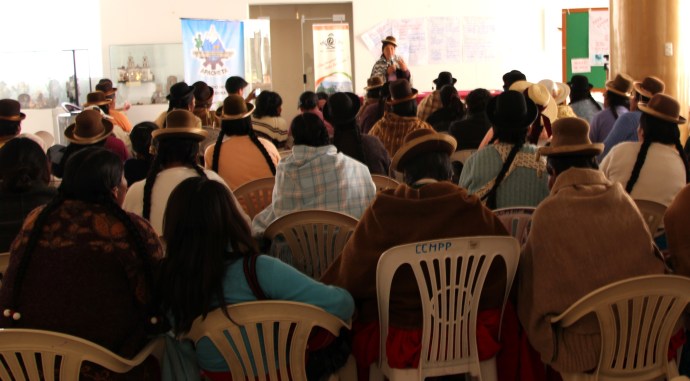
I hate meetings. In fact, I’ve pretty much developed a career around avoiding them. So I was somewhat dismayed when my introduction to Heifer Peru came in the form of a women’s meeting in Puno – a city about 14,000 feet above sea level in the south Central Highlands near beautiful Lake Titicaca.

The view outside...

Luckily, this meeting was like no women’s networking session I’d ever attended. For one thing, everyone had the same hairdo. The room was a sea of long black braids, topped by outrageously insouciant hats, tilted just so.

The view inside...

Instead of power pantsuits and hire-me heels, these women were decked out in abundantly colorful, multi-tiered skirts, intricately embroidered vests and spangled blazers. And while listening intently, almost every woman was simultaneously knitting or crocheting– hence getting a lot accomplished. I loved it!

The softest alpaca goods -- so beautiful!

The women were there to celebrate Heifer’s FEED project, in existence for 4 years with a mission to improve food security, nutrition and income, and encourage women in eight Puno rural communities to produce and collectively sell their handicrafts.

Like many of Heifer Peru’s projects, the FEED program is aligned with a local organization called APACHETA, The Center of Andean Development (obviously, Peruvians are as acronym-crazed as we are). While Heifer guides, funds and monitors APACHETA’s activities with 700 Peruvian women and their families, the leader of that organization is Cleida Incacutipa, a formidable 6-foot tall woman who used to work for Heifer but is now boots-on-the-ground in APACHETA’s drive to improve the lives of Puno women in ways both simple and complex.

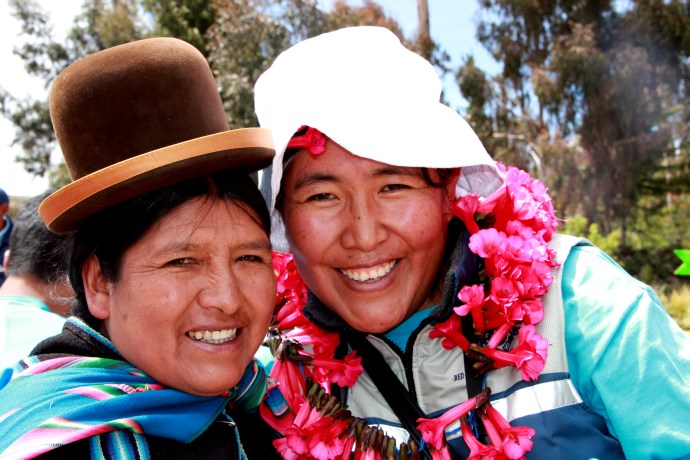
Candida Canaza & the incomparable Cleida Incacutipa

The “simple” part is giving women the animals and the trainings to improve their families’ nutrition and income – teaching them how to grow more potatoes, breed the animals for income, and produce more high-quality handicrafts. More complex is developing leadership capabilities in these women farmers, training them to advocate for themselves in their households, neighborhoods, and local governments. To say Cleida has a gift for this kind of work is an understatement: she knows every woman’s name and personal history, she’s hugely dedicated, and she believes passionately in their capacity to achieve.

Three local leaders: Lidia Quiroz, Felipina Apaza & Elisabeth Ticona ...power to spare!

In a world where women are often not allowed to attend or speak in their local village meetings (not to mention their own households), Heifer’s gender equity sessions represent nothing less than a quiet revolution. From dealing with domestic violence to organizing a Congress of Female Farmers to running for local office, these women graduates of the gender workshops are taking the empowerment ball and running with it – especially the three fabulous rabble-rousers I sat down and talked to, while their friends were busy displaying their award-winning handicrafts on hilariously Caucasian manikins.

The women spoke again and again of the life-altering discovery that “I have a voice.” Once they truly embraced that, it was natural to begin to ask for things for themselves: workshops and looms to improve their community handicrafts, municipal help to support their entrepreneurial efforts, and always, in the Heifer way, offering to share knowledge and decision-making with other women to lift them up, too.

“In the past we were asleep,” says impish Felipina. “And then we woke up. We are new women now.” 

At the end of the long afternoon, I woke up to the shopping opportunities at hand, bought some beautiful hats, and got hugged about a million times around the neck. It was just about my favorite meeting ever.

Categories: Heifer International, Peru, Photography, Poverty, Travel, Women | Tags: , , , , , , , , , , , , , | 30 Comments

Bienvenidos a Peru!

Heading across Lake Titicaca

First, a bit of a disclaimer: this is your unapologetically turistica introduction to the beautiful land of Peru!

Right now I don’t quite have the perspective or internet bandwidth to post about all the deeply moving stories I’ve experienced so far in this amazing country. So I’m just going to give you the view from 15,000 feet .. which is approximately how high I am today in Pasco City, the highest city in Peru. (And yes, that is the sound of my heart pounding, trying to pump oxygen to my brain.)

Peru is severely beautiful .. with miles of ocean shoreline and the Andes (sierra) and the jungle (selva). It’s bordered by Ecuador, Colombia, Brazil, Bolivia, and Chile and is packed with silver, gold, copper and zinc – making it well-nigh irresistible to mining interests that never saw a mountain they didn’t want to level.

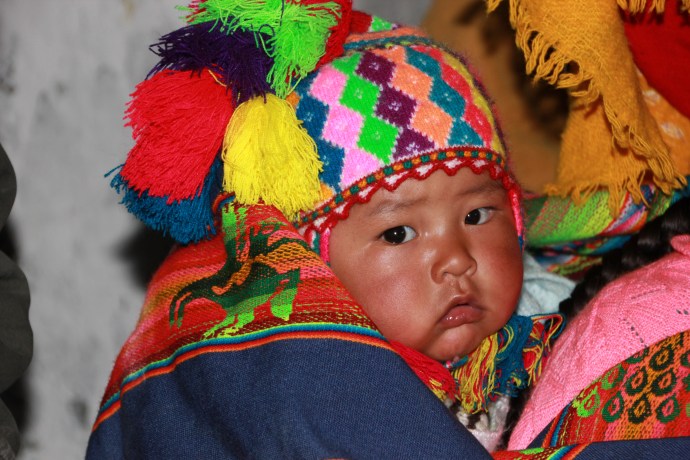
Although the country’s economy has improved dramatically over the past decade, the indigenous people in the Highlands (where Heifer does most of its work) are still overwhelmingly poor, ferociously independent, and definitely know how to rock a hat.  

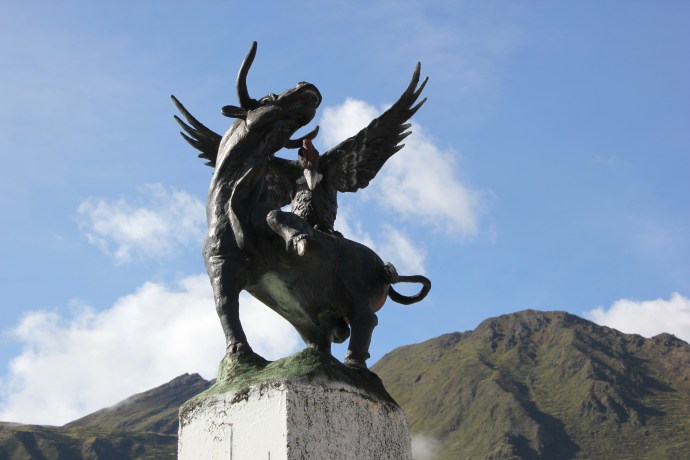
In the center of Marcopata, we saw a statue that pretty much captures the Highland spirit. The bull represents the Spaniards who colonized Peru. The condor tied to its back is the indigenous people, who claw and fight to be released from bondage – literally drawing blood.

These proud descendants of the Inca Empire are going to need every shred of that irrepressible spirit today to resist the triple threat of mining companies, urbanization, and climate change. Almost one-third of the country’s 30 million inhabitants now lives in Lima, yet you know it must kill something inside these proud people to leave their mountains and ancient traditions to descend to the arid pull of the city.

Heifer’s projects are mostly in the high central plateau, where it is developing programs that support the Highlanders’ traditional pursuits of raising alpaca and llama, growing potatoes, and making handicrafts – working with communities to make these pursuits economically viable, entrepreneurial, and sustainable.

Which means that more children can grow up with a future in the countryside they love, and preserve the land and traditions that are under siege. 

I can’t wait to share those stories… just as soon as I can breathe properly again. It’s gonna be epic!

Categories: Agriculture, Animals, Heifer International, Hunger, Peru, Photography, Poverty, Travel | Tags: , , , , , , , , , , , , , , | 20 Comments

Blog at WordPress.com.