 Here’s to America the Beautiful…
with a fireworks display of flowers…
from Edgartown, Martha’s Vineyard.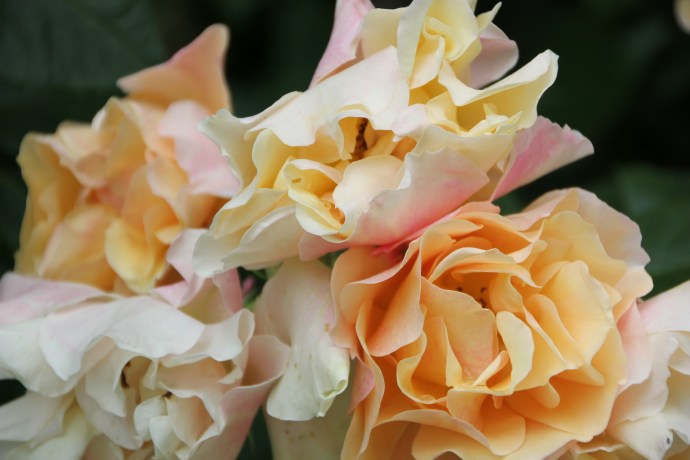
Three cheers for the Red, White & Blue!
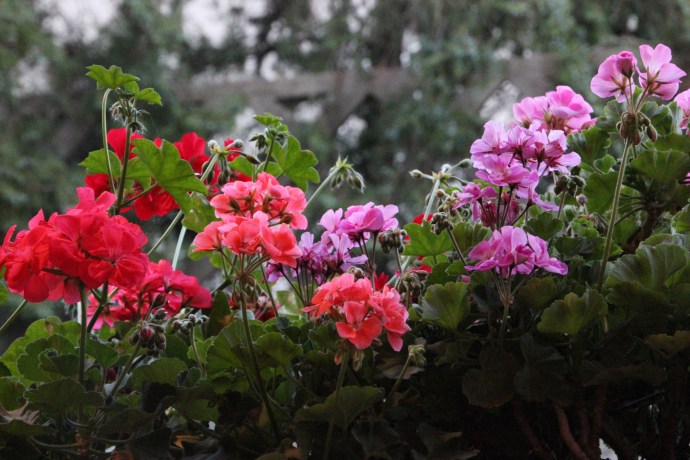


Happy 4th of July, folks!

Here’s to America the Beautiful…
with a fireworks display of flowers…
from Edgartown, Martha’s Vineyard.
Three cheers for the Red, White & Blue!
Happy 4th of July, folks!
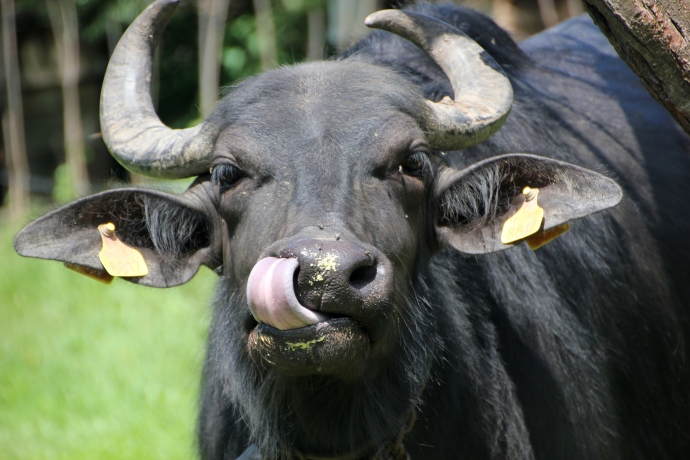
The original WB.
Water buffalo aren’t the only species struggling to make a comeback in the beautiful rolling hills of Aschileu, Transylvania. The 1,841 poor farmers who live in these five verdant villages and were shoved off their lands under Communist rule are also fighting to regain a foothold in the local economy. Now thanks to Heifer’s first water buffalo project in Romania, the two may well help each other over the hump.
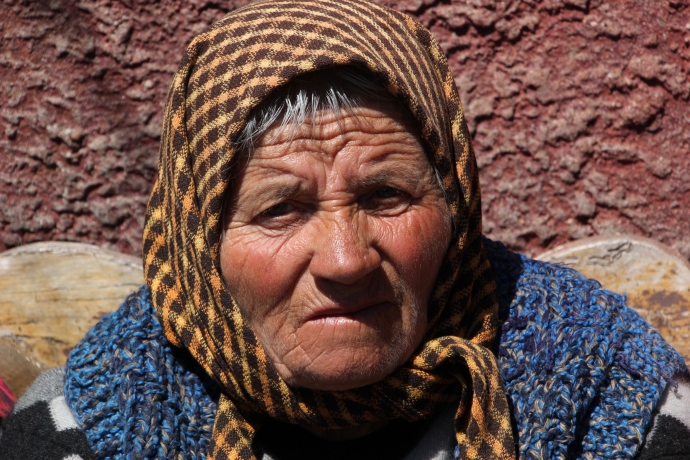
At 78, Anna remembers feeding the Germans, then the Russians, then the Communists, then losing her land and all her animals. But now she’s got a new water buffalo to call her own…
Water buffalo have been raised in this area since they were first introduced by the Turks during the Ottoman invasion in the 15th century. Called the “poor man’s cow,” a water buffalo thrives on even poor fodder, rarely gets sick, makes a terrific draft animal, and will produce 5-10 liters/day of very rich, healthy milk that can be made into delicious cheese, sour cream and yogurt. (And Romanians are nuts about dairy.)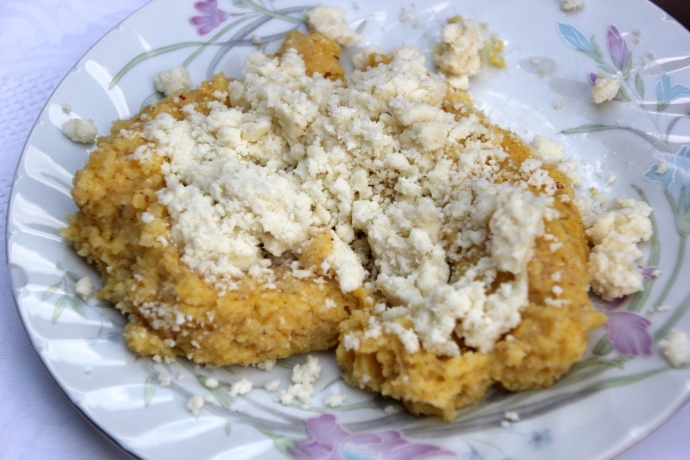
However, after the fall of Communism in 1989, farmers were encouraged to raise cows and the numbers of water buffalo dropped perilously by 80%, threatening the breed’s survival. To promote biodiversity, income generation and better nutrition; offer an alternative to strict EU standards that limit the sale of cow’s milk; and encourage peace & understanding between neighbors in the Hungarian Mera village and Romanian Aschileu village, Heifer started the Revitalization of Water Buffalo project last year, giving 36 water buffalo and trainings to needy Romanian families (who will Pass on the Gift to another 36 Hungarian families in Mera).

About half of Ion & Felicia’s children/grandchildren.
One of the first recipients of a water buffalo was Ion, Felicia and their nine children. Ion is one of 10 orphans whose mother died and were then abandoned by their father and left to raise each other in the village. Today, those 10 brothers are mostly illiterate and work as laboring farmers and shepherds, but each has managed to build a home, establish loving families, and amass a brood of livestock. Their self-sufficiency and dignity were palpable, despite how thin and wan Felicia looked ( and raising 9 children and 3 grandchildren, who wouldn’t be?)

Ion & Felicia
As we climbed into the hills in a horse-drawn cart to visit the goats, cows and water buffalo herds that Ion tends on communal pastures, the views became more and more stunning and I felt more and more like I was in some modern version of The Sound of Music. 
Lordana, Ion’s daughter, kept turning around to grin at me, her fingers tucked into her father’s thickly-tooled shepherd’s belt as we lurched across stream beds, and I kept thinking “What a hard life. What a beautiful life.”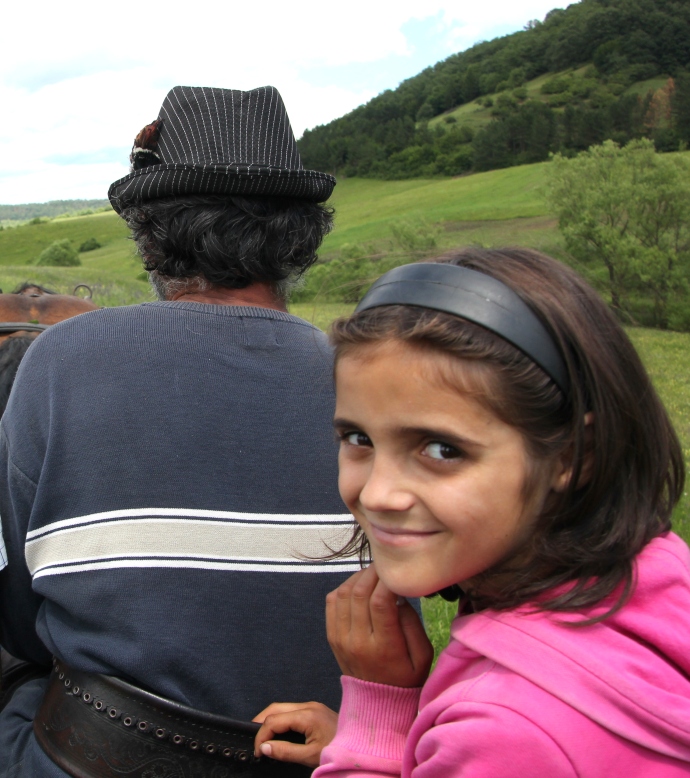
With village milk collection centers and cooling tanks in place, and an ever-increasing demand for high-butterfat, high-protein, low- cholesterol buffalo milk, hopefully life here will become a lot less hard and a lot more healthy.

The lovely Miss Lordana.
And the hills will be alive with the (very loud) sound of water buffalo… once more.
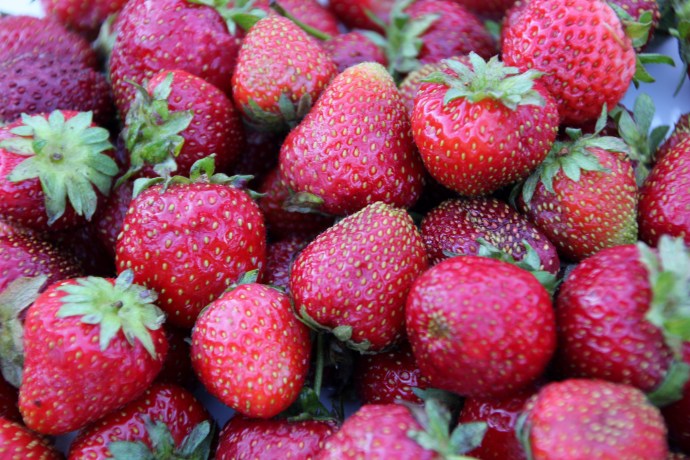 What didn’t I eat in Romania is more to the point.

Boletus mushrooms, fresh from the forest.
Romanians love nothing more than to feed you. And because they are really, truly hurt if you refuse to partake (and will serve you a robust helping anyhow)…
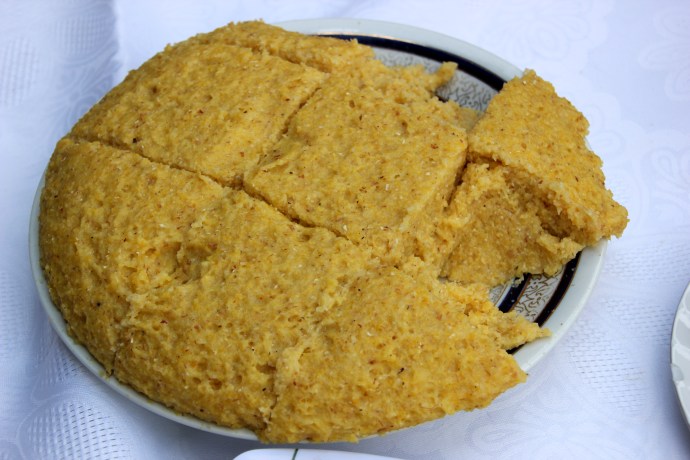
Homemade polenta… really low-cal!
I stepped up to the plate and ended up eating my weight in potatoes, sheep cheese, goat cheese, salt cheese…
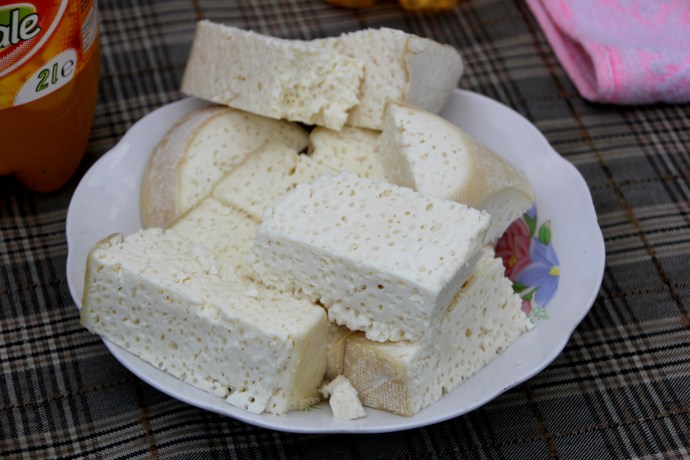
Sheep cheese — very salty & yummy!
onions, cucumbers… 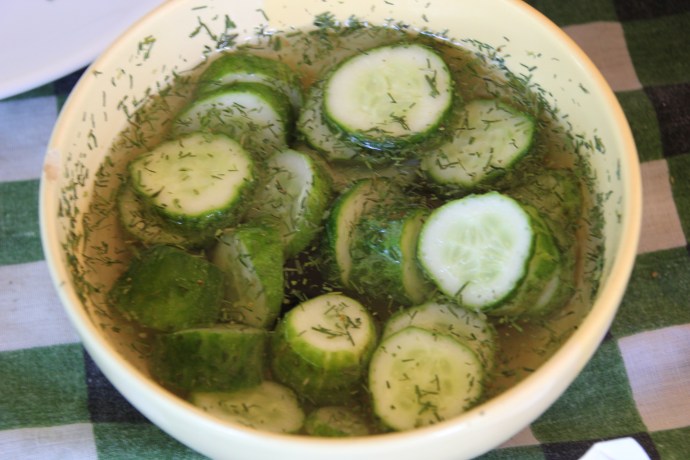
tomatoes, salad…

Greek(ish) salad, served at every meal.
bread, toast, bruschetta…
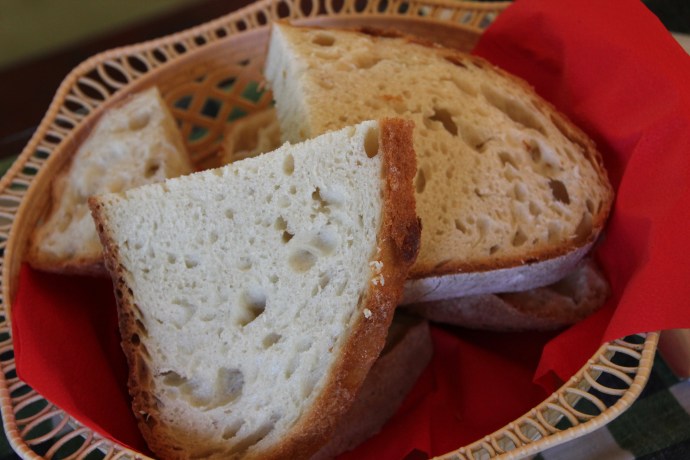
Almost every restaurant has homemade delicious bread.
…cake, dumplings, strudel…
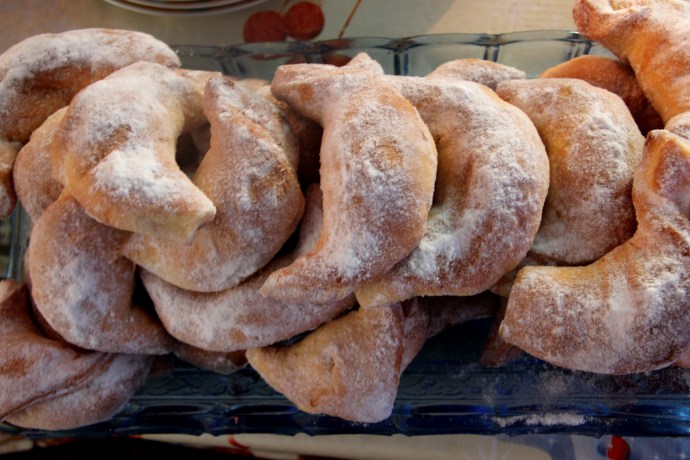
Chifle – a beautiful little walnut pastry I got to know well.
croissants, donuts…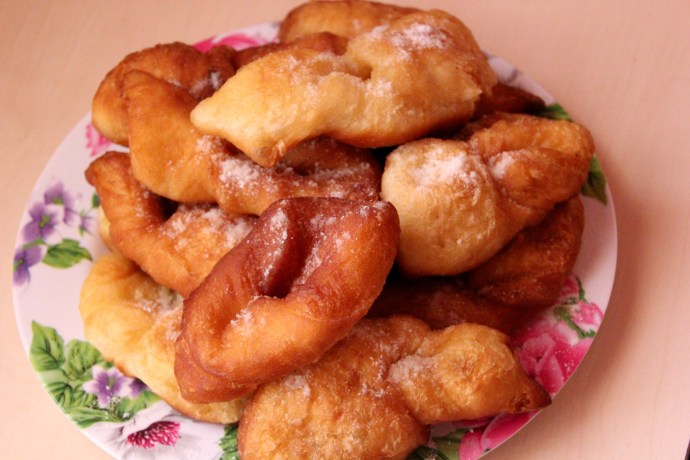
honey, more cheese, more potatoes, sour cherry jam…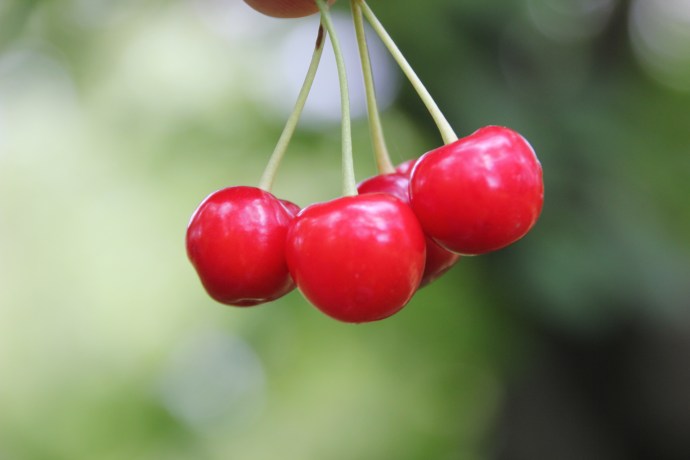 ..and lots of plum brandy in various strengths and portions.
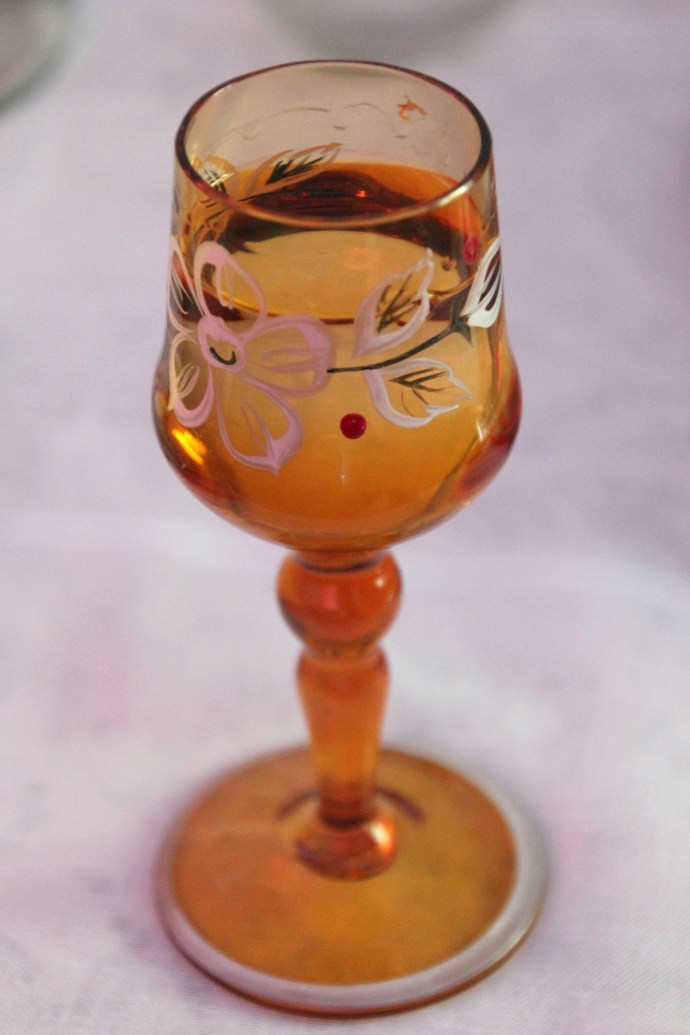
Weak or wake-up-the-dead strong, homemade plum brandy (Palinca) was ubiquitously delish!
Oink!

Sarmale (cabbage rolls) with pork…. (mine were with fresh mushrooms)
The only thing I didn’t eat much of was meat because I’m a pretend vegetarian…
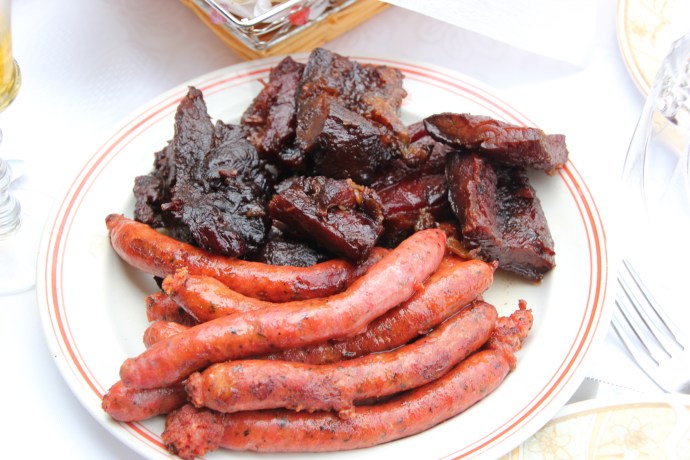
Beef (I think) and homemade sausages
..but that was kind of stupid because Romanian meat is exceptionally fresh and free-range as all get out.
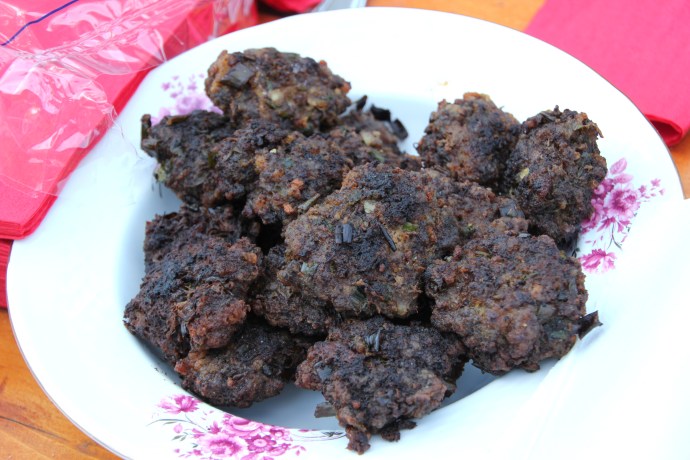
Cliftele (meat balls of beef, pork, onion, garlic and rice)
I’m also lactose intolerant (for real) so you would think that would have put a slight damper in my epic caloric intake.
Au contraire –the only thing that meant was no ice cream (to which Romanians are addicted) and no gigantic wollops (the dollop’s overweight cousin) of sour cream, to which Romanians are also exceptionally partial.

Somlói galuska – yes, it’s Hungarian but the Romanians love it anyhow.
With all this glorious food, you would think that Romanians would be huge but they’re not (although milk-fed babies in the rural villages were kind of scary large). The women have the classic Slavic beauty, the men do a lot of physical exercise, and the people love to be outside—walking, picnicking, farming, gardening, and strolling around village squares.
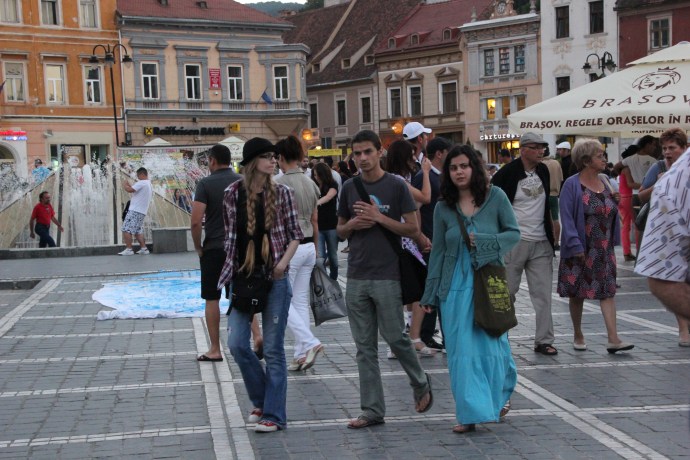
Weekend evening in beautiful Brasov square.
It was a delicious experience eating Romanian and being treated to mad generous hospitality in every household…
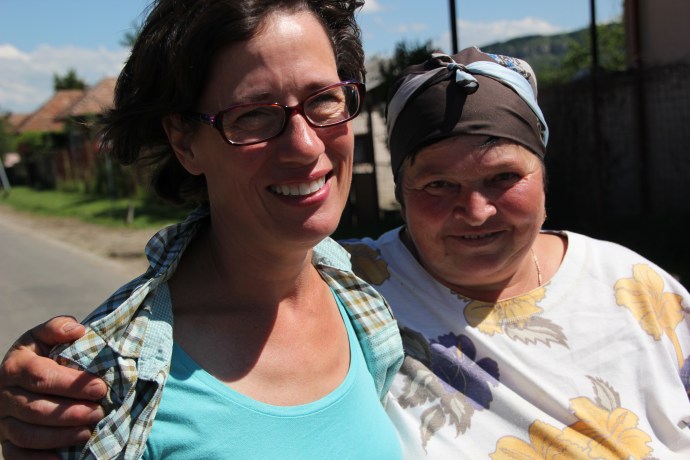
My pal and fellow traveler Laura Voisinet & Maria who made us a beautiful lunch in Aschileu.
(and the Ursus beer wasn’t too shabby, either!)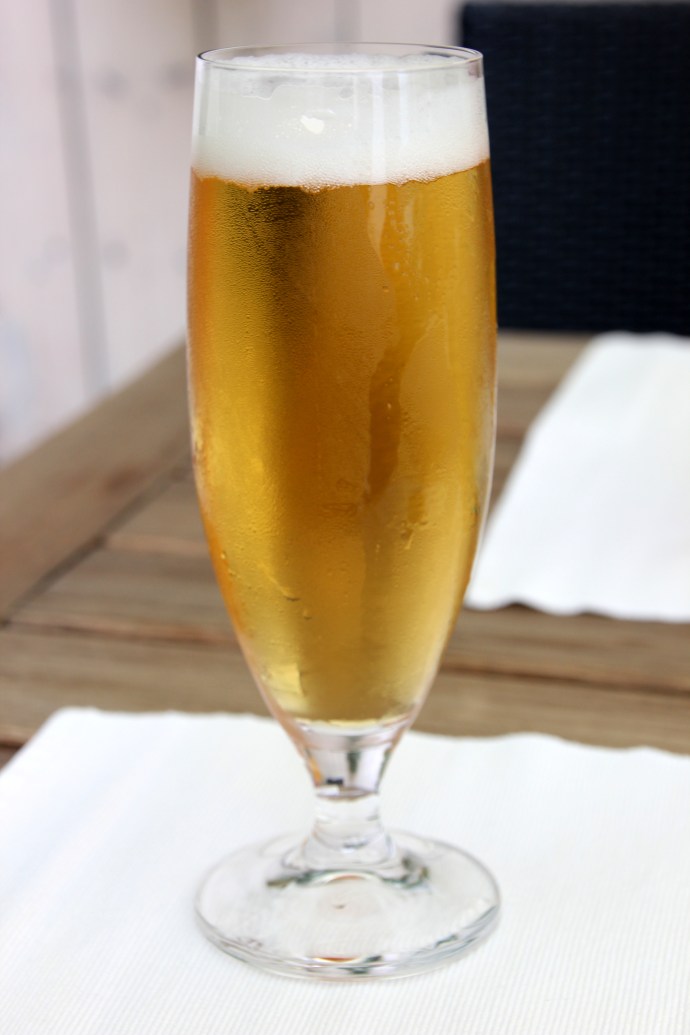
Noroc!! (And I am so hungry now, I can’t even tell you… this post should have come with a warning!)
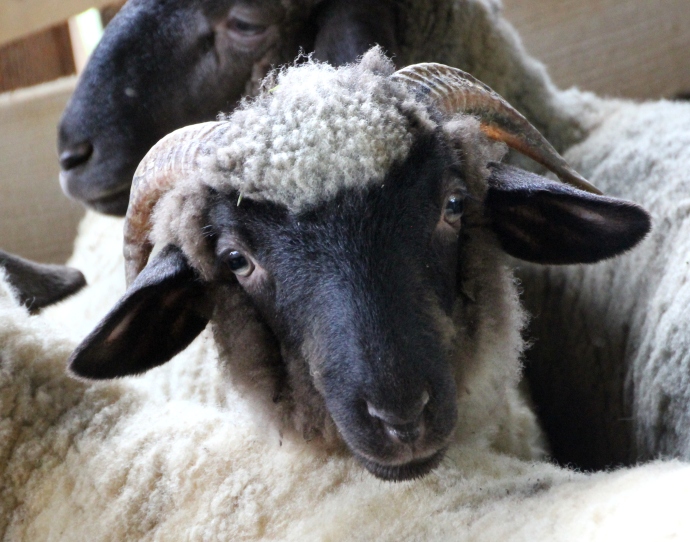 The day we went to see the sheepfolds of Lepsa, Romania was my favorite day ever (til tomorrow). The impossible-to-spell-or-pronounce region of Vrancioaia is located between the Black Sea and Transylvania, on the junction of two tectonic plates and is prone to earth-quakes, has salty soil from when it used to be under the ocean, and is retouched-calendar-photo perfect.

It’s not bread, it’s cottage cheese.
For centuries, this has been sheep-breeding & cheese-making country but with anemic production of the local sheep breed and new cheese standards imposed by the EU (Romania became a member in 2007 and had five years to get up to speed) that traditional way of life is fading fast. People can’t make a living on the farm, and young people are fleeing to Europe and the cities to find jobs.
So Heifer and the 2700-member Mountain Farmers Federation have joined forces to help these sheep-breeders transition to a free market economy. The plan is to revitalize the Red-face Tigaia breed with Black-face meat rams and fresh Red-faced ewes … and train farmers to meet new hygienic standards of cheese production.
It sounds good on paper, but you really don’t get it ‘til you see the sheepfold in action — and then it’s like something right out of Laura Ingalls Wilder’s books, complete with hay harvested with scythes and fashioned into fat haystacks that will last through the long, hard winter.
From April til October each year, Ion (John) and Dorica Cobzaru live up in the sheepfold with a few other shepherds and seven big dogs, taking care of their own sheep and 100 of their neighbors’ goats and sheep.  They rise at 4:30 am, milk the flock at 6 am, take the herd out to pasture and then make the sheep cheese (there is no electricity to refrigerate the milk so it has to be immediately boiled and made into cheese). The flock will produce 8 kilos of cheese each milking: (at noon and 8 pm), and in between there is hay to be harvested, sheep to be shorn, and animals to be herded and fed.
  During the night, the shepherds make big fires to keep away wolves, bears and wild boars, the seven dogs sleep around the perimeter of the herd, and John sleeps outside to keep guard against the wily wolves.
For their hours of labor, the shepherds will keep 3 kilos out of every 10 kilos of sheep cheese they make, and middlemen regularly come to the sheepfold on horseback to pick up the freshly made, immensely popular cheese to sell in the local markets.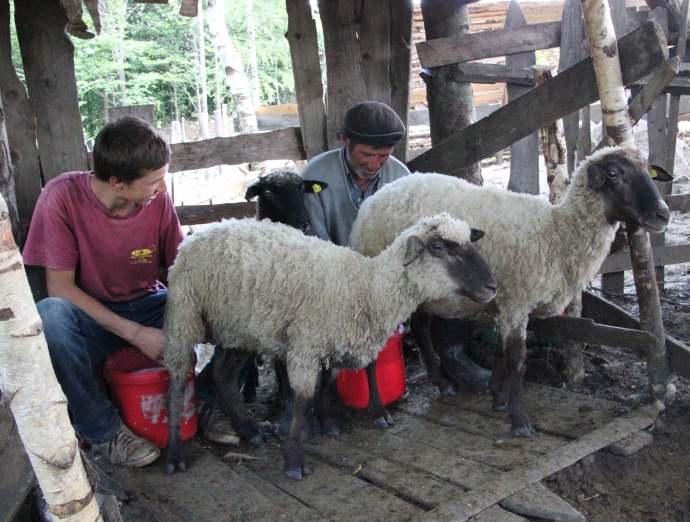

Chubby little lamb.
With Heifer’s gift of 10 new sheep and 1 new ram to each of 50 families in the valley (plus the support of the local veterinarian and town mayor), the project is producing bigger, fatter lambs that are far more profitable for the farmer. Ewes can get pregnant sometime before their second year and will have 2-3 babies a year for about 8 years. Male lambs are sold at 2-3 months and the fatter and sweeter they are (black-faced lambs are reputedly delicious), the more income they’ll bring to the farmer.
And with that income, the farmers can work together (never use the word “collectively” in post-communist Romania) to improve hygiene standards in making sheep cheese, establish better routes to market for wool, leather, milk and lamb, and make Lepsa a place where a farmer can make a living.
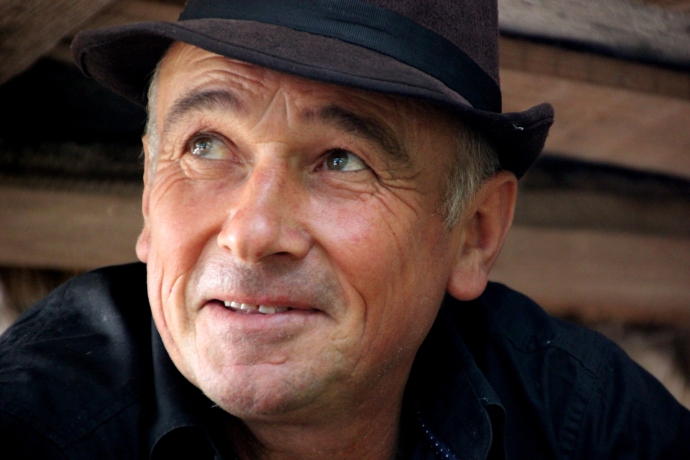
Like a leading man out of a Bernardo Bertolucci movie, John loves the rural life.
John went to Italy three times to work before he decided, “If I’m going to be poor, I might as well be poor in my own country.” His son Adrien, 21, just returned from picking strawberries in Italy and is happy to be back in the fold.

Adrien Cobzaru
With the new sheep from Heifer and a new sense of hope in the valley, maybe all the farmer boys of Lepsa can grow up to be prosperous in their own country.
 Rural Romania is so beautiful, it can be hard to see the poverty that is staring you right in the face. But make no mistake, it’s there in almost every village; in the orphanages that take in 80,000 to 100,000 abandoned and orphaned children every year; and in the deep lines etched in the faces of farmers who possess a few hectares of land, maybe one horse, a small house, and work like crazy through 5 months of summer to survive the 7 long months of Transylvanian winter, with virtually no way to get ahead or make an income.

Gheorghe Coldea, Rasca farmer.
So Heifer International, Rotary and Bóthar , a wonderful Irish charity working in Eastern Europe and Africa, decided that things would start to change for these Romanian farmers when cows fly… literally.

Now that’s what I call a jetway!
Following the success of their predecessor program, Farmers Feed the Children, Heifer & Bothar established Milk for Orphans and air-lifted into Romania 140 pregnant pure-bred Friesian cows (famous for producing copious amounts of milk and beef). These heifers were distributed to the poorest members of rural communities that lie in the hills around Transylvania’s capital of Cluj-Napoca last November and this May.

Right at home in Rasca.
These farmers will raise the heifers and pass on the first female offspring to another impoverished family. In addition to feeding their own families and having milk to sell for income, the farmers will also provide fresh 300 liters of fresh milk, yogurt, sour cream and cottage cheese to institutionalized orphans and disabled children, whose state food allowance is about $2.50 a day. Ultimately, the program will benefit more than 1,000 children every year.
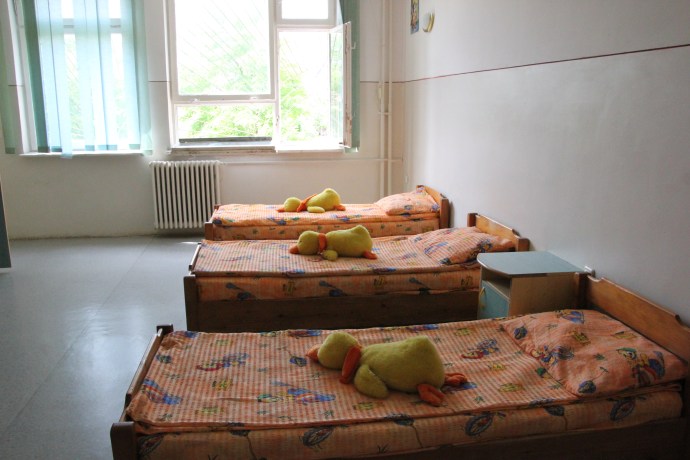
An orphanage for disabled children in Cluj.
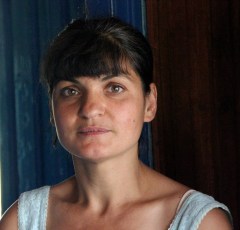
A rare picture of Gina indoors.
What a beautiful program to witness in action! In the village of Rasca, Gina Rosu (one of 14 children raised in abject poverty) had big plans for her mama heifer and baby calf, and was using the milk income (Friesian cows produce about 20 liters of milk a day, compared to local cows’ 10 liters) to buy piglets, build a new concrete pig sty, and establish other sources of income.
Gina and her husband are unemployed but very hard-working and totally focused on giving their two children a far better educational future than they had. (Though Gina has only an 8th grade education, she’s managed to teach herself English and Spanish.) And just like American parents, they are struggling with the teenage angst of their artistic daughter Anca, for whom they don’t have money to buy paints, and the high energy antics of son Johnny who’s a musician like his dad.
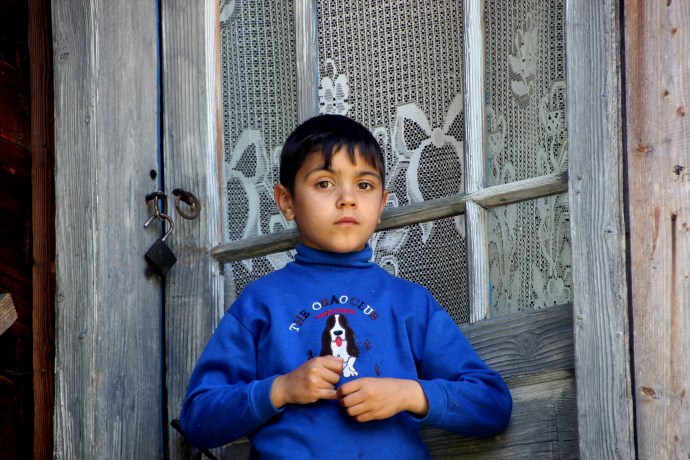
The real beneficiary of Gina’s heifer: young Johnny Rosu.
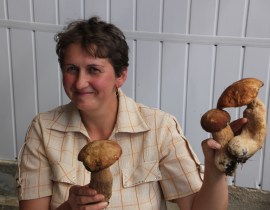
Angela and her amazing boletus mushrooms.
Angela is Rasca’s Milk for Orphans community leader and her house and barns are spotless; clearly, she has a gift with cows and her home is the milk collection center for the village. She also buys the boletus mushrooms and arnica that everyone hunts in the hills surrounding the village to sell in the Cluj market. With Olimpio, community leader and Heifer-trained animal health worker, Angela is the go-to person for help with any animal issues in the village. In fact, while we were visiting, Olimpio got five calls for artificial insemination. (Once a cow secretes the fluid that tells you she’s in the mood, you have 8-10 hours to get her the goods. Clearly, we were like Michael Bolton for the female cows of Rasca.)
 While clouds piled up in the Rasca sky, and Olimpio went to work making the way for more cute heifers, we went to visit the last family of 25-year old Lenuta and her husband Adrian. They were the poorest couple we saw in Rasca.

Lenuta has a severe hearing problem and all the money from last year’s hay crop had been spent getting her a proper hearing aid so she could hear the voices of her children Natalia and Darius.

Natalia, Lenuta’s mom and baby Darius.
The family lives in a one-room house on Lenuta’s father’s land, but luckily their Irish cow had given birth to a female calf (that would be passed on) and Darius was flourishing on all the fresh milk.

Natalia and the new baby heifer.
In the one tidy room the family lived in, Lenuta laid out a lovely, modest meal for us but I was ashamed to eat their precious food, despite being touched by their hospitality. Everywhere we went in Romania, we were lavished with food – which made me realize how important it was to ask the beneficiary farmers to help feed the orphans. Allowing a poor recipient to become a generous donor is a transformative act of dignity and a powerful demonstration of competence.
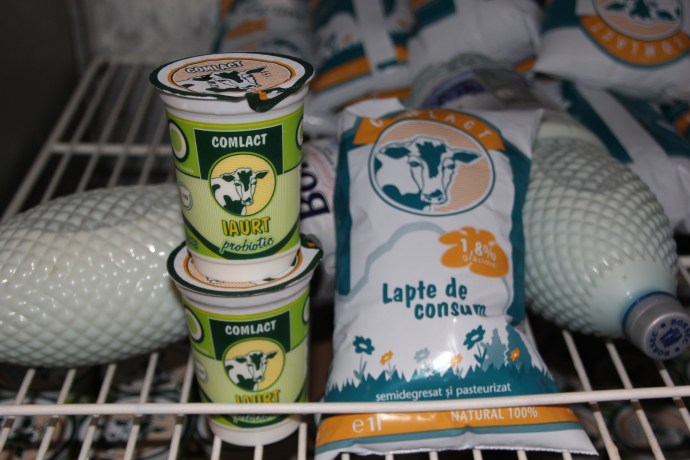
The refrigerator of the orphanage, packed with the bounty of Irish bovines and their farmer-owners.
And you can milk that for all its worth. 


 Heifer 12 x 12