Poverty

Hunger (No games.)

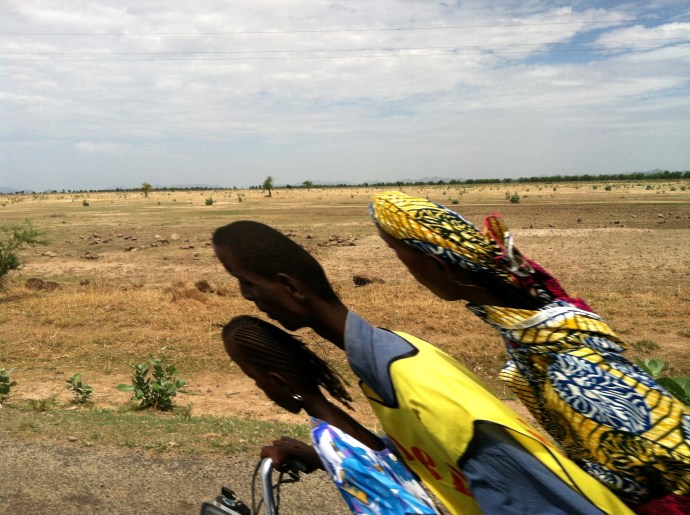
The first thing you notice when you travel from southern Cameroon to the Far North is that suddenly, everyone seems a little bit taller and a whole lot thinner. The people of the Far North remind me of the Masai – long, impossibly lean, and elegant beyond description, with cheekbones that could cut glass.

A dried-up riverbed on the edge of Maroua (at night it’s awash in soccer games).

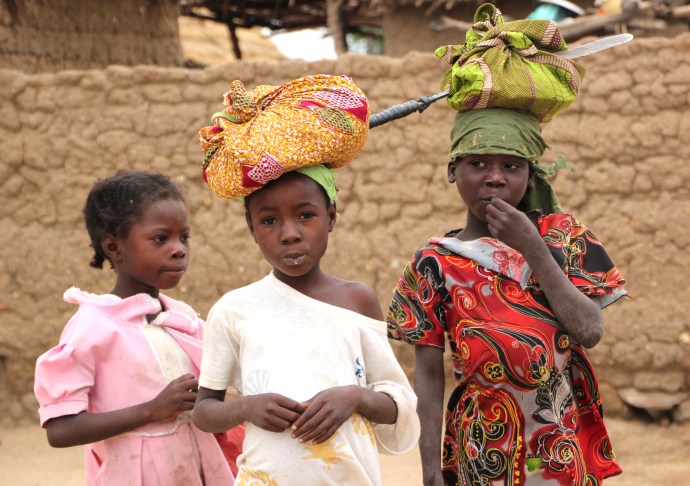
The second thing you notice is color – the total lack of it in this parched dun landscape aching for water at the end of the dry season, and the raucous surfeit of it in the robes, scarves and head coverings of the women. Even in the withering heat, they look amazing.

But the day I visited Mordok village outside Maroua, instead of blazing sun, we had cool, rainy weather. We were traveling with Heifer‘s aptly titled Animator, Robert Ndouwountang, a local organizer who speaks both French and the tribal language of Guiziga, and he is a force of nature all by himself. Robert has been responsible for training, implementing, overseeing and motivating Heifer’s project in Mordok since 2007, as part of Heifer‘s large umbrella  project that will benefit 1,270 farm families of 10,160 people here in Cameroon’s Far North.
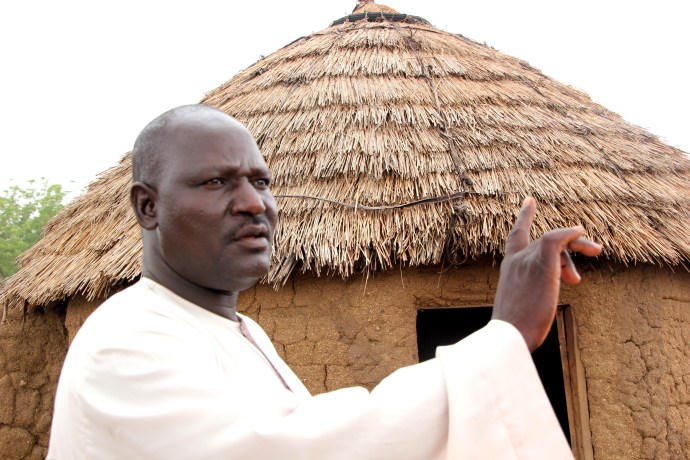
The Mordok group -actually 2 groups – is 100% women and the project’s goal is food security for the village. In this region with 38% malnutrition in children, and about 9 children per household (2-3 of them usually adopted from other families or relatives), that’s no small undertaking.
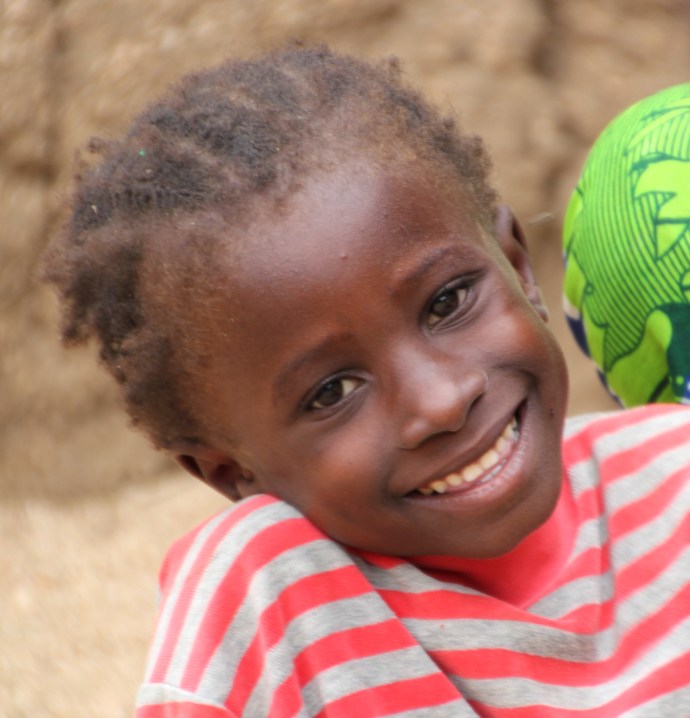
The reddish tint to this sweet girl’s hair is a sign of malnutrition. And she was tiny.

Yet with the gift of sheep and a few simple tools & trainings, life here has become markedly better.

Take the energy stove. Each woman built one using local clay in about 30 minutes (with the animator’s guidance), and now the firewood laboriously collected in the bush & hauled home lasts five days, instead of 1 ½.  To prove that to her daughter, one woman did a side-by-side test and found the energy stove used 70% less firewood and cooks faster. (Plus, the women can cook outside during the 9-month dry season, shielding the whole family from dangerous indoor smoke.)

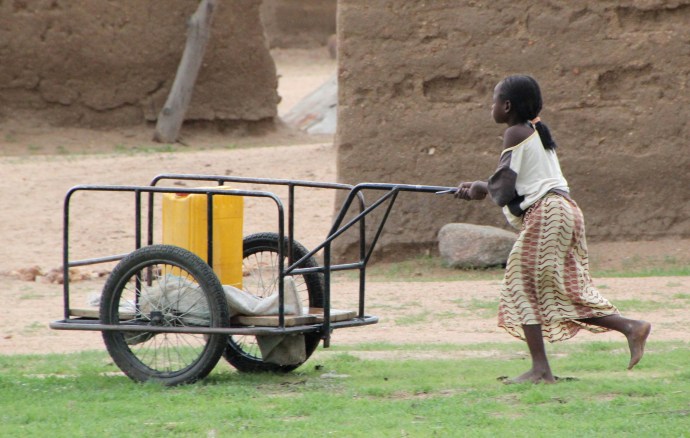
In the project, Mordok women were also given 18 handcarts, which makes carrying 20 liter bottles of water from the borehole a lot faster and easier (and gives girls time to go to school).
The sheep the women received from Heifer have not just added protein and income to families’ lives, their manure is collected to produce compost that has doubled the production of their fields. And by using retaining walls and terracing, as Robert has encouraged them to do, farmers are protecting the region’s soil from erosion and degradation and conserving precious water.

Women’s groups in several villages have even banded together to build water-tight storage facilities for their grains and onions, so they will last through the wet season, instead of counting on traditional handmade straw structures to keep out the rain and moisture. The impact of that improvement? An 80 kilo bag of onions that sells for 5000 francs ($10) at harvest time will bring in 120,000 ($240) at the end of the wet season. And these joint efforts are a direct result of the leadership and organizational trainings the women are putting into action.

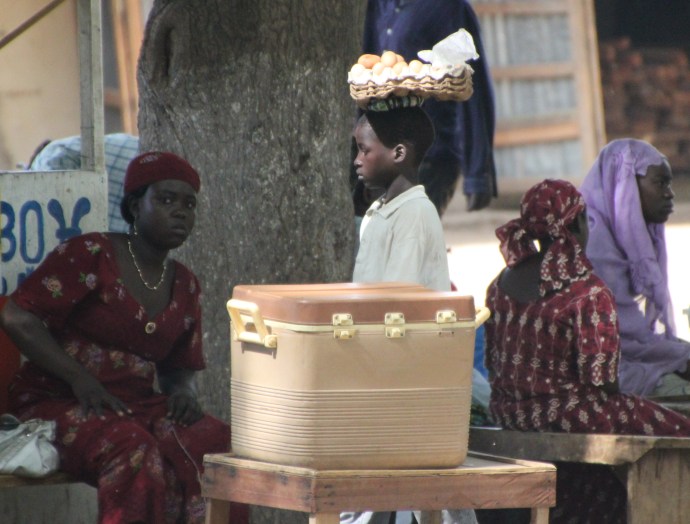
And yet, life is still very difficult here. The children are too skinny, and some of the women looked so fragile. When I asked what the family eats in a typical day, the women say they have pap, or bui, (cooked grains) for breakfast. For lunch, it’s sauce and cous-cous, the ubiquitous fu-fu of cassava, yams or plantains, boiled and pounded into dough. And more cous-cous and sauce for dinner. Once a month, the family will have meat. And once a week, fruit.

That’s not a lot to go on, or grow on.
Yet somehow the women’s group here, organized since 1998, has found a way to give to others — passing on the gift of knowledge and animals to another women’s group – and they are happy that the gender trainings have encouraged their husbands to help out more around the household (women do 90% of the farming and 70% of the livestock care).

Even Village Chief Ezekiel shares some of the farm & home work with his wife Sali Damdam.

I loved this village of Mordok and its beautiful people, and I can’t stop worrying about how they’re doing.

No mother should ever have to see her children go hungry.
Categories: Africa, Cameroon, Heifer International, Hunger, Photography, Poverty, Travel, Women | Tags: , , , , , , , , , , , , , , , , , , , | 26 Comments

Poverty, slimed.

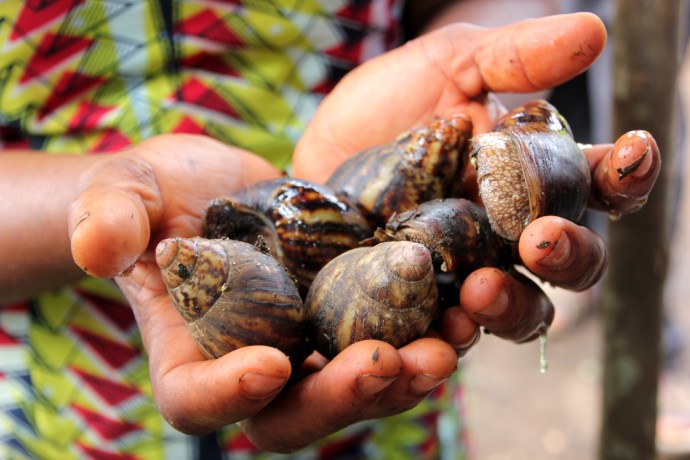
What could be a more perfect creation than a snail? Oh sure, they look kind of creepy, what with their long grasping tongues and rapacious need for water … and nobody would agree with that more than the Nkongsamba farmers in Groupe d’Initiative Commune (GIC) Placanamec, who started raising snails in this Heifer-sponsored project in 2010.

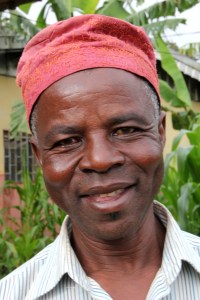
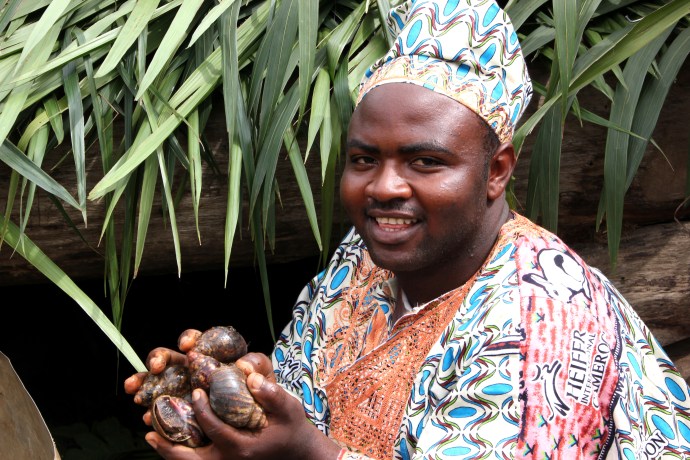
Daniel Nikanche, snail convert

“At first, we thought snails were from nasty, dark places in the forest and we didn’t want anything to do with them,” explained Daniel Nkanche, president of the GIC group. He’s right: snails live in the humid forests around Nkongsamba, Cameroon and are creatures of the night. In fact, they have been so voraciously hunted after dark, despite dangers of snake bites and violence, snails are endangered here in the wild.

But another group of farmers told the GIC Placanamec folks how rich the snails were in protein, minerals and iron; how good they were for children and for healing all kinds of maladies; and how delicious they tasted when cooked (escargot!). The group was also persuaded by the price snails fetch in the local market: $12 for a 15-liter bucket that would be snatched up immediately by eager buyers. So they applied to Heifer, whose staff was eager to protect the snails in the wild and foster an income-producing, nutrition-enhancing livestock program in this poor crossroads town where AIDS, prostitution and poverty has afflicted the population.

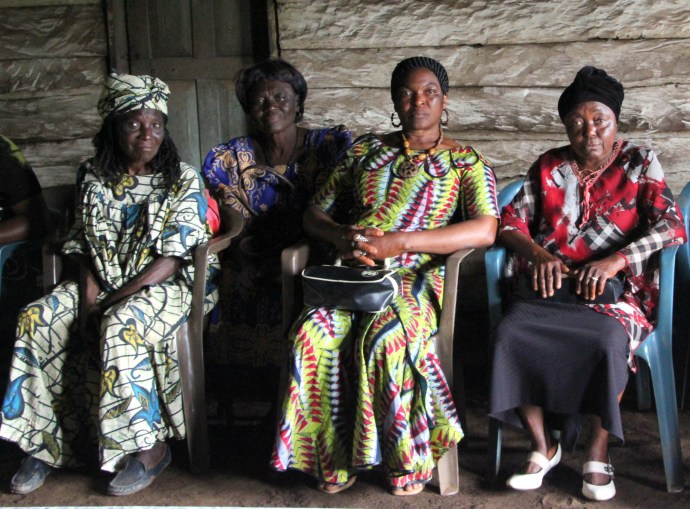
Slowly but surely, the Placanamec farmers (90% of them women) began to learn the intricacies of raising good snails.

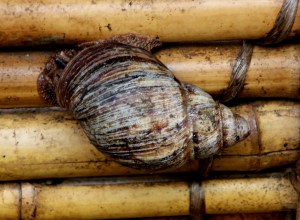
First, you need to build a bamboo and wood hutch with available materials — that takes a few hours. You need good clean soil; paw-paw and sweet potato leaves for the snails to eat; forage for them to burrow and lay their eggs in; fresh clean water morning and evening to give the snails energy and happiness; and some kind of barricade (like a water moat) to keep out predators like millipedes, mice, rats and red ants.

Adults, babies & eggs

Then you sit back and let them eat, drink and reproduce. Snails are hermaphrodites, meaning the sistas/brothas are doing it for themselves, laying 5-9 eggs at a time, beginning when they are about 4 months old. Most species of snails will generally lay about 32 eggs in their lifetime, and the babies dig their way out of their shells and begin to grow in a week, fattened on a diet of ripe bananas and leaves. The snails are generally eaten after they’ve finished laying their eggs, at about 6 months to a year, when they are 150 grams or more.

But that’s just the tip of the follicle. In addition to the delicious meat they eat roasted or parboiled, the GIC folks use every single part of the snail to profit the family. The shells are ground up and eaten for the calcium to alleviate aches and joint pains, or applied to wounds to heal them faster. The waste parts of the snails are dried, ground, and used to feed chickens. And the slime … well, it’s collected into a skin serum that the women swear makes skin look younger, fresher and wrinkle-free.

My Heifer Cameroon guides snorted that no Western woman would use this product and I had to laugh. “Honey, American women would drink the stuff if they thought their skin would look like Marie’s.”

Marie Ediang, champion snail raiser & skin serum wizard.

And truly, the women’s skin here looked amazing! But maybe it was just the increased nutrition and financial security the snails offer? The families are now eating about 300 snails a month, and with their snail sales, families are able to pay children’s school fees, repair a roof, afford a cell phone, or connect electricity so “my house shines in the night!” one woman claimed proudly.

As we drove away, the Heifer staff were enumerating some of the issues still facing this pilot snail project: there has been some stealing from the hutches, and farmers are not quite meeting high demand in the market. But all I could think was snails =better nutrition for the family (kids love them so much, they’ll sneak into the cages to help themselves) + increased income (especially for women) in a country where malnutrition hovers around 30% and women make less than $1/day.

And then there’s the age-defying slime.

Snails anyone?

Quite frankly, I was ready to dive into the nearest shell myself.

Categories: Africa, Animals, Cameroon, Heifer International, Hunger, Photography, Poverty, Travel | Tags: , , , , , , , , , , , | 28 Comments

Bienvenue Cameroon!

When I was heading off to Cameroon the most common question I was asked was: “Ummm, where is that?” Cleverly, I’d logged on to Wikipedia where I found this helpful diagram… so now you know!

Cameroon is not a place many people have been, but that doesn’t make it any less fascinating (and to my mind, more so). In fact, this country of 20 million people in a landmass the size of California is a kind of mini-Africa, with every climate represented within its borders: coast, desert, mountains, rainforest and savanna– as well as pretty much all the problems and challenges that beset the continent (and that we Westerners had a big hand in creating).

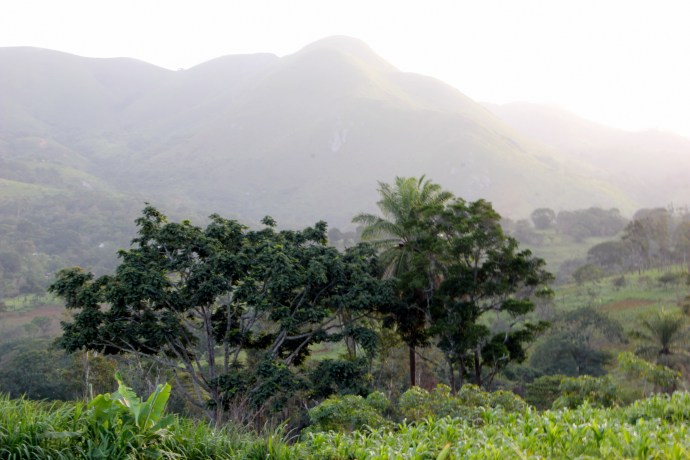
The extremely dry, extremely beautiful Nord.

In the Far North (or “L’extreme Nord” as the French poetically put it) the land is in the Sahel, the 100- to 600-mile wide swath that stretches across Africa and lies between the Sahara to the north, and the savanna grasslands to the south. This is the poorest part of Cameroon, the least educated, the hottest, the driest and oddly, the most populous, with a population that’s exploded 37% in the last 12 years.

In the south, the land is wet, fertile, and home to equatorial rainforests, rich plantations of timber, bananas, cocoa and rubber, coastal ports, and Cameroon’s biggest trade center in Douala and the capital city of Yaounde. Though the South is primarily Christian and the North has many Muslims, there is religious harmony in Cameroon and a long (though repressive and corrupt) history of political stability since Cameroon gained independence, after 45 years of colonialism, from France and Britain in 1961 – a year I actually remember.

It’s a young country, and although the poverty index is heart-breakingly high (the average income is $538/year – but only $220 in the Far North), the people are filled with energy and purpose. At 6 a.m., the streets are packed with folks of all ages going to work and school, and the place is jumping – no matter where you are.

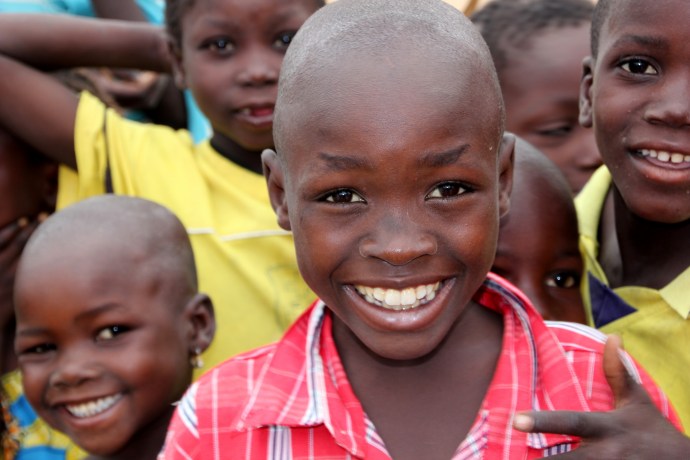
And naturally, the people of Cameroon are gorgeous.

I wasn’t expecting to love Cameroon – or to get to see so much of it, but luckily we missed our plane the first day (totally not my fault), and so I ended up seeing far more of the country than was originally planned. I found myself mesmerized by both the lush South and the sere Far North, grieved by the wretched poverty I witnessed, and captivated by some of the strangest Heifer livestock projects I’ve ever seen.

It was a beautiful, wild ride – can’t wait to take you there!  

Oh … and I’m a little bit tired of doing all the work on this blog (tee hee!) so here’s my latest offer: You write me one question that you really want answered about Cameroon (or about my biggest travel challenge, or my shoe size, or my worst hotel experience) and I’ll do a whole Readers’ Twenty Questions post with all my responses. Game on!

Categories: Africa, Cameroon, Heifer International, Hunger, Photography, Poverty, Travel | Tags: , , , , , , , , , , | 48 Comments

A new Namaste.

In my farewell post for Nepal, I thought I’d bow to the adage that actions speak louder than words. And the most common action in Nepal is the lovely Namaste (described in a whole bunch of words below).

When I was visiting the amazing women in Lamatol Village, Chitwan, President Nani Maiya Lama of the Self Help Women’s Group & Cooperative cut to the heart of the matter by describing what the Heifer trainings and animals had done for her.

“I used to be so shy and afraid to talk, I couldn’t even look at someone when I’d Namaste,” Nani said.

“But now that I can read a book, sign my name and earn my own income, I’ve got a new Namaste.”

For all the beautiful women (and men) of Nepal, here’s one final Namaste.

Categories: Animals, Heifer International, Hunger, Nepal, Photography, Poverty, Travel, Women | Tags: , , , , , | 11 Comments

She works hard for the money-less*

Goma Bhattarai is my kind of hero.

In 1991, she and a few other poor women in the small village of Gitanagar in Chitwan District, Nepal decided they wanted to start a women’s economic group, like men were forming. In those days, women couldn’t step outside their homes alone or talk to any man but their husband, they owned no property, and they were utterly dependent on their husbands for money – even to buy the tika red dye they wear on their foreheads.

When the women timidly approached the Ministry of Agriculture in the village to ask for a loan, they were told they had no assets and should come back with their husbands. Instead of that rejection crushing them, as Goma says, “It only fueled our determination.” Despite opposition from their husbands, 15 women joined together in secret meetings, each saving 25 rupees a month (that’s 30 cents). From that fund, every two months, they would buy 2 goats for a member, then start saving all over again.

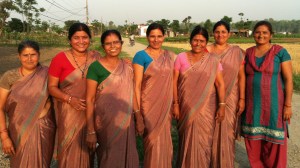
Goma’s liberation army…

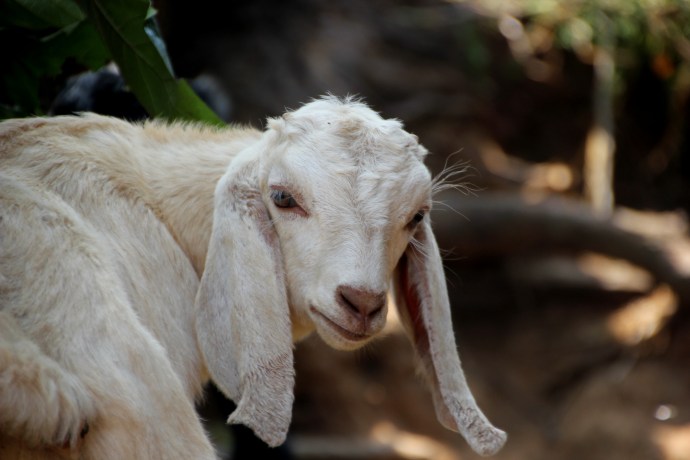
Give a girl a goat & she’ll thrive.

Goats were something the women knew how to raise, and it was acceptable women’s work in the village. Girls at marriage often bring livestock with them when they move to their husband’s house, and those are considered their possession (often their only possession). But saving up for two goats in two months was taking too long…

After a year, the women went to the District Livestock Office to try to register their group and met officer Mahendra Lohani – who happened to be in talks with Heifer to start programs in Nepal. After hearing the women talk about their struggle, their experiences and what they wanted to accomplish, Mahendra convinced Heifer to back the women, and in 1993 the Baruwa Goat Raising Project became Heifer’s first project in Nepal (and Mahendra quit his job and went to work for Heifer, where he’s now Vice President of Asia & South Pacific).

The women received 25 goats, and their visible success in raising and breeding the goats quickly convinced other village women to jump on board (and convinced most husbands that women earning an income was a good thing).  Soon 23 groups of women had formed, and in 5 years, 5 generations of goats from the original Heifer gift were passed on to families in need – but that wasn’t enough progress for Goma and her crew. It was taking too long for every women’s group to get goats; they wanted faster change.

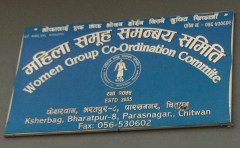
In 1997 the women decided to form an NGO that could ramp up the pace of things. The Women’s Group Coordination Committee was born and in 14 years they’ve managed 13 projects for Heifer, formed 275 women’s groups, helped 7,622 families rise out of poverty, and started a 373-member women’s cooperative.

Goma & Saraswoti Mishra, president of WGCC

But here’s where it gets really interesting. Last year, WGCC had a conversation with Pierre Ferrari, the new CEO of Heifer saying, “Things are going too slow. We need faster change.” (Are you noticing a pattern here?)

The indefatigable WGCC Team

So now they’re working with the government, Heifer and other co-ops on an $18 million initiative to develop a value chain that will supply 30% of the 500,000 goats that Kathmandu consumes every year (now mostly imported from India) with cleaner, healthier, Nepalese-raised goats that will profit Nepalese rural families and enable them to feed their country. Genius!!

As a person who’s never stayed at the same task for long, I’m in awe of the steadfast 21-year commitment and creativity that Goma and her compatriots have shown, fighting an endless battle to liberate Nepalese women from poverty and helplessness.

Who they’re fighting for…

“Tolerance and patience are the key to achieving anything,” Goma says cheerfully – meaning I’m in deep, deep trouble. “We face the same resistance in every village, but we are pioneers. Women look at us and know we’ve been exactly  where they are and changed… and they can, too.”

Sisterhood is powerful.


* With love & R-E-S-P-E-C-T for Donna Summer, Eternal Queen of Disco.

Categories: Animals, Heifer International, Nepal, Photography, Poverty, Travel, Women | Tags: , , , , , , , , , , , , | 21 Comments

Blog at WordPress.com.