Agriculture

Goat-ed into greatness.

 My first visit to a Heifer Nepal project took me way up into the hills surrounding Kathmandu – where immediately the air got sweeter and the views became more and more spectacular, with the Himalayas shimmering like a mirage in the distance.

My Heifer guide, the lovely Puja, told me that when Tibet invaded Nepal, the cavalry stayed on the hilltops as lookouts and they eventually settled there, which helps explains the Tibetan look of the Tamang people here (and my immediate attraction).
Our destination was Ramkot Village where a Heifer project had been started in 2008 through a local partner group: Women’s Feeling Unity Forum, with the adorable acronym WFUF. In Nepal, Heifer always partners with a local NGO (non-government organization) that has organized the community through a Women’s Self Help Group, proven the participants are committed and motivated, and then applied to Heifer for animals and training. Once approved, WFUF’s staff was trained and paid by Heifer to be the hands-on managers of the project in Ramkot and three other villages — and their hard work with Heifer has paid off. Even though this Ramkot Heifer project is complete (projects are active for 3 years, then go into a reporting stage for another 2), the group continues on, thanks to the efforts of some very compelling women.

Vice President Tirtha Tamang (everyone’s last name is his or her caste group) is 38, married to a farmer, with 2 sons and 1 daughter. Like two-thirds of women in Nepal, Tirtha is illiterate – but in the Heifer program, she learned to read slowly, write her name, and do basic arithmetic. From the original Heifer gift of 2 does, Tirtha has raised, bred, fed and sold dozens of goats to pay for her children’s education; now two are in college and one is entering high school.

Think of that! Instead of passing along illiteracy, she has totally rewritten the future for her children, turning goats into college degrees. And that’s not half of what Heifer has helped this community accomplish for itself!

Madame President Mithu Tamang

Under the leadership of President Mithu Tamang, Ramkot women started a group savings account in 2008 (each member contributing 100 rupees – about $1.20/month), enabling the members to borrow money for seeds, medicine, school fees, or family emergencies–like food– at minimal interest. When you’re living on $2/day income, easy access to money means a lot… and the repayment rate is 100%. The women have built a new, cement community center to host their meetings and other village events, as well as two beautiful new bamboo greenhouses for starting seeds. In fact, with the manure from their animals and Heifer trainings in raising organic produce, the women grow enough vegetables to feed their families and sell in the market. It’s a 3-hour walk to the market (each way) and they carry their produce on their backs, leaving at 2 a.m. twice a week during harvest months — but on a good day they can make 500 rupees ($7) in sales.

Tirtha & Mithu with the women’s group water harvesting cistern, new greenhouses below, and hills of pumpkins.

OR… if they sell a young male goat about 4 months old, the women can earn 12-15,000 rupees (over $100). A female goat can start having babies at 6 months, have 3 kids every pregnancy, and up to 2 pregnancies a year.
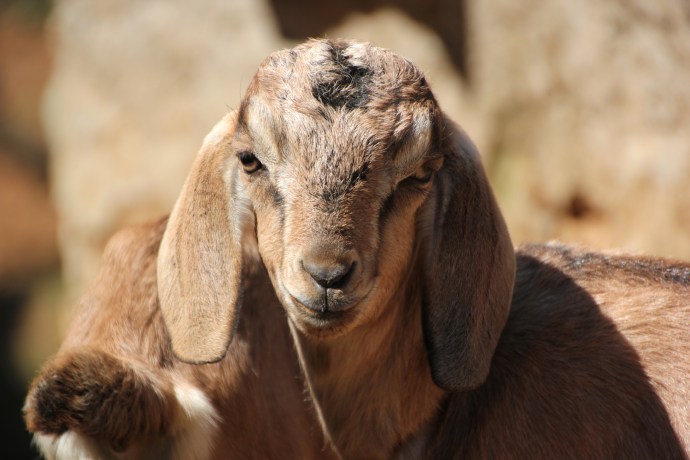
So –don’t you love Heifer math that adds up the multiplying effect of the single gift of a goat?? (And of course, all the women have passed on the gift of offspring and trainings to other village families in need.)

Heifer has been working in Nepal with women’s groups since 1993, and in less than 20 years has helped more than 60,000 families like those in Ramkot with the gift of livestock and training. That’s a great story. But as we were bouncing back down the road to Kathmandu, Puja started telling me about how Nepalese women’s groups are joining forces, forming larger cooperatives and instituting change on a whole new scale – like the $60,000 water project all the villages around Ramkot are working to build, that will allow them to double their production.

Why Women’s Self Help Groups (and co-ops) are a great idea.

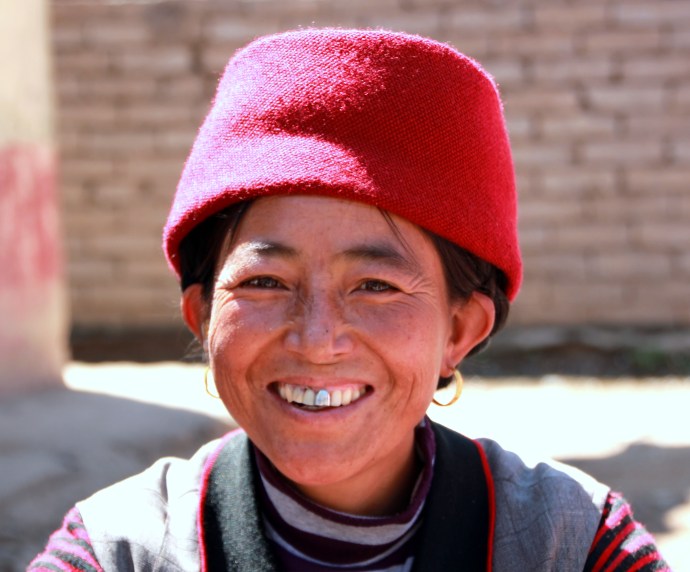
That concept (and the beautiful smiles of the Tamang people) took my breath away. More on co-ops tomorrow!

Never underestimate the power of a Nepalese woman!

Categories: Agriculture, Animals, Heifer International, Nepal, Photography, Travel, Women | Tags: , , , , , , , , , | 22 Comments

Farewell, my lovely …

The new breed … smarter, better, prettier!

My last two days in China were spent visiting Heifer International projects in Jingu and Fuxing Village … towns that were hit hard by the disastrous 7.8 earthquake that tore a path of destruction 500 kilometers through the heart of Sichuan province on May 12, 2008. These rural communities raised livestock and fruit, but inside the collapsing barns and houses most of the livestock were killed – along with 68,000 people.

The rebuilding of the Earthquake- Affected area by the Chinese government has been intense, but the Lizhou Poverty Alleviation Bureau chose to work with Heifer for livestock replacement because of its reputation for long-term results. (Or as the Heifer China staff humbly told me, “Our strict standards, high expectations of our farmers, and precise reporting of results make us challenging to work with. But I think we got chosen because we have a reputation for changing people, communities, and the government entities we work with for good.”)

Yang Shengxue, a master breeder & his wife Wuchang Lian in their newly renovated pig barn in Jingu.

The project started in March 2010  in the two villages (and six neighboring communities) with the establishment of 26 Self Help Groups consisting of about 20 families each. They met weekly to begin trainings in animal husbandry; breeding; group savings; animal barn improvement; Heifer concepts like the 12 Cornerstones in cooperation, sharing and gender equality; and value chain marketing.

Only then—after six months’ work – did the 505 families in Lizhou receive their animals. Some chose chickens, some pigs – depending on the land they had to raise crops and the labor required. But by the end of 2011, those original 505 families had recruited 505 more families to form new SHGs, passed on their trainings, and are getting ready to pass on the gift of animals in June of this year.

A captivating local pig!

And what a gift!! The pigs, in particular, are beauties.

The new breed of sows provided by Heifer are more shapely than the local stock (these are the words of the villagers, but I’m not taking sides as I kind of got attached to the local babe on your left), they grow heavier faster with more meat and less fat, and when they do reproduce, the sows have 13-16 babies in a litter. Unfortunately, there have been some fertility issues with the new breed and Heifer vet techs are working to encourage the farmers to feed the sows carefully with only raw food, give vaccinations, and keep their barns clean and hygienic to promote pregnancy.

Oh, Mama!

One of the indomitable ladies of Fuxing.

In Fuxing I met with the only all-women’s Self Help Group, as most of the men have left to work in the city, their teenagers are away at boarding school, and the women have been left behind to farm and raise animals.

Organic forage is best.

Communally, the women can support one another, meeting once a week to share their stories, discuss animal problems (for instance, when a pig develops a weak hind leg, you don’t just wait for it to die, you treat it with meds and stop feeding it so much protein and no cooked food…good to know!!). The women also work together to maintain the new road into town, clean the village, and build reservoirs to harvest water to get them through the 2-month drought period when they used to have to carry water up to the fields in buckets.

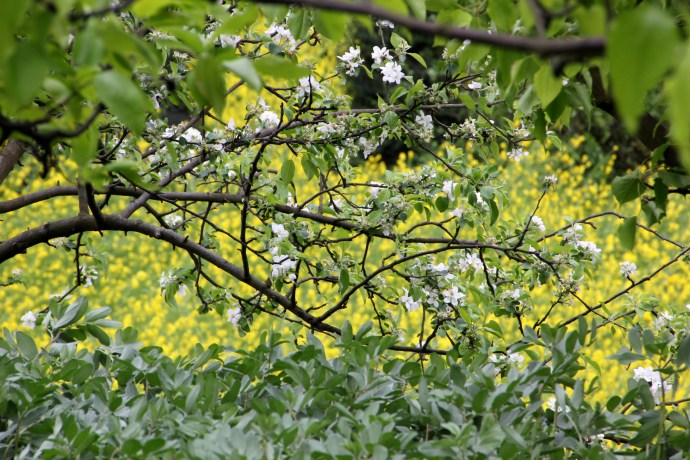
The villages are beautiful – blanketed with yellow fields of rapeseed (for oil), orchards, and neat fields, but the women have despaired of their children moving back here. “Emotionally we want them to come back, but financially, we know they can’t survive here. Our children can’t get used to the hard farm work we do or handle the risk of a failed crop or lost animals.”

“They’ll have an easier, better life in the city,” another mother says.

… I’ll be waiting …

I ask the mothers if they want to move to the city and they laugh and say in unison, “Never. It’s hard here but we can’t get used to the air and the noise in the city. Maybe things will get better someday and our children will come back to the farm.”

I’ll leave you with this haunting song from the women of Fuxing (sorry it’s dark but we were inside by a fire)!

Next stop… Nepal!!

Categories: Agriculture, Animals, China, Farming, Heifer International, Photography, Travel, Women | Tags: , , , , , , , , , , , | 10 Comments

A beautiful life.

The first thing you notice about Waqi Wunin is how deeply alive she is– with sparkling eyes, a melting smile and a big personality housed in a pixie frame. Which is ironic considering the fact that every day, Waqi confronts her own death.

Waqi has AIDS; she got it from her drug-addicted husband who died in 2010, leaving her a widow with three small children, now 10, 8 and 6.

The good news is that Heifer International started a pig project in Zhaojue County, China in 2006 –and in 2009, Waqi was selected as a Passing on the Gift recipient of two piglets and a sow.

Despite the fact that she was then very ill (with fevers that gravely damaged her hearing), Waqi never missed a single training from Heifer staff and project managers. She learned to build a concrete sty for her pigs, and religiously adopted the habit of cleaning it three times a day to keep it hygienic and insect-free. She learned how to inject her pigs with vaccines and give them medicine so they could survive debilitating diarrhea and minor infections. She learned to raise nutritious forage crops in the fields behind her house and feed her pigs organically. And she learned to keep meticulous breeding records to improve the genetics of her stock.

As a result of her hard work, Waqi is now breeding the most healthy, clean, fertile, and laid-back pigs I’ve ever seen.

And it’s not just my opinion; the whole village of Puti knows that Waqi has the best piglets around. In 2011, she sold 140 piglets for 12,000 yuan ($2,000), plus earned another 4,000 yuan from an abundant rice crop fertilized by her pigs’ manure. All this from an original 2 piglets and a sow from Heifer – a gift that she passed on to a new needy family last year, along with all the teachings and trainings in how to raise good pigs that she generously shares with any neighbors who want to learn.

Waqi is a leader in Puti Village, the Zhaojue government official associated with Heifer’s project told me in admiring wonder. Teaching by the power of her own example, she’s paid off her husband’s debts, sent her children to school, loaned money to others in need, and even though she needs IV treatments three times a week and has to take handfuls of government-supplied medicines daily to stay healthy, she never stops working.  

Looking around her spotless, cheerful household with all its responsibilities of animals, farming and beautiful young children, I know it’s an overwhelming burden for one small healthy woman to manage. When I asked her where she gets the will and energy to prevail–and to give to others — for the first time her smile disappeared and the grief running just below the surface of her life crumpled her face in tears.

“Sometimes it’s hard for me to get up in the morning, but thinking of my children forces me to get up and do the work,” she says when she composes herself again and breaks out the twinkling smile each one of her children has inherited. “It’s for my children that I want to go on.”

Waqi’s adorable oldest daughter.

This Mother’s Day you can share the love that Heifer is letting loose in the world by clicking here. ( I know it’s what I’m asking for.)

Categories: Agriculture, Animals, China, Photography, Travel, Women | Tags: , , , , , , , | 28 Comments

I’ve got friends in high places.

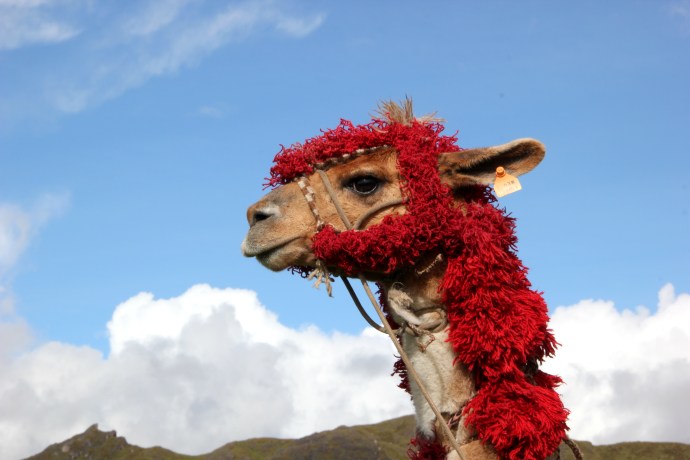
Up until now, I’ve spent a lot of time swooning over the alpaca, while paying precious little attention to its camelid cousin, the llama. So in my last blog about Peru (boo hoo!) I’m aiming to rectify the matter.

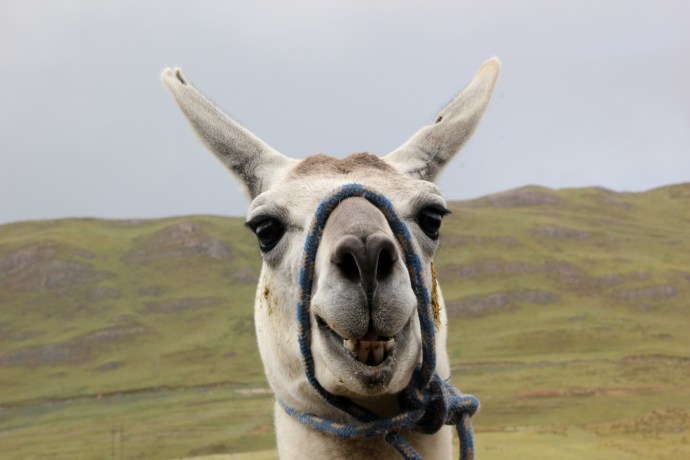
The llama doesn’t get much respect in many places in Peru– it’s the shaggy, blue-collar cousin of everybody’s favorite cuddle-bug, the alpaca, and the irresistible, Audrey Hepburn-channeling vicuna.

How can you compete with the ever-elegant vicuna?

But in reality, the llama is a working class hero – capable of carrying 35 kilograms of potatoes on its back, trudging long distances without breaking a sweat or requiring too much water, reproducing without drama, and providing tons of meat when it’s required to make the ultimate sacrifice.

To see the best llamas the world has to offer, we traveled to one of the worst cities I’ve ever seen: Pasco, Peru. Heifer’s charismatic country director, Alfredo Garcia, insisted I go to Cerro de Pasco (at 14,200 feet, one of the highest cities in the world) because he wanted me to see firsthand the destruction that mining has wrought …and boy, did I. The irony is that the countryside around Pasco is staggeringly beautiful, reminding me of nothing so much as Paradise Valley, Montana. 

Glorious Iscaycocha, which is Quechua for “land of two lakes.”

Yet when you enter Pasco City, you understand the meaning of “Something evil this way comes.” The mine isn’t near the city, it has consumed the heart of the city in a huge, gaping hole oozing rusty rainbows of effluents pooling into foul, oil-slicked ponds, billows of suspicious fumes, and enormous, variegated hills of toxic mine tailings. It’s a monstrous cavity in the maw of the drab, gray, cold city.

Cerro is the mining company plumbing for riches here in copper, zinc, gold and silver, and it employs most of Pasco City’s residents. It’s hard to imagine anyone choosing to live here or, god forbid, raise children in this toxic waste dump, but my Heifer translator Rosaluz Salazar assured me that having a job in the mines is a coveted position in Peru, something that kids from the countryside aspire to.

From here to the unimaginable mines?

Which makes the work Heifer is doing, supporting the tradition of raising llamas in 800 families in 13 agricultural communities around Pasco so critically important. We visited Iscaycocha, a community of 60 people who are part of this Heifer/FODESA project to celebrate a community greenhouse, witness a Passing on the Gift ceremony, and adore some spectacular llamas.

Don’t hate me because I’m beautiful … hate me for all my many, many awards.

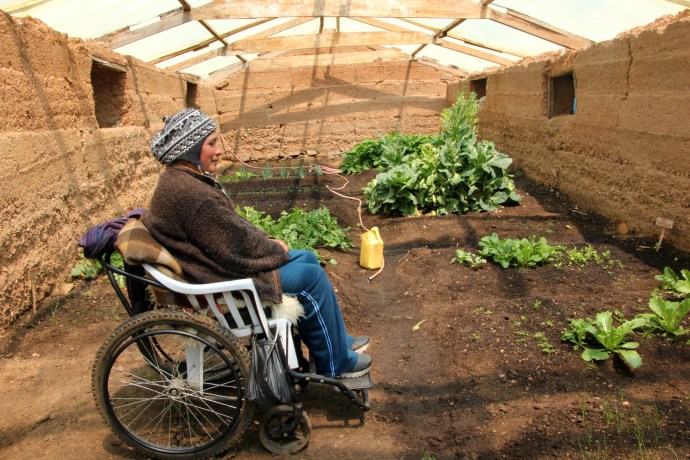
The day was chilly and looked like rain, but when we walked into the 1-year old greenhouse it was toasty warm as Luis Basilio Ramirez and his wife Yaqueline Mesa greeted us. The greenhouse was built by members of the community, with Heifer providing materials and FODESA (a local NGO that’s been working here for 17 years) giving technical advice. It was placed at the Ramirez house because its proximity to the road means all the families can easily come for the robust harvests, and because Yaqueline, crippled in a car accident three years ago, was seriously depressed and needed something to grow. That’s just the kind of close-knit, caring communities that Heifer tends to create (“The projects teach us brotherhood,” one participant said simply.) 

Yaqueline Mesa Ramirez in the community greenhouse.

Now Yaqueline waters, plants, and oversees the organic garden that provides lettuce, tomatoes, beets, cauliflower, carrots, coriander, cilantro, cabbage, radishes and fava beans to family & neighbors who literally have never had vegetables in their diets before. (At 14,000 feet, there is no growing season without a greenhouse.) And those vegetables taste particularly beautiful with the llama meat that Heifer has helped these breeders to produce, promote, market and sell.

Fresh, nutritious fava beans .. yummmm!

For years, llama meat (like llamas themselves) was considered dirty, and vastly inferior to alpaca. But these prime breeders of Pasco are producing such high-protein, low cholesterol, super-clean meat with their award-winning llamas, they have quadrupled its price– and their business plan (written with a Heifer advisor) is to market their llama meat regionally and nationally, with specialties like llama burgers, llama sausage and llama hot dogs winning over dubious hearts & stomachs.

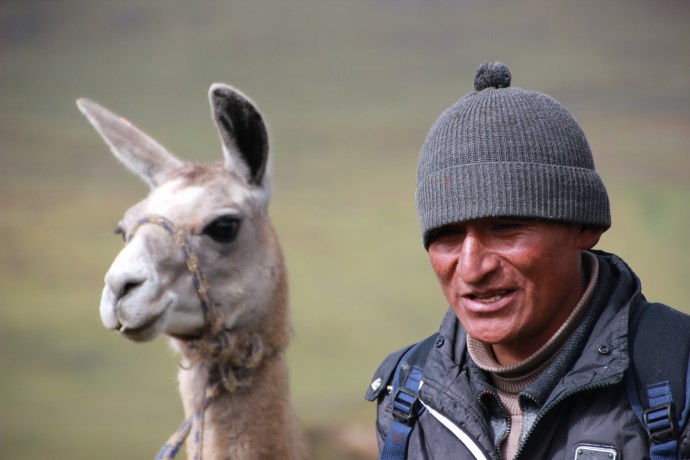
Do the best breeders come to resemble their llamas?

As we watched a third generation of really spectacular Heifer llamas being passed on from one Iscaycocha family to another, the sun came out, candy was thrown to celebrate, and the mining and environmental degradation of nearby Pasco City felt a million miles away. Where God willing, it will stay.

A gift for giving…

Goodbye for now, beautiful Peru!

Categories: Agriculture, Animals, Heifer International, Hunger, Peru, Photography, Travel | Tags: , , , , , , , , , , , , , , , , , , | 27 Comments

Guinea pigs … not just for breakfast anymore.

If you’re going to eat guinea pigs (and in Peru, you’re going to) you’re going to have to raise guinea pigs. Which plenty of Peruvians do, in their kitchens, in their sheds, in a random, atomized way.

To an agro-ecologist like David Rocca, who coordinates Heifers “Good Living” IMAGEN (a local NGO) project in Puchyara, Peru, this represents a huge missed opportunity. To his mind, cuy equals the possibility of a commercial venture on a scale that can lift an entire community out of poverty. David is one of the unbelievably committed people working with local communities in partnership with Heifer, (like Cleida and Claudio from my previous Peru posts) who have the vision, plans, expectations, personal relationships with families, and follow-through to make real change happen. And it does take vision to look at a guinea pig and see the cash rolling in.

David Rocca & Sebastian Huillca

But here’s how it happens: When David started to work with Sebastian and Elena Huillca (and their three children), the family had 2 donkeys, 4 cows, 1 horse, a passel of guinea pigs in a rough shed, and a piece of land one hour ‘s walk away. The house was a mess and the yard was worse. In Heifer workshops, the family learned a few new habits that literally changed their life. They established a Healthy Homeand gave each child his/her own room.

Back to the bio-garden!

They built a shed for their animals, collected the manure that was now in one handy place, and with the help of some industrious Heifer worms, used that compost to fertilize their new bio-garden where they grow enough vegetables to eat and to sell in the local market.

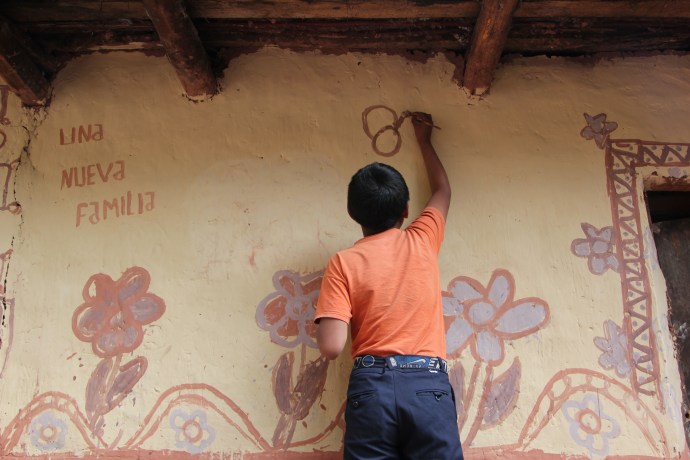
The family planted fruit trees.  They learned how to use local clay to plaster (and beautifully decorate) their house, instead of buying expensive materials they couldn’t afford. And in the guinea pig shed, they covered the walls in clay (with happy drawings), built compartments to separate males, females and babies, grew better forage to feed them, and began keeping breeding records to control reproduction and improve genetics.

What a happy guinea pig house!
The Huillcas followed David’s teachings and put ashes in the entrance of the house to kill bacteria, used meds to treat sick animals, and bred the gift of new Heifer guinea pigs with the local stock to double the weight of their piggies. One year later, they’ve both doubled the number of their pigs, and the price they get per cuy at market. (And both their daughters are attending college!)

3 pregnancies a year, that's fertility!

David is such an ardent believer in the potential of guinea pigs, he contends that profits will begin to repay Heifer’s investment in 2-3 months (including passing on the gift). And his math works. Guinea pigs are ridiculously fertile; females can have 3 pregnancies a year, and the better the feed, the quicker the baby comes. What David has taught his farmers is that if they take care of their guinea pigs— guinea pigs will pay off– big time– for the whole family.

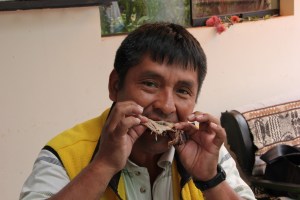
Cuy is served in almost every restaurant in Peru, from sidewalk cafes to the swankiest eateries, so the demand is virtually unlimited. Its meat is high protein, low cholesterol and supposedly truly delicious (that’s right, I wimped out).

A gentle man, Felipe Ayachu.

And unlike bigger animals that demand grazing and herding, guinea pigs can be raised on small plots of land, and handled by older beneficiaries like Felipe Ayachu, who is trying to keep his farm running despite an illness, with only his devoted daughter to help him.

David’s also inspired enthusiastic spark-plugs like Dolores Delgado – whose sterling example of taking the guinea pig ball and running with it has been so inspiring, she’s moved her community’s Heifer involvement from 3 families to 35 (out of 40!)… built a whole new guinea pig barn and organic garden, and doubled the price of the town’s pigs! It’s what she promised Heifer President Pierre Ferrari she would do when he visited Puchyara last year, a meeting she remembered with overflowing tears and copious hugging.

Dolores' experimental, hydroponic, awesome new GP house!

Beautiful Dolores & daughter.

In fact, it’s the example of Heifer beneficiaries like Dolores, Felipe, and Sebastian who start showing up with big, fat guinea pigs for sale, their homes shining with fresh clean designs, and their gardens bursting with produce, that catches neighbors’ attention and spurs participation in the project. These early adopters have become Heifer/IMAGEN promoters, their communities have organized, and now David has the success stories and community backing to intercede with municipal authorities to continue to invest in the materials, seeds and structures that will make Puchyara Pigs the toast of nearby Cusco.

Writing a whole new future for families in Puchyara...

A succulent cuy may never pass my lips, but I predict that before long, David’s dream will be a yummy roasted reality.

Heifer's Carlitos loving his cuy.

Categories: Agriculture, Animals, Heifer International, Peru, Photography, Travel | Tags: , , , , , , , , , , , , , | 37 Comments

Blog at WordPress.com.