Food

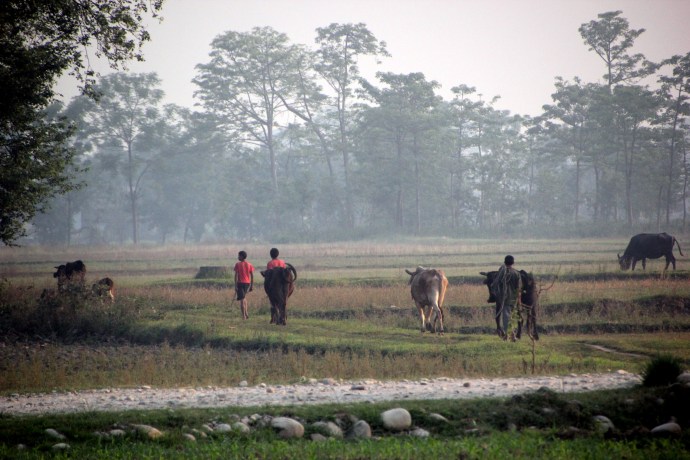
Til the cows come home.

Rural Romania is so beautiful, it can be hard to see the poverty that is staring you right in the face. But make no mistake, it’s there in almost every village; in the orphanages that take in 80,000 to 100,000 abandoned and orphaned children every year; and in the deep lines etched in the faces of farmers who possess a few hectares of land, maybe one horse, a small house, and work like crazy through 5 months of summer to survive the 7 long months of Transylvanian winter, with virtually no way to get ahead or make an income.

Gheorghe Coldea, Rasca farmer.

So Heifer International, Rotary and Bóthar , a wonderful Irish charity working in Eastern Europe and Africa, decided that things would start to change for these Romanian farmers when cows fly… literally.

Now that’s what I call a jetway!

Following the success of their predecessor program, Farmers Feed the Children, Heifer & Bothar established Milk for Orphans and air-lifted into Romania 140 pregnant pure-bred Friesian cows (famous for producing copious amounts of milk and beef). These heifers were distributed to the poorest members of rural communities that lie in the hills around Transylvania’s capital of Cluj-Napoca last November and this May.

Right at home in Rasca.

These farmers will raise the heifers and pass on the first female offspring to another impoverished family. In addition to feeding their own families and having milk to sell for income, the farmers will also provide fresh 300 liters of fresh milk, yogurt, sour cream and cottage cheese to institutionalized orphans and disabled children, whose state food allowance is about $2.50 a day. Ultimately, the program will benefit more than 1,000 children every year.

An orphanage for disabled children in Cluj.

A rare picture of Gina indoors.

What a beautiful program to witness in action! In the village of Rasca, Gina Rosu  (one of 14 children raised in abject poverty) had big plans for her mama heifer and baby calf, and was using the milk income (Friesian cows produce about 20 liters of milk a day, compared to local cows’ 10 liters) to buy piglets, build a new concrete pig sty, and establish other sources of income.

Gina and her husband are unemployed but very hard-working  and totally focused on giving their two children a far better educational future than they had. (Though Gina has only an 8th grade education, she’s managed to teach herself English and Spanish.) And just like American parents, they are struggling with the teenage angst of their artistic daughter Anca, for whom they don’t have money to buy paints, and the high energy antics of son Johnny who’s a musician like his dad.
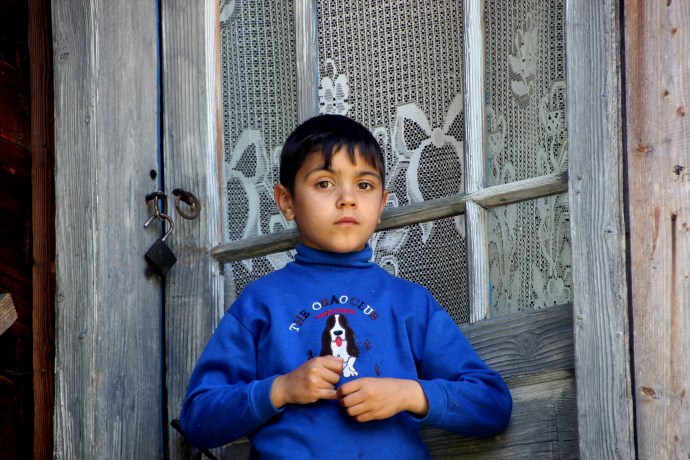
The real beneficiary of Gina’s heifer: young Johnny Rosu.
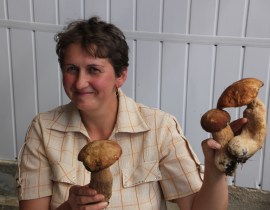
Angela and her amazing boletus mushrooms.

Angela is Rasca’s  Milk for Orphans community leader and her house and barns are spotless; clearly, she has a gift with cows and her home is the milk collection center for the village. She also buys the boletus mushrooms and arnica that everyone hunts in the hills surrounding the village to sell in the Cluj market. With Olimpio, community leader and Heifer-trained animal health worker, Angela is the go-to person for help with any animal issues in the village. In fact, while we were visiting, Olimpio got five calls for artificial insemination. (Once a cow secretes the fluid that tells you she’s in the mood, you have 8-10 hours to get her the goods. Clearly, we were like Michael Bolton for the female cows of Rasca.)

While clouds piled up in the Rasca sky, and Olimpio went to work making the way for more cute heifers, we went to visit the last family of 25-year old Lenuta and her husband Adrian.  They were the poorest couple we saw in Rasca.

Lenuta has a severe hearing problem and all the money from last year’s hay crop had been spent getting her a proper hearing aid so she could hear the voices of her children Natalia and Darius.

Natalia, Lenuta’s mom and baby Darius.

The family lives in a one-room house on Lenuta’s father’s land, but luckily their Irish cow had given birth to a female calf (that would be passed on) and Darius was flourishing on all the fresh milk.

Natalia and the new baby heifer.

In the one tidy room the family lived in, Lenuta laid out a lovely, modest meal for us but I was ashamed to eat their precious food, despite being touched by their hospitality. Everywhere we went in Romania, we were lavished with food – which made me realize how important it was to ask the beneficiary farmers to help feed the orphans. Allowing a poor recipient to become a generous donor is a transformative act of dignity and a powerful demonstration of competence.
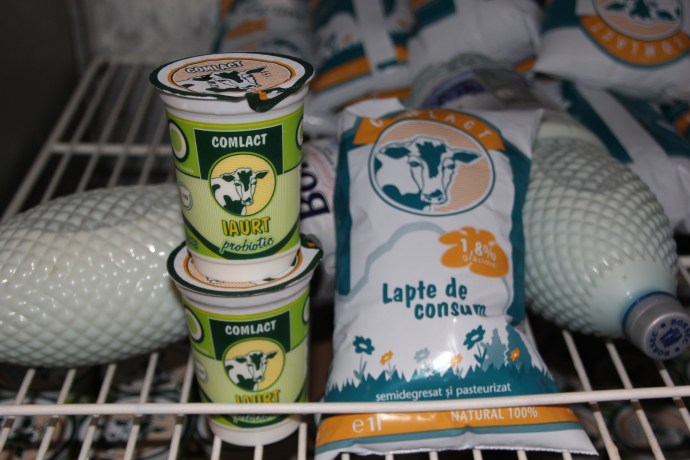
The refrigerator of the orphanage, packed with the bounty of Irish bovines and their farmer-owners.

And you can milk that for all its worth.

Categories: Animals, Farming, Food, Heifer International, Photography, Romania, Travel | Tags: , , , , , , , , , , , , | 19 Comments

One woman’s nightmare is another man’s dinner.

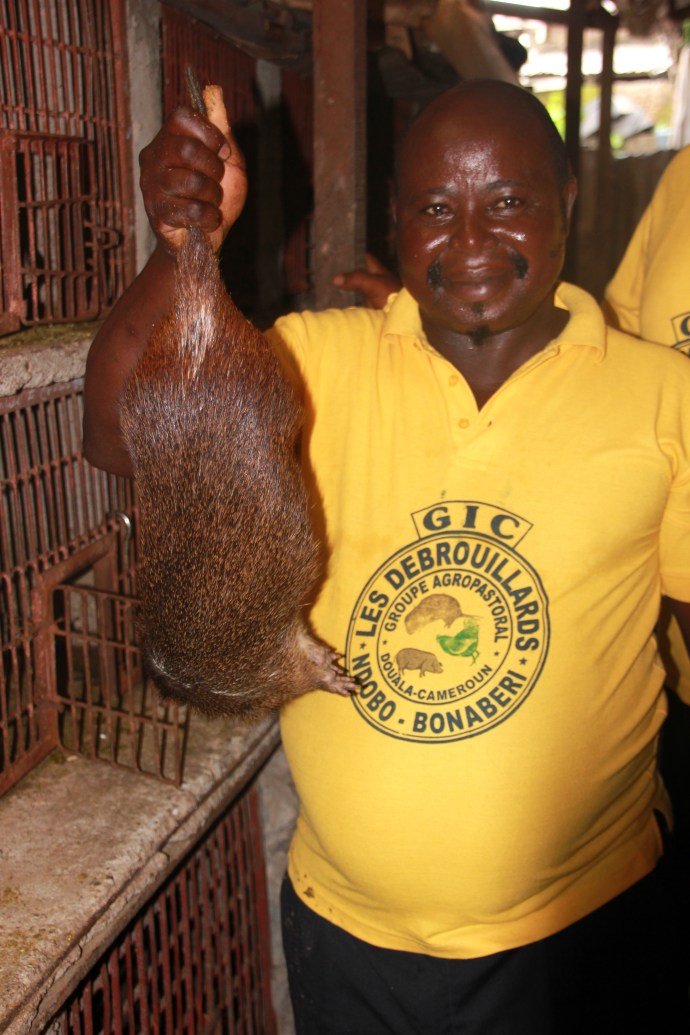
For your sake and mine, this is going to be a really short post about a really big thing. And that thing is a Cane Rat.

I’m not afraid of much, but I am jump-on-the-table terrified of mice and their unspeakable older cousin, the R-word. Nevertheless, when I heard that Heifer had a project in Ndobo village, outside Douala, empowering poor communities there to raise, breed and eat Cane Rats—a delicacy greatly savored by Cameroonians– I knew I had to go, no matter what the psychic damage.

Not photo-shopped, I was really there!

And go I did. I met with the sweet folks making up the project group GIC Debrouillards (“Overcoming Group”) in the middle of a very poor, boisterous neighborhood. The members have a communal farm 3 km. from town where they grow cassava, corn and vegetables, but their real strength is the 64 rats they received from Heifer, which have now multiplied to (god forbid) hundreds of 30-pound meatballs that they have sold for $30-$50 apiece…or eaten.

Okay, the photos suck but that’s because I couldn’t bring myself to look through the lens…

Heifer helped the farmers build the giant $110 steel cages that are about the size of a big Ikea bookshelf and can fit in the back of a house. The folks were also schooled in raising cotton grass and given seeds to grow feed; and given animal husbandry techniques to keep the rats healthy and strong (I didn’t think you had to encourage that).

Ahh, a nice relaxing photo of cotton grass!

The rats can get pregnant when 8 months old, will have a 5-month gestation period, then give birth to 4-8 babies.  Those little cuties (not) weigh 300 grams at birth but in one to two years, they’ll weigh 6-8 kilograms and can be sold for a bundle on any street corner, particularly during the holidays when people treat themselves to a nice big rat.

Sweet family man is sending his girls to school with money from his rats.

No, I did NOT taste Cane Rat roasted, grilled, fried or boiled in stew– but I can’t help but love what these critters have done for the Struggling Group. One man uses his rats to pay for his grandkids to go to the hospital when they get malaria (and everybody gets malaria). One man is using his to pay off his $1,000 hospital bill for cancer treatment. Another is sending his 9 children to secondary school– three of whom he adopted when their parents died.

Beautiful Ndobo girl carrying firewood.

I’d like to say that in Ndobo I learned that rats aren’t all bad. But actually, I merely learned that in Cameroon, any animal protein is good. In this country, the average animal protein consumption is just 30 kilos a year, (including almost 10 kilos milk)… and that’s not even 66% of the minimum consumption for health.

So if this program can get good food in people’s bellies, I will give a rat’s ass …… and happily.

Categories: Animals, Cameroon, Food, Heifer International, Hunger, Photography, Travel | Tags: , , , , , , , , | 45 Comments

What I ate in Nepal.

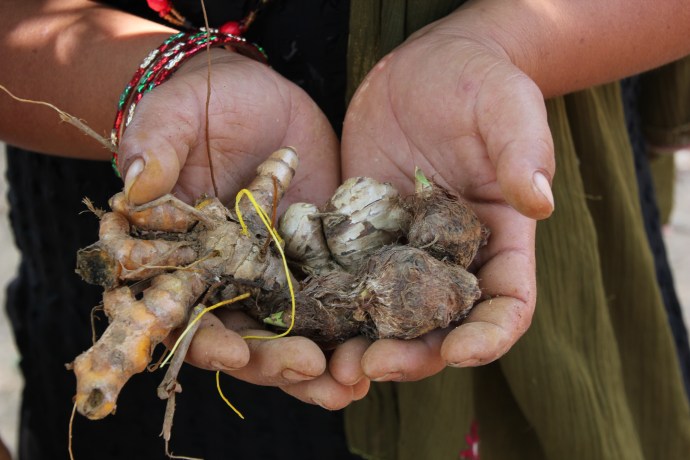
Ginger, Tumeric and Cassava … yum!

After (not) eating all the exotic food in China, arriving in Nepal was like coming back to Normalsville.

In crazy, touristy Kathmandu you could find every possible iteration of American food, including cinnamon rolls and pastries galore. (Obviously the trekkers are carb-loading.)

It was fun to see identifiable fruit and the tiny baby bananas.

Vegetarian chili and Everest beer was my boring but satisfying transitional meal for a day or two.

Then it was onto a beautiful dal plate of curry, rice and lentils, which is a staple of real Nepalese food.

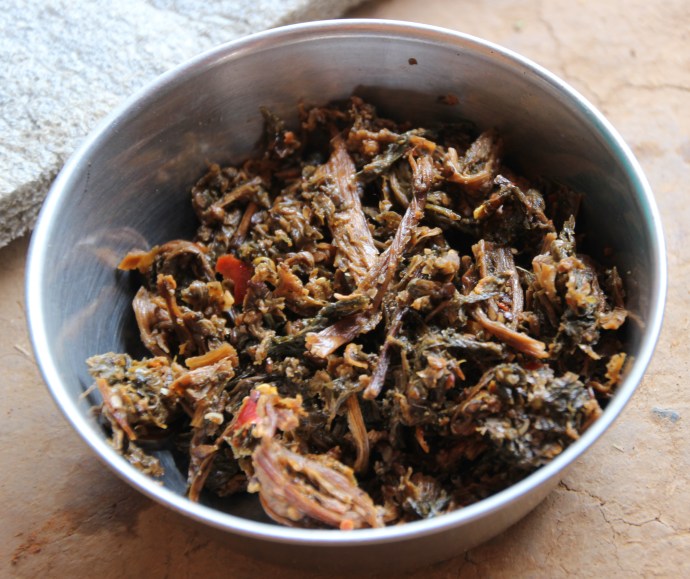
And some super yummy corn & bitter greens we ate for lunch on the porch with the women of Devitar Village.

But my favorite taste treat was in Shaktikhor, Chitwan in a snack shop where the owner whipped up a concoction of peas, potatoes, spices, and corn served on a piece of paper with a cardboard “spoon.”

I loved that the paper “plate” had writing on it. Now that’s recycling!

For 5 rupees (about 8 cents) it was spicy, hot, tangy, salty perfection. He sells about 100 a day and if I were in town his sales would probably double.

The last day we visited the Heifer Dairy Cooperative in Haraiya and met the women bringing in liters of water buffalo milk.

From there we went straight to pure yogurt heaven.

Namaste, folks… next food stop, Cameroon!!

Free range yogurt.

Categories: Food, Heifer International, Nepal, Photography, Travel | Tags: , , , , , , , , , , , | 17 Comments

A scaredy-cat taste of China.

Fish-head soup

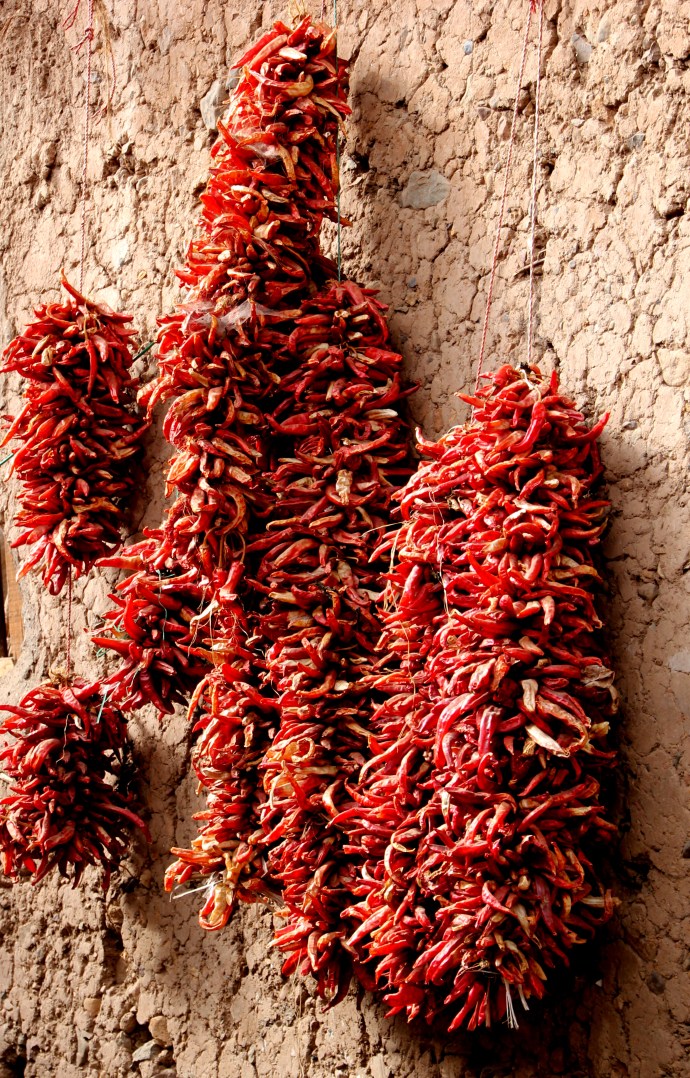
I was a tiny bit afraid of eating in China (because I’m a food wimp) but since I was going to Sichuan, China’s spiciest province, I knew at least my vegetables and tofu would be full of flavor and kick. And boy oh boy, was that an understatement. The Sichuanese douse just about everything in a devilish, oily-red brew of onions, garlic, chiles and pepper, and when it comes to eating, they bring the heat.

Pork fat with vegetables

Now, I’m not claiming that I ate everything you’ll see here … not even close. But what I have to say is that despite my deep loathing for most Chinese food in the States (all that greasy, MSG-infused, takeout grossness), the food in China was the most elegant, beautiful, serious, creative, fresh, lovely and inspired cuisine I’ve experienced anywhere.

Duck tongue (no, it’s not a metaphor and yes, I agree — they’re disguising it quite beautifully).

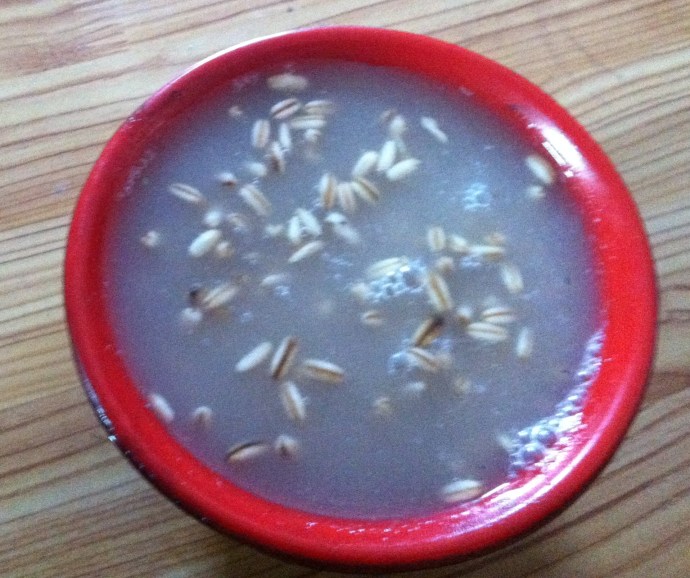
Even when the Chinese were serving alcohol, they managed to offer something I’d never seen or heard of: a big, heaping BOWL of fermented oats (I did try this, but not more than one courageous gulp).In fact, everything was so beautiful and looked so seductively innocent, I had to always ask my Heifer China hosts what the dish was, so I didn’t mistakenly tuck into some brain marrow and beans, or soft intestines and greens.

Intestines (I think)… but aren’t they pretty?

People who eat a lot of tofu are considered a joke in China, so I was happy I could entertain my hosts so easily. I was also complimented on my agile use of chopsticks — and no, I’m not kidding. The only thing I found really hard to pick up were the big wedges of cucumber and the individual roasted nuts.

One nut at a time … but SO worth it!

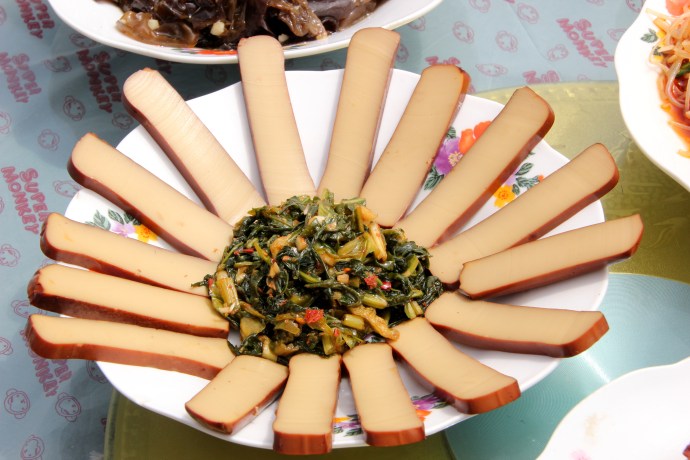
This tofu was beautiful and boring, but man, that center green salad packed a punch!

My only real challenge was breakfast. And here’s why:

Even at lunch, almost every time we sat down, somebody was offering us a room temperature beer the size of a wine bottle (750 ml) — and even though I like Tsingtao, a little beer goes a long way with me. I found myself longing passionately for a glass of Diet Coke, or more accurately, a gin & tonic, but that was a dim dream. As was any hope of getting a cup of coffee that wasn’t concocted of powdered Nescafe and hot water.

All the effort in China goes into tea – like this chrysanthemum version that was superb (but still not coffee, alas).

Dessert was also not happening — but the Sichuanese served a lot of dishes that were so gorgeous, I couldn’t believe they weren’t sweet — even after I tasted them. What a fake-out!

It’s just plain pumpkin.

Buckwheat “cake” that tasted a lot like sawdust.

The real Chinese idea of dessert … up to $180/pack for the most VIP brands.

In short, eating in China was an adventure — and like any adventure, sometimes you’re totally in, and sometimes you sit on the sidelines– or get dragged, kicking and screaming, into the game.

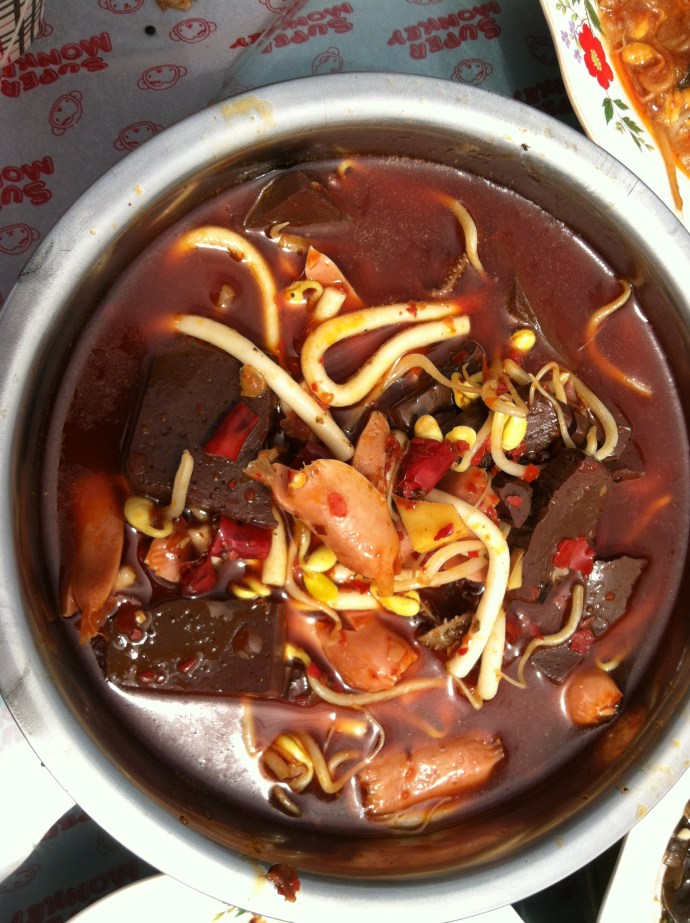
Blood soup….seriously.

My Chinese hosts were always very sweetly protective of me and my vegetarian habits, although they kept offering me big slabs of meat, so I guess they either knew I wasn’t a true vegetarian (an “opportunistic vegetarian” is how I like to think of myself) or they just couldn’t grasp the concept of not wanting to chow down on a tasty hunk of chicken’s feet. Either way, I made it through and just hope I didn’t insult anybody too badly.

Hmmm … who could resist?

And by the time I got to Nepal, I really did kinda miss having noodles for breakfast. With chile, of course!

Breakfast of champions

Bon appetit!!

Categories: China, Food, Heifer International, Photography, Travel | Tags: , , , , , , , , , , , , , , , | 45 Comments

What I ate in Peru.

Serving size may vary.

I feel like a bit of a fraud writing any kind of travel food post, since I am anything but an adventurous eater (my favorite foods as a child were hot dogs and baked beans, to give you a brief synopsis of my limitations). But I’ll try to cover all the bases with an enthusiastic description of what I loved to eat, and lots of photos of what I didn’t eat, with full apologies to Anthony Bourdain for my timid palate.

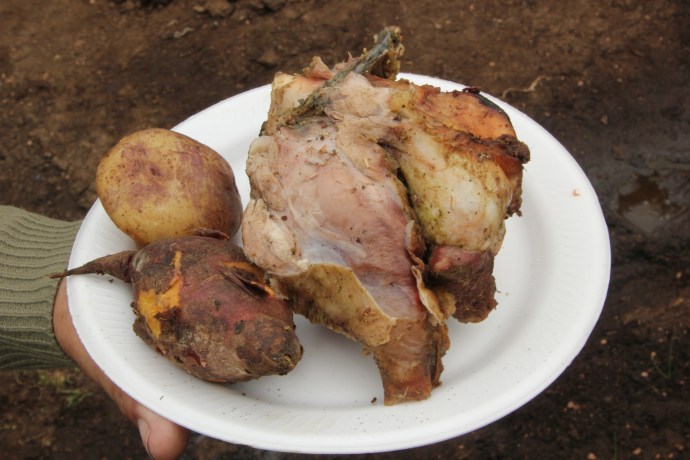
Pachamanca: slow, stone-roasted potatoes & llama, which I actually tasted & liked! Kinda…

Peruvian cuisine is based around native animals (alpaca, llama, beef, fish and cuy.. yep, it’s guinea pig) & potatoes. Peruvians love their starch, and since potatoes originated here (not in my beloved Ireland, mates) and there are 3000 varieties in every conceivable flavor, texture and color, I was totally at home on the veg side of the table. Beautiful fava beans, carrots, cauliflower, beets, green beans, creamy avocado, and/or some type of yummy slaw were usually served alongside the potatoes and so, no matter what the “main” course, I was in hog-less heaven.

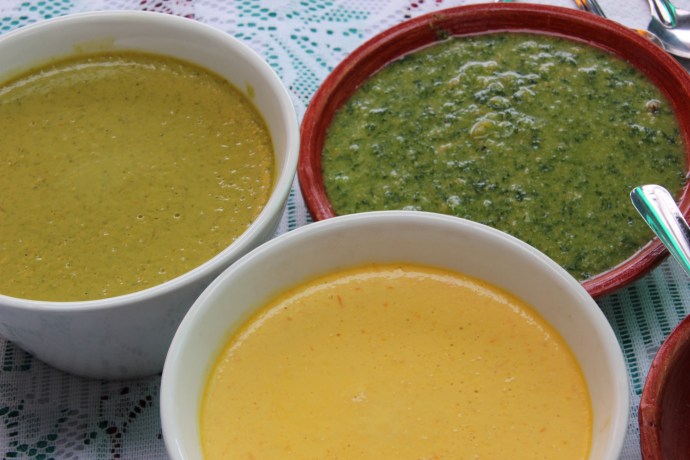
Oh, and just to make the potato/veg thing really sing, Peruvians make the most luscious sauces to dip/slather on your potatoes: green herb, racy red radish, guacamole, and my fave: a golden mustardy/mayo concoction that I wanted to pour over my entire plate.

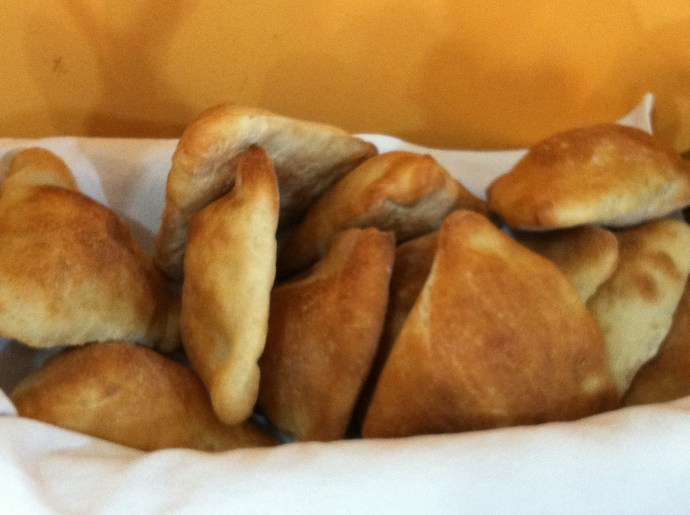
The last time I was in Peru, my friend Judith fell in love with lomo saltado – a Peruvian stir-fry featuring chicken or beef, peppers, tomatoes, rice and French fries, and I was dying to have a platter of carbs in her honor. But since we were mostly at really high altitudes, where your appetite evaporates even faster than your breath, we ate a lot of soup. Delicious chicken soup, pasta soup, noodle soup and vegetable soup ..which luckily is my favorite food ever, particularly when paired with their airy, triangular bread.Some of the traditional dishes that I didn’t exactly eat (but tasted!!) were pachamanca shown above (and that sweet potato was the best I’ve ever had) and the dreaded cuy. Cuy is low-cholesterol, high protein and quite nutritious–and Peruvians adore it– but I couldn’t get past the little paws on the plate. Sorry …

Instead, I usually opted for the trucha frite — fried trout — which is ubiquitous in Peru, from roadside stands to upscale restaurants. Ceviche (lime-marinated raw seafood that is amazing) is also hugely popular but since we spent almost no time on the coast, we didn’t see a lot of it.

The acid test for any cuisine, in my humble opinion, is the coffee and in Peru (as in most coffee-producing countries), it wasn’t too hot. Literally. They brew the coffee really, really strong, then set it out in a pitcher and suggest you add hot water from a thermos.  I like my coffee scalding, so I only achieved partial coffee satisfaction. As for alcoholic beverages, the pisco sour is quite tasty, made from Peru’s own unique pisco liqueur (don’t confuse it with the Chileans’ copycat version or they will get really crabby). Cusquena, my beer of choice, was delicious – but the bottles were a big commitment. Like 42 ounces. And that’s a Big Gulp.

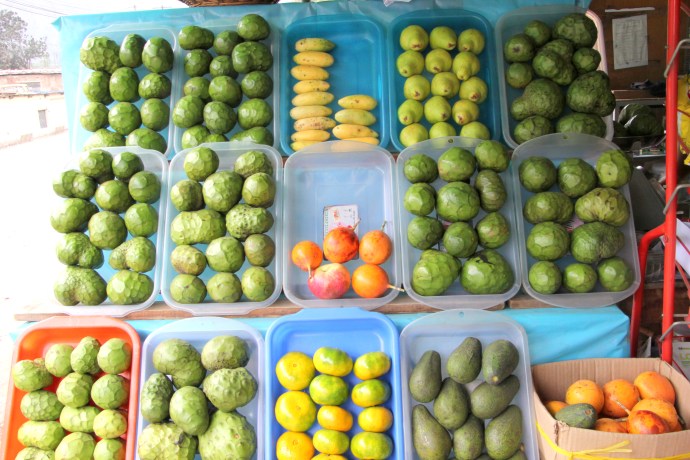
My big surprise was the fruits. Sure, the usual suspects: cantaloupe, pineapple, mango, watermelon were fine, but I really loved the granadia, tumbo, and chirimoya which we bought at roadside stands and devoured in the car — totally unique in their sour, sweet and musty tastes and fun to eat, too.

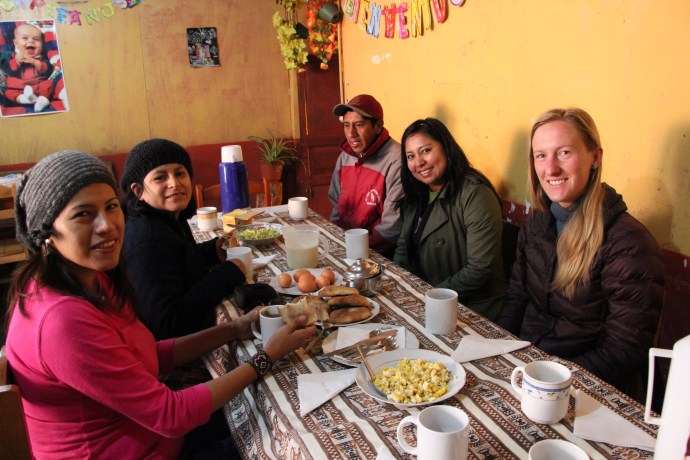
Breakfast of Heifer champions: Rosaluz, Madeline, Claudio, Lidia & Kristen.

So what do I miss the most? The sauces! And the way everybody always sat down at meals together and shared the food with grace and gusto. That was really delicious.

Categories: Food, Heifer International, Peru, Photography, Travel | Tags: , , , , , , , , , , , , | 34 Comments

Blog at WordPress.com.