Poverty

Despair & hope in the Delta.

Traveling from Appalachia to the Arkansas Delta was a shock to me. I thought I was prepared to see poverty – heck, I’ve been seeing poverty this whole year of travel with Heifer – but there was something about the sheer desolation of the town of Hughes, Arkansas that just about broke my heart.
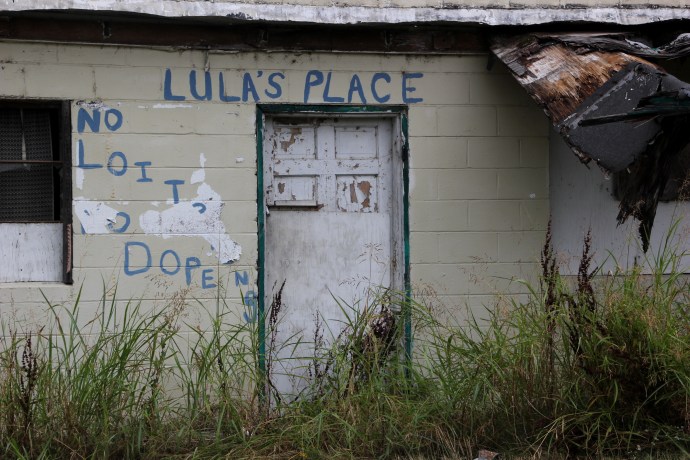
The Delta stretches across the far eastern part of Arkansas, in the vastly fertile bottom lands of the Mississippi River where giant agribusiness farms of 10,000 acres prevail. Yet in an ocean of agricultural fecundity, Hughes is a food desert – its only grocery store burned to the ground.
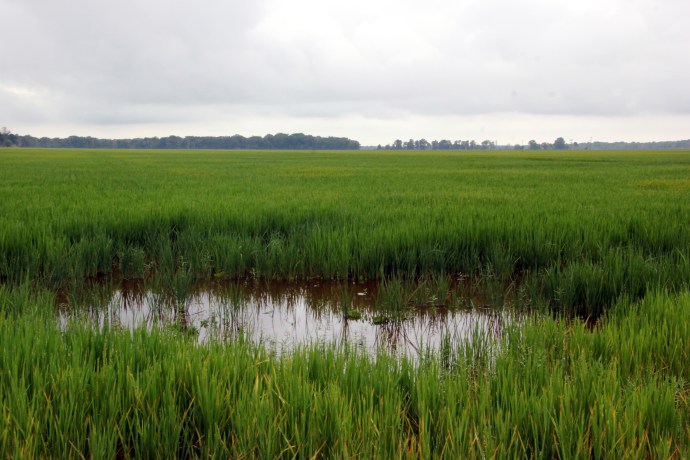
Delta folk are predominantly African-American; brought to the region as slaves, they worked as sharecroppers for decades after the Civil War, then as agricultural day laborers until farm mechanization reduced the need for human labor. Now unemployment in the Delta stands at about 40%, prostitution and drug use are rampant, food insecurity of children is about 25%, and even the Blue Devils Hughes football team is a fading memory on a rusting water tower.

Main Street, Hughes

But as Perry Jones, Director of Heifer USA reminded me, “This is the before photo. We’re just getting started here, and things are going to change.”

Sweet girls of Hughes saying, “Take my picture! Take my picture!”

Heifer’s Seeds of Change program will focus five years working in 9 counties in the Arkansas Delta to create community food enterprises (and jobs) growing healthy, local, organic food and linking small-scale farmers to larger and diverse markets in nearby Little Rock and Memphis, where local food is sought-after and valued.

That sounds good on paper, but it’s the people making it work who turned my feelings of despair into something approaching optimism. Perry himself is a fire hose of positivity. Having spent 14 years working for Heifer in Bolivia, Jones still believes he has the “best job in the world” and that “if you give people the chance for a dignified, self-reliant life, they’ll lunge into that opportunity.”

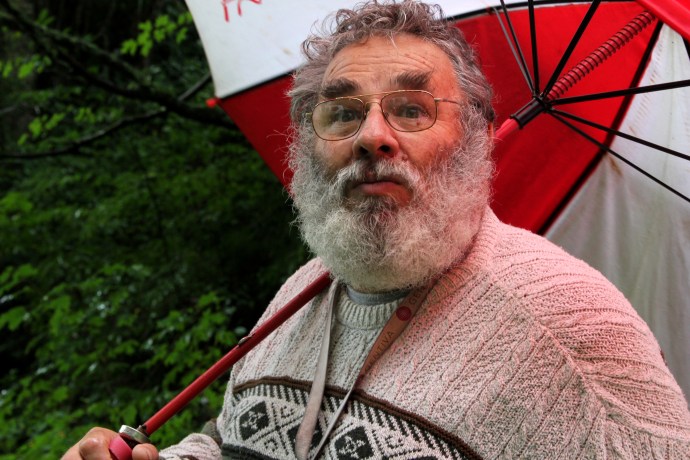
Gardener William Eldridge

And indeed, we saw some of that lunging. William Eldridge, a local gardener, introduced himself to us on the street while I was taking photos and was eager to drag us over to see his garden.
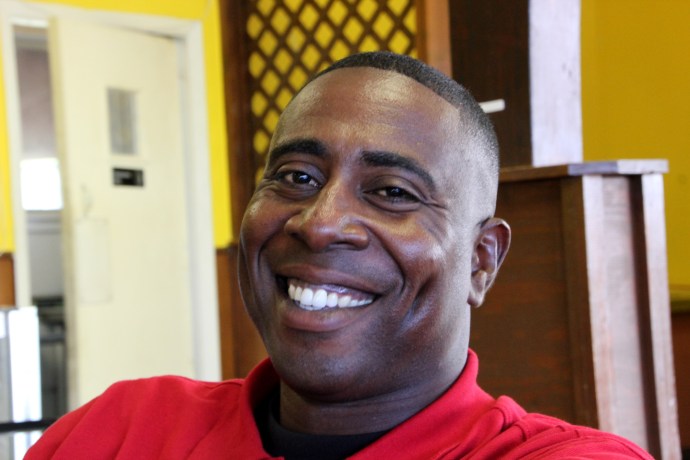
Edward Rucker, Heifer Production Manager in Hughes.

Edward Rucker, Heifer’s Production Manager, grew up in the area and is recruiting local growers like William, assisting them with farm trainings and marketing, and searching for a place to establish a Farmer’s Market to sell local produce. The East Arkansas Enterprise Community, established in 1995, is partnering with Heifer to offer technical and financial assistance to these local growers and to help dispel negative notions that keep people from farming. Notions like working the land is tantamount to slavery, or that giving up government assistance to work is too big a risk (any income can cause essential benefits to be taken away). These are real issues and can only be resolved with proof that success is possible.
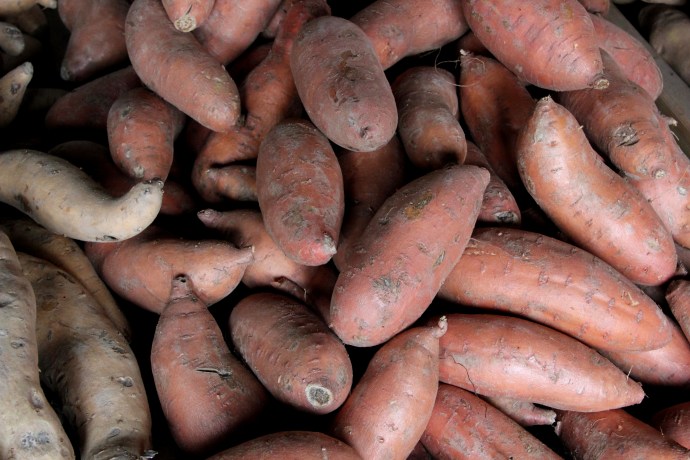
Local sweet potatoes, a high value crop in the Delta.

And that’s what Perry and his team are out to do: create a model of economic, social and environmental health in a place where it has never existed. Like in the new Hughes Community Garden, overseen by Reverend W.E. DuBois — 90 years old and “retired” from teaching agriculture in the nearby community college.

Reverend W. E. DuBois and his garden

It’s been said that the darkest hour is just before the dawn, and I’m praying that’s true. It’s high time for a Delta dawn.
Categories: Agriculture, Appalachia, Farming, Heifer International, Hunger, Photography, Poverty, Travel, USA | Tags: , , , , , , , , , , , , , , , , | 36 Comments

A hard rain’s gonna fall.

Bill has been unemployed for 2 years, sold his house in Florida at a loss, and now lives in tents with 5 family members.

I just got back from spending six rain-soaked days in Appalachia and the Arkansas Delta, viewing some of Heifer’s newest projects to reduce hunger and poverty here in America.It was a damp and eye-opening trip in which I got to meet some remarkable people, experience despair at the entrenched poverty I saw, and feel beams of hope in the creativity and passion of farmers, cheese-makers, biker pastors, entrepreneurs and dreamers in both regions.

Charles Church, organic farmer.

American poverty is the great silent shame of our time. At $15 trillion dollars a year, the American economy is the largest in the world, producing ¼ of the planet’s entire gross domestic product. Yet one in seven people in America live below the poverty line of $22, 113 for a family of four. A person working full-time at the minimum wage earns about $14,500 a year – and 80% of single mothers heading a household work at least one job and still can’t provide the basic necessities for their children.

The largest demographic of poor people are children – with 44% of American children living in low-income working families. About half of all American children will receive Supplemental Nutrition Assistance Program benefits (food stamps) before the age of 20; for African-American children, that number is 90%. And the majority of all Americans will live in poverty at some point before reaching the age of 65.

Now that you’re in a coma of statistics and depression … let me tell you how beautiful Appalachia is. (I’ll get to the beautiful Delta later..)

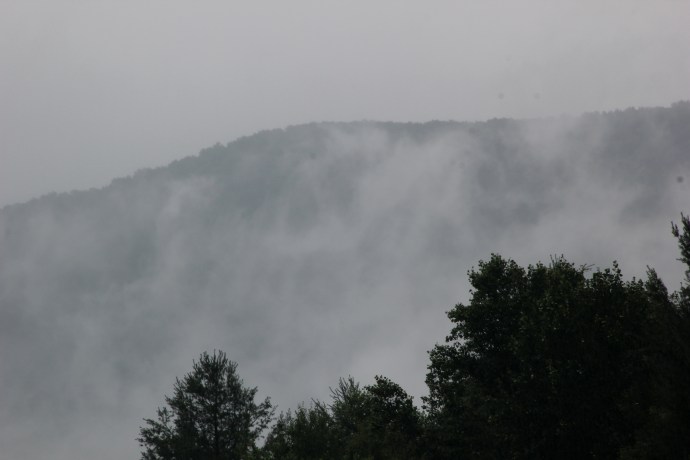
I spent my first four days in Boone, North Carolina and the surrounding towns in far western North Carolina. Even in the relentless rain, the green of the fields and mountains, the tidy gardens of the small households, and the sweeping vistas you knew were huddled behind the dark clouds were glorious. But you can’t eat beauty. In Appalachia, the problem is not a lack of land but the lack of production of local food, organic produce, and provisions that are sought after and becoming ever more valuable in these tourist-driven communities. In the Delta, amidst huge agribusiness farms on endless swaths of land, the people have no acres to call their own, their local economy has dried up like the drought-stricken earth, and they are literally stranded in towns buffeted by crop dusters and blown past by anyone with wheels.

Poison raining down from above.

Somehow the land’s beauty in both places makes the hardscrabble lives of so many residents even harder to accept– along with the mining and manufacturing jobs that won’t be coming back, and the traditional ways of life evaporating like fog on the mountain. But Heifer and a bunch of other folks in these mountain and Delta communities are determined to draw a line in the sand and simply not allow that to happen.

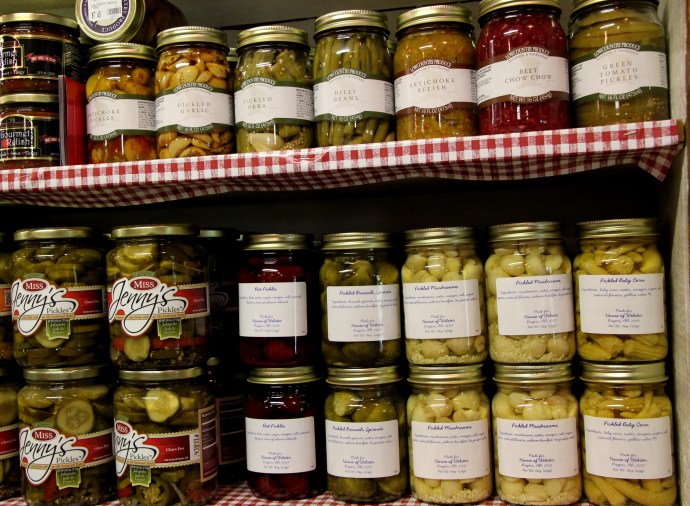
Mast General provisions .. yummm!

I’ll be telling you their stories over the next two weeks. In the meantime, here’s Bob Dylan to take you back to those days when we swore we’d never let something like this happen here.

Categories: Agriculture, Appalachia, Farming, Heifer International, Photography, Poverty, Travel | Tags: , , , , , , , , , , , , , , , , , , , , | 25 Comments

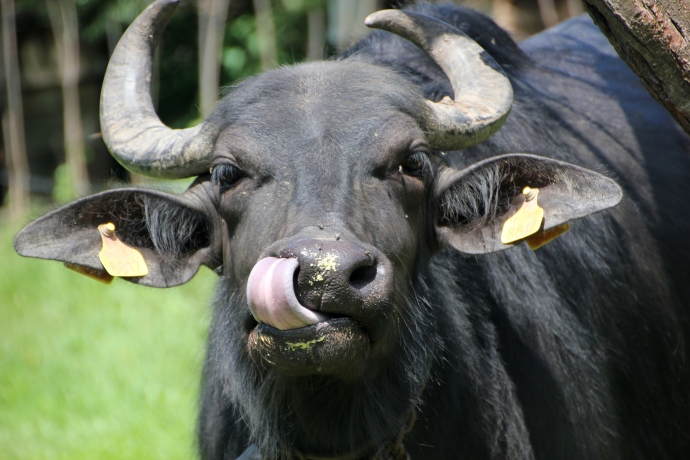
A big, hairy tale of survival.

The original WB.

Water buffalo aren’t the only species struggling to make a comeback in the beautiful rolling hills of Aschileu, Transylvania. The 1,841 poor farmers who live in these five verdant villages and were shoved off their lands under Communist rule are also fighting to regain a foothold in the local economy. Now thanks to Heifer’s first water buffalo project in Romania, the two may well help each other over the hump.

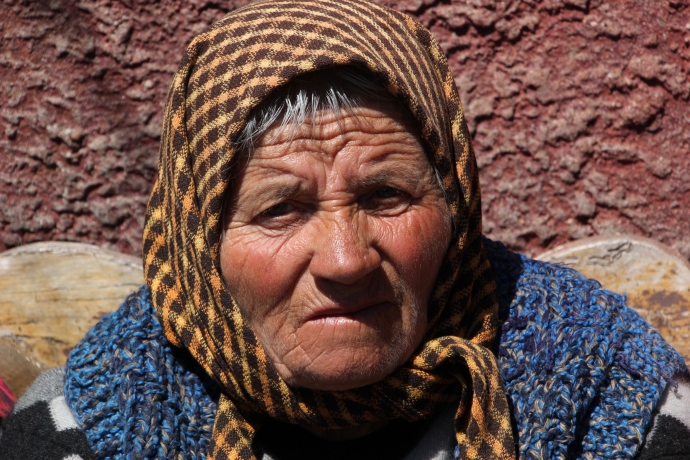
At 78, Anna remembers feeding the Germans, then the Russians, then the Communists, then losing her land and all her animals. But now she’s got a new water buffalo to call her own…

Water buffalo have been raised in this area since they were first introduced by the Turks during the Ottoman invasion in the 15th century. Called the “poor man’s cow,” a water buffalo thrives on even poor fodder, rarely gets sick, makes a terrific draft animal, and will produce 5-10 liters/day of very rich, healthy milk that can be made into delicious cheese, sour cream and yogurt. (And Romanians are nuts about dairy.)

However, after the fall of Communism in 1989, farmers were encouraged to raise cows and the numbers of water buffalo dropped perilously by 80%, threatening the breed’s survival. To promote biodiversity, income generation and better nutrition; offer an alternative to strict EU standards that limit the sale of cow’s milk; and encourage peace & understanding between neighbors in the Hungarian Mera village and Romanian Aschileu village, Heifer started the Revitalization of Water Buffalo project last year, giving 36 water buffalo and trainings to needy Romanian families (who will Pass on the Gift to another 36 Hungarian families in Mera).

About half of Ion & Felicia’s children/grandchildren.

One of the first recipients of a water buffalo was Ion, Felicia and their nine children. Ion is one of 10 orphans whose mother died and were then abandoned by their father and left to raise each other in the village. Today, those 10 brothers are mostly illiterate and work as laboring farmers and shepherds, but each has managed to build a home, establish loving families, and amass a brood of livestock. Their self-sufficiency and dignity were palpable, despite how thin and wan Felicia looked ( and raising 9 children and 3 grandchildren, who wouldn’t be?)

Ion & Felicia

As we climbed into the hills in a horse-drawn cart to visit the goats, cows and water buffalo herds that Ion tends on communal pastures, the views became more and more stunning and I felt more and more like I was in some modern version of The Sound of Music.

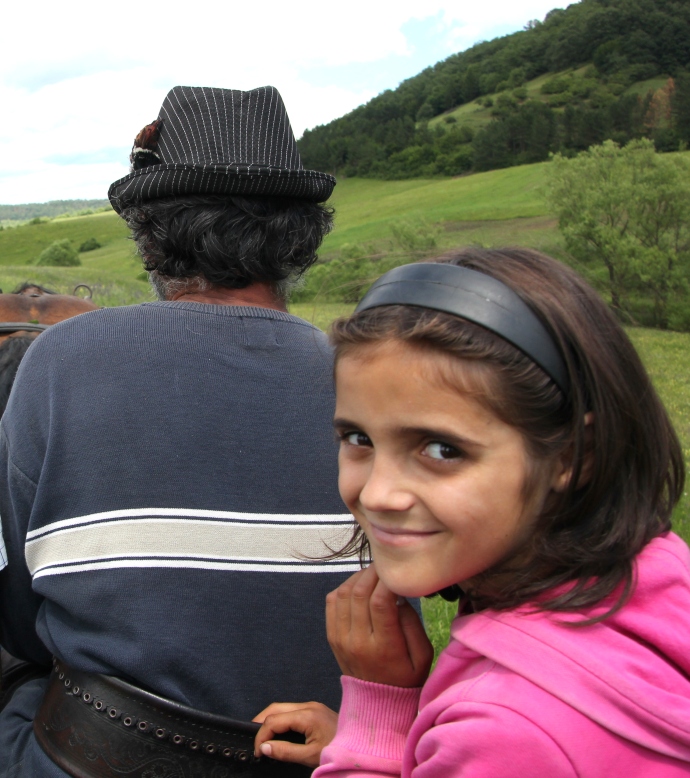
Lordana, Ion’s daughter, kept turning around to grin at me, her fingers tucked into her father’s thickly-tooled shepherd’s belt as we lurched across stream beds, and I kept thinking “What a hard life. What a beautiful life.”

With village milk collection centers and cooling tanks in place, and an ever-increasing demand for high-butterfat, high-protein, low- cholesterol buffalo milk, hopefully life here will become a lot less hard and a lot more healthy.

The lovely Miss Lordana.

And the hills will be alive with the (very loud) sound of water buffalo… once more.

Categories: Animals, Farming, Heifer International, Photography, Poverty, Romania, Travel | Tags: , , , , , , , , , , , , , | 21 Comments

Just add water.

There are many places on the planet where climate change is being debated. Barza Village in the Far North of Cameroon isn’t one of them.

The beautiful houses of thirsty Barza.

This area in the Sahel area of Africa (the transitional swath of land between the Sahara desert to the north and savanna to the south) has always been hot and dry, with 7 months of scorching heat that often reaches 113 degrees. But in the past 22 years, things have gotten far, far worse for the farmers of L’Extreme Nord.

The grannies remember when rainfall was dependable and water accessible.

Rainfall has decreased from 900 mm to about 400 mm a year. Nearby Lake Chad had a surface area of 25,000 square kilometers in 1970; today its surface area is 2,000 square kilometers. (How did I not know this??) And for the people here in Barza, water has gone from being something that is a challenge to obtain — to something that consumes their entire day, as the people walk back and forth repeatedly to the only source of water, a river 10 kilometers away.

In 2003, Papa Maliki, Barza’s village chief, in desperation started a GIC community group, with the intention of asking for help in ensuring the education of the town’s children and reducing poverty and malnutrition.

But it all starts with water.In 2006, Heifer began to offer assistance with sheep and donkeys (that can carry water) and in 2011, in conjunction with Bethlehem Foundation and the GIC community group, Heifer dug a borehole that would provide clean, potable water to the town — for which the people are indescribably grateful.

The daily queue for precious water at the borehole.

The hole is 55 meters deep, but working 16.5 hours a day it’s already pushing capacity, and every day at noon it must be given 90 minutes to rest and refill. Barza’s borehole is managed by Tabitha Koffa, president of the GIC, and with the water committee, she’s established a system of distribution based on the town quadrants, and a maintenance fund to which everyone contributes in the event the borehole needs repair: $4/year for a family; $2/year for a single person.

Borehole President Tabitha Koffa, with a lot on her mind.

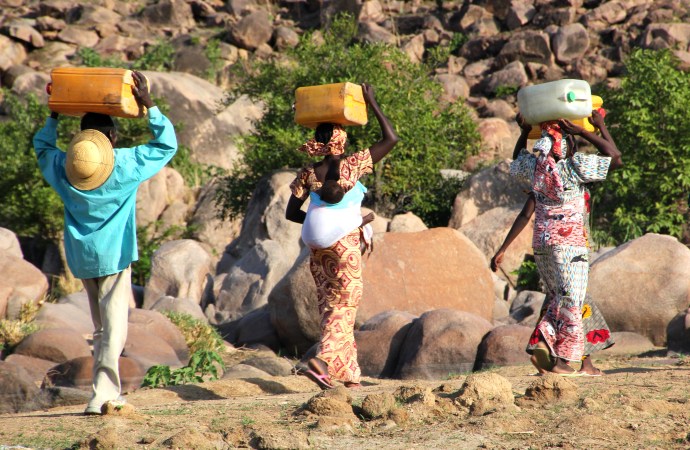
Each of Barza’s 200 families may take (2) 20-liter jugs every other day of the fresh, clean water from the borehole –but it still takes about 150-200 liters of water a day to provide drinking, cooking, washing and animals’ water in these large households. So the women (and men, since Heifer’s gender trainings taught that water collection is not just women’s work) must still walk 5 miles each way to carry questionably safe river water back to their homes.

When I saw the process and drove (not walked) the route, I got enraged. Many philanthropic organizations like charity:water and Dig Deep have called water a basic human right – and when you consider the complete, utter, appalling waste of human capital as people haul water on their heads five miles to home … it makes you wonder what our priorities are. Yes, it’s a government’s job to build the infrastructure that provides water to people’s homes, but it’s a moral crime, in my estimation, for us to allow anyone on this planet to live without water.

One borehole costs @ $15,000. The Far North of Cameroon is estimated to need 11,600 of them. That would cost $174 million – about 40% of what the USA spends on a single F-22 Raptor aircraft.

Politicians can argue all they want about climate change, but the fact remains that we’ve caused the vast majority of it (Americans use 25% of the world’s energy & cause far more of the carbon emissions that are driving up temperatures and wreaking havoc on weather patterns) and poor people in the Sahel are picking up the tab.

Or should I say picking up the 20-liter bottles of unclean water, putting them on their heads, shifting their babies on their back – and walking slowly home.

Categories: Africa, Cameroon, Heifer International, Photography, Poverty, Travel, Water | Tags: , , , , , , , , , , , , , , , , | 28 Comments

Dead Hen Walking

After 16 years, Pauline’s favorite hen succumbed to Newcastle disease.

If you are a woman living in a village in the Far North of Cameroon, chances are you’ve been raising chickens since you were knee-high to a grasshopper. And chances are, every year in the cold dry months you’ve watched helplessly as your chickens stop eating, droop their wings, and begin listlessly walking in circles – then keel over and die. Despite the fact that these chickens account for most of your family’s income—and 16% of the country’s poultry—there’s been nothing you could do but watch your food & income perish.

Pauline & Madeline discuss their chicken losses.

This scourge of chickens is called Newcastle disease and although it’s been an affliction here in the Far North for years, little has been done to combat it. The day we visited Pauline Tcaday and Madeline Maylaou, two chicken farmers in Kar Hay, we saw the carnage first hand.

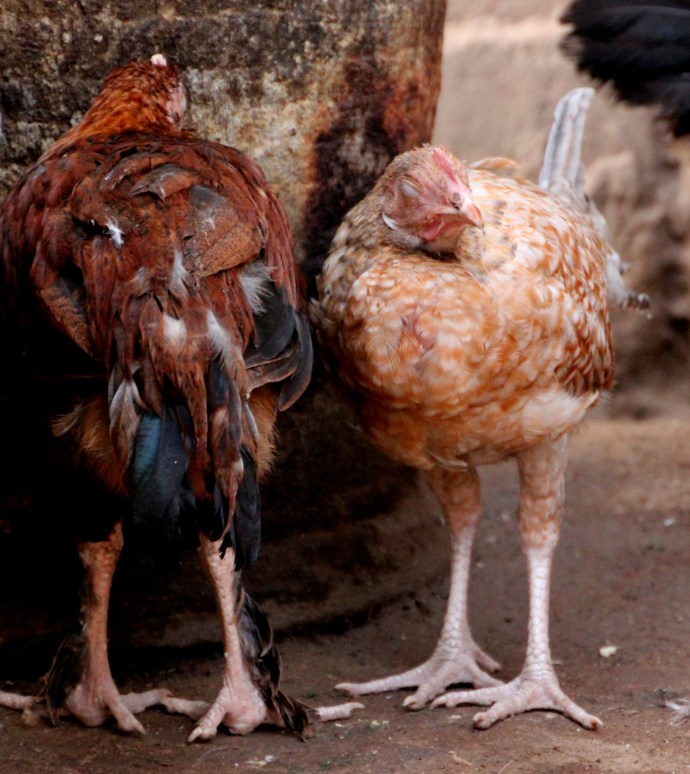
Two sick chicks, not long for this world.

Pauline’s flock of 100 birds had been totally healthy until she brought one new chicken home from the market. That chicken was infected and now her entire flock was dying. 53 of Madeline’s 56 chickens had perished in a single day. And almost overnight, the village population of 79,000 chickens had shrunk to 28,000 — a loss of about $170,000!

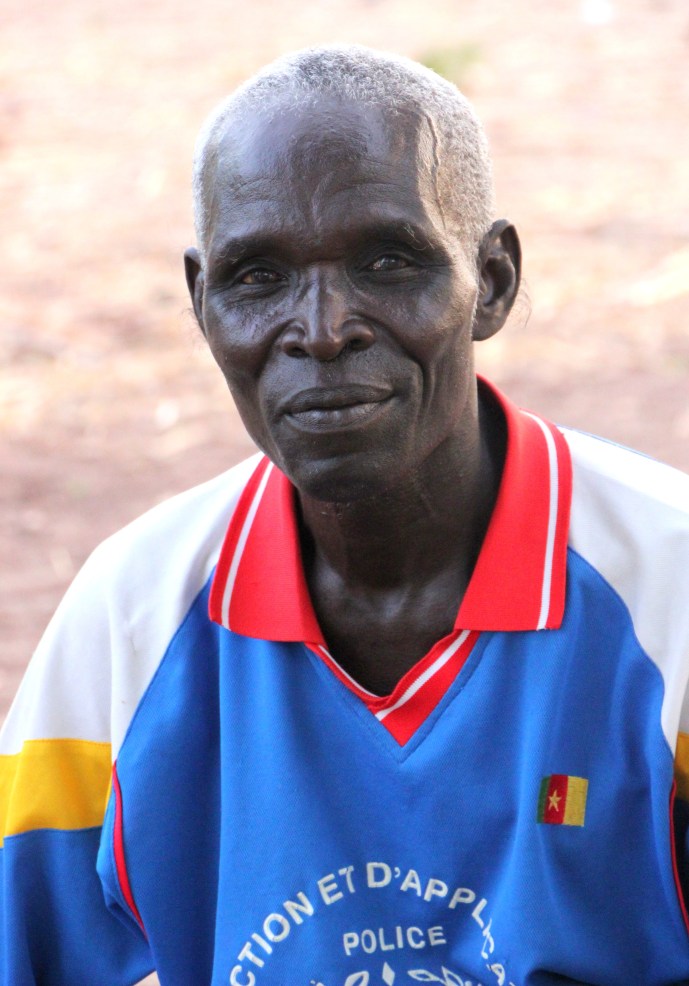
Norbert Mayla, chicken farmer of Kar Hay, tries to make sense of the epidemic.

Luckily, a plan is in action that will help 9,000 rural farm families like Pauline’s save their chickens– and the vital income & nutrition they represent. Heifer International, in collaboration with GALVMed(a non-profit global provider of livestock vaccines), and MINEPIA (Cameroon’s Ministry of Livestock, Fisheries and Animal Industries) has started a pilot program in 40 rural villages to vaccinate 490,000 chickens against Newcastle disease – and it’s brilliant on about 5 different levels.

First, it’s a sophisticated, well-coordinated, thoughtful campaign based on research and epidemiology. The vaccine is highly effective in protecting against the disease and if every chicken were treated, Newcastle’s could effectively be wiped out in a few years. That’s not just chicken pot-pie thinking; it’s a potential reality.

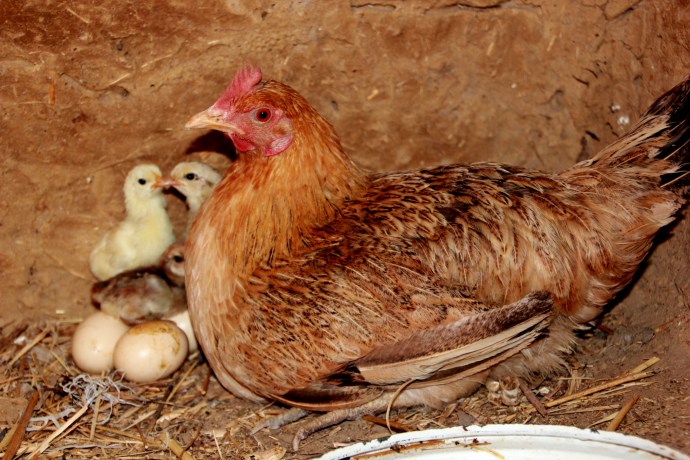
The desired outcome..

But initiating a program this ambitious has been anything but simple. Heifer and team had to figure out the cold chain to keep the vaccine viable (in a country where electricity is spotty); adjust the dosage size so a vial could be administered in a single day; and find dependable, experienced people to see the program through.

Wyang Agah, Kar Hay’s AHCW.

Eight Animal Health Care Workers with diplomas in animal husbandry were hired and provided with 4 motorcycles to reach the 40 far-flung villages, and 4 solar refrigerators to keep the vaccine at its essential cool temperature in their vet stores.

The AHCW supervise the Village Vaccinators, two per village, who are local residents, literate, and have been trained to administer the vaccine to the chickens (by eyedrop). The Vaccinators have been given new bikes and insulated cooler boxes that will keep the vaccine fresh while they travel from the vet store to their villages.

Everybody’s excited about the new program (and the new Vaccinator bikes)!

They’re off and running…

The vaccine costs 50 francs (10 cents), administered 3 times a year. So for 30 cents annually, farmers can protect a chicken that will fetch $3-$5 in the market. What’s more, the 50-franc fee covers the price of the vaccine, the salary of the AHCW, and the Vaccinators – meaning the program is immediately self-sustaining, and everyone involved has a strong motivation to make it a success. And in late May this year, vaccinations began.

For farmers in the Far North, the stakes couldn’t be higher. Not only does chicken income pay for school tuition, health care and clothes, animal protein is already in perilously short supply, while the population is projected to grow by almost 30% in the next 5 years. With 38% of the children in the Far North currently malnourished, a strong, steady supply of chicken that the people could both eat and sell would be nothing short of a miracle.

Madeline’s feeling hopeful!

When I asked Pauline and Madeline if their families ate their chickens’ eggs or sold them, they burst out laughing. “We don’t eat eggs, we don’t sell eggs,” they said ruefully. “We don’t even eat our chickens. We’re poor and we have to sell them.”

But hopefully, those days are numbered.

Categories: Cameroon, Heifer International, Hunger, Photography, Poverty, Travel | Tags: , , , , , , , , , , , , , | 23 Comments

Blog at WordPress.com.