Poverty

Divine peaks & intransigent Maoists… or “Welcome to Nepal!”

As I was flying from Chengdu, China to Kathmandu, Nepal – over the most spectacular vistas you will ever see from the window of a plane (8 of the 10 highest peaks in the world are in Nepal and they’re on glorious display), you might have thought I would be in a paroxysm of delight. And I was … sort of.

The only Tibetan I met.

But I was also plenty cranky because we were flying over Tibet – where I was supposed to be going for three spectacular days, if my visa had not been rejected by the Chinese government. Yes, after I’d spend $200 to assure that my passport, Chinese visa, 30-day in advance Tibet visa application, confirmed flights, carefully crafted bio (in which I assiduously tried to avoid using the word “writer”) and thorough retinue of places I wished to travel was in order, China flipped me the bird.

Now, the fact that you even need a separate visa to go to Tibet, which China is obsessive about referring to as its own territory, adds salt to the wound of having to pay $500+ for a stupid Chinese visa … it’s like paying an arm and a leg for a USA visa, then having to pay extra to visit Montana (which would be totally worth it, btw). In any case, I was bitter about my aborted visit to Tibet when I could SEE IT from the plane… in fact, we landed in Lhasa and spent an hour in its militaristic little terminal.

The Lhasa Airport (all I saw of Tibet)

To make my bitterness even more acute, my adjusted plans to visit additional Heifer projects in Nepal (after my last-minute rejection in Tibet) were jettisoned by threatened Maoist strikes throughout that country. So yeah, I was experiencing a little Global PMS (Post-Maoist Sh#$%t).

But then I got to Kathmandu and the sheer, delightful energy of the place blew my crankiness straight away.

This dusty, frenetic city of 1 million people is wall-to-wall shopping, drinking, eating, building, bargains, music, stupas, shrines, westernized food, trekkers, scarily fit Europeans, aging hippies, buskers, players, monks and prayer wheels.

The eyes of the Buddha are upon you.

Nepal was a surprise to me on many levels – probably because I assumed I knew quite a bit about the country (so many people I know have been there) but in truth, I was clueless.

I thought Nepal was mostly Buddhist; it’s actually 90% Hindu, with an ingrained caste system that is rigid and unforgiving, particularly for women.
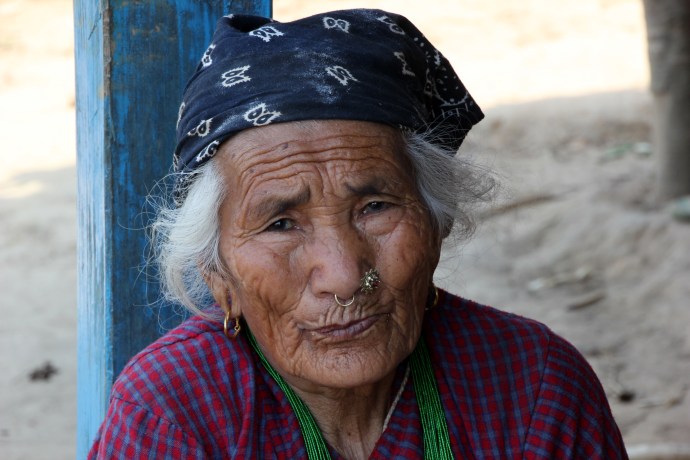
I also thought Nepal was a monarchy; but the King and his family were assassinated in 2001, and a Maoist revolution succeeded in 2006 (hence the strikes that truncated my project visits). This small landlocked country, sandwiched between the titans of India and China, is the only Asian nation never to be colonized and knows well how to walk the delicate line between diplomacy and independence.

Nepal’s 3 regions: Terai lowlands, Hill Country & Mountains — and what mountains!

Not to sound too tourist guide-y, but Nepal is a land of contrasts, from the rice paddies of Chitwan to the nosebleed peaks of Annapurna and Everest– and a country of constant surprises.

The swastika is a Hindu symbol for prosperity, and the Star of David stands for knowledge – but what a juxtaposition to see on a home’s entrance gate!

I knew Nepal’s 26 million people were poor, but I didn’t realize that 40% of children under five are underweight and likely to be stunted in growth.

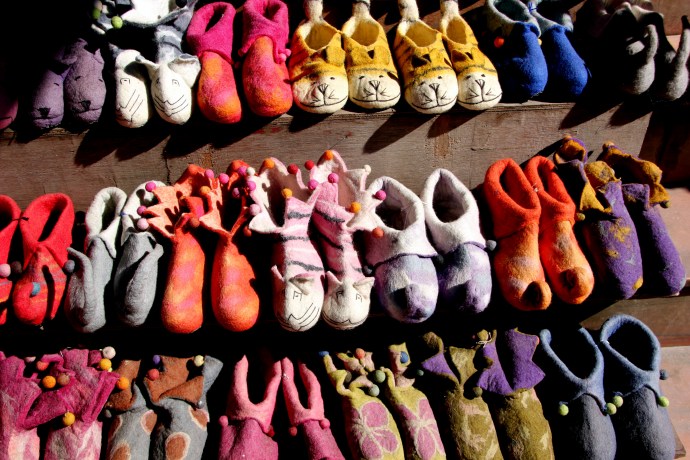
And I didn’t realize there would be so many adorable things to buy, but for once I’d have no appetite for shopping.
I was happy to be in Nepal, and a bit sad to be alone in my sweet room at Kathmandu Guest House.But mostly, I just needed to go see some Heifer projects and people… the cure for all crankiness.

(But that’s tomorrow’s story.)

Categories: Children, Heifer International, Hunger, Nepal, Photography, Poverty, Travel, Women | Tags: , , , , , , , , , , , , , | 28 Comments

First Impressions of China …

A lot of how you first experience China probably depends on how you feel about China before you go there.

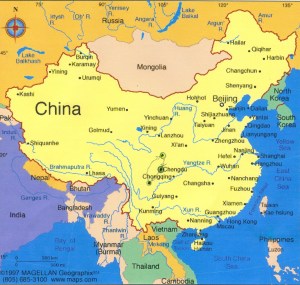
Where I went in China (Sichuan province).

For instance, if you think of China as the majestic, longest- lasting civilization in the world–one  that invented paper, gunpowder, kites, ice cream and toilet paper (hard to say which I value the most)— you’re going to be pretty darn impressed with all the rich history and present-day achievements you see. But if you are pretty sure that with 1 billion people, a land mass only slightly smaller than America (I was totally sure it was twice our size) and an economy growing at breakneck speed, China will be taking over the world in our lifetime – and not in a fun, let’s-break-the-bank European way but in a we-are-all-striving-together-to-suffer-and-achieve way – then you’re less likely to be enamored of the culture. Although I have to say, there wasn’t a whole lot of culture on display where I was in Chengdu. Mostly it was just gray skies, lots of smoking and spitting, a million high-rise buildings, and noodles galore. (But I wasn’t in the groovy old-world part of Chengdu with all the pandas, etc. so maybe I just missed the boat.. or the junk.)

Yup, this is pretty much my memory of Chengdu.

Once you get out into the countryside, though, China is awfully pretty.

The people are adorable, friendly and fascinating. The roads are great. Everywhere you look, you see building and new bridges and tons of billboards offering tons of stuff for sale and people who seem to be coping with the stress of living in this highly competitive, highly regulated country pretty well.

I have no idea what this means, but you gotta love a headline that uses the word "protagonist" right?

And make no mistake: China is regulated. You can’t get on WordPress, any Western blog sites, Facebook, twitter or YouTube in China. And my month-long quest to get a visa to visit Tibet came to naught, as they don’t seem to want to let Westerners in to visit that cheerful, beautiful Buddhist country. It’s astonishing how restrictions like this chafe and bind when you’re used to being able to go anywhere you please and criticize, make fun of, and badger your government (go, Jon Stewart!).

Despite the general affluence of China (there are more thousand-dollar handbags slung over skinny girls’ shoulders here than in New York), I also witnessed some of the worst poverty I’ve even seen.

I heard last night on CNN that the Chinese economy has slowed down to a roaring 8%, although China is still producing more millionaires a day than anywhere else on the planet. But there is a world of difference between people in the cities and people in the countryside – as well as a huge income gap between the haves and the have-nots. Which makes the work that Heiferis doing to improve the lives of rural, agrarian Chinese so vitally important. The people I was with were gentle, thoughtful, grateful and sweet– of course! they were Heifer folks, working in conjunction with some really helpful and committed people from the Chinese government– but I have to say, the overall charm quotient in Chinese cities is pretty low. By the time I got to Nepal and a beautiful monk smiled directly my face, I almost dropped over in surprise, I was so accustomed to the anonymous stare of the urban Chinese.

But looking back, all I can remember (as usual) are the children.

And what’s not to love there?

Categories: Children, China, Heifer International, Photography, Poverty, Travel | Tags: , , , , , , , , , | 31 Comments

Just sitting around knitting (and changing the world).

I hate meetings. In fact, I’ve pretty much developed a career around avoiding them. So I was somewhat dismayed when my introduction to Heifer Peru came in the form of a women’s meeting in Puno – a city about 14,000 feet above sea level in the south Central Highlands near beautiful Lake Titicaca.

The view outside...

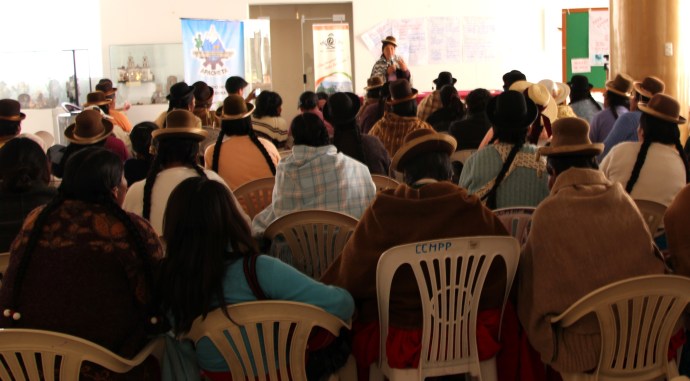
Luckily, this meeting was like no women’s networking session I’d ever attended. For one thing, everyone had the same hairdo. The room was a sea of long black braids, topped by outrageously insouciant hats, tilted just so.

The view inside...

Instead of power pantsuits and hire-me heels, these women were decked out in abundantly colorful, multi-tiered skirts, intricately embroidered vests and spangled blazers. And while listening intently, almost every woman was simultaneously knitting or crocheting– hence getting a lot accomplished. I loved it!

The softest alpaca goods -- so beautiful!

The women were there to celebrate Heifer’s FEED project, in existence for 4 years with a mission to improve food security, nutrition and income, and encourage women in eight Puno rural communities to produce and collectively sell their handicrafts.

Like many of Heifer Peru’s projects, the FEED program is aligned with a local organization called APACHETA, The Center of Andean Development (obviously, Peruvians are as acronym-crazed as we are). While Heifer guides, funds and monitors APACHETA’s activities with 700 Peruvian women and their families, the leader of that organization is Cleida Incacutipa, a formidable 6-foot tall woman who used to work for Heifer but is now boots-on-the-ground in APACHETA’s drive to improve the lives of Puno women in ways both simple and complex.

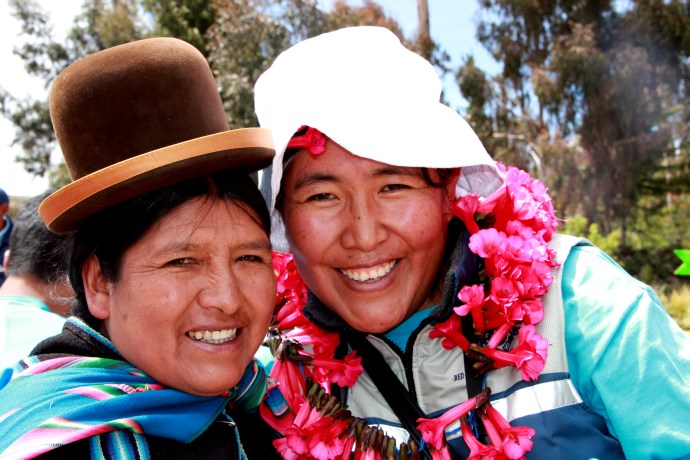
Candida Canaza & the incomparable Cleida Incacutipa

The “simple” part is giving women the animals and the trainings to improve their families’ nutrition and income – teaching them how to grow more potatoes, breed the animals for income, and produce more high-quality handicrafts. More complex is developing leadership capabilities in these women farmers, training them to advocate for themselves in their households, neighborhoods, and local governments. To say Cleida has a gift for this kind of work is an understatement: she knows every woman’s name and personal history, she’s hugely dedicated, and she believes passionately in their capacity to achieve.

Three local leaders: Lidia Quiroz, Felipina Apaza & Elisabeth Ticona ...power to spare!

In a world where women are often not allowed to attend or speak in their local village meetings (not to mention their own households), Heifer’s gender equity sessions represent nothing less than a quiet revolution. From dealing with domestic violence to organizing a Congress of Female Farmers to running for local office, these women graduates of the gender workshops are taking the empowerment ball and running with it – especially the three fabulous rabble-rousers I sat down and talked to, while their friends were busy displaying their award-winning handicrafts on hilariously Caucasian manikins.

The women spoke again and again of the life-altering discovery that “I have a voice.” Once they truly embraced that, it was natural to begin to ask for things for themselves: workshops and looms to improve their community handicrafts, municipal help to support their entrepreneurial efforts, and always, in the Heifer way, offering to share knowledge and decision-making with other women to lift them up, too.

“In the past we were asleep,” says impish Felipina. “And then we woke up. We are new women now.” 

At the end of the long afternoon, I woke up to the shopping opportunities at hand, bought some beautiful hats, and got hugged about a million times around the neck. It was just about my favorite meeting ever.

Categories: Heifer International, Peru, Photography, Poverty, Travel, Women | Tags: , , , , , , , , , , , , , | 30 Comments

Bienvenidos a Peru!

Heading across Lake Titicaca

First, a bit of a disclaimer: this is your unapologetically turistica introduction to the beautiful land of Peru!

Right now I don’t quite have the perspective or internet bandwidth to post about all the deeply moving stories I’ve experienced so far in this amazing country. So I’m just going to give you the view from 15,000 feet .. which is approximately how high I am today in Pasco City, the highest city in Peru. (And yes, that is the sound of my heart pounding, trying to pump oxygen to my brain.)

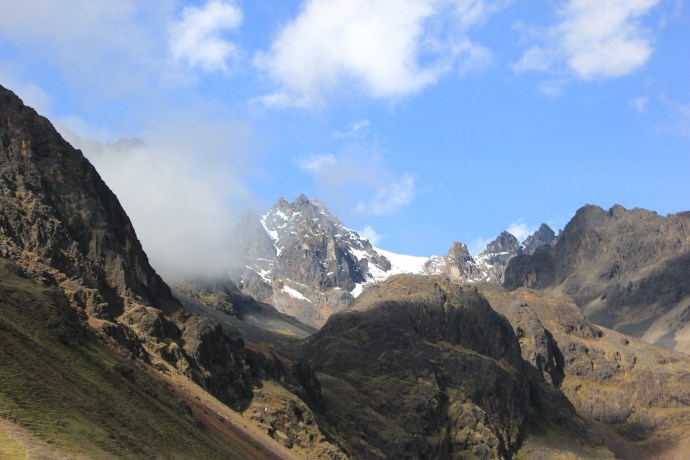
Peru is severely beautiful .. with miles of ocean shoreline and the Andes (sierra) and the jungle (selva). It’s bordered by Ecuador, Colombia, Brazil, Bolivia, and Chile and is packed with silver, gold, copper and zinc – making it well-nigh irresistible to mining interests that never saw a mountain they didn’t want to level.

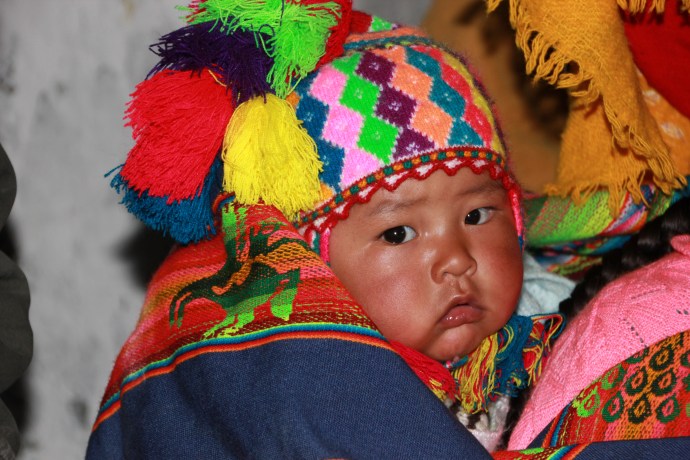
Although the country’s economy has improved dramatically over the past decade, the indigenous people in the Highlands (where Heifer does most of its work) are still overwhelmingly poor, ferociously independent, and definitely know how to rock a hat.  

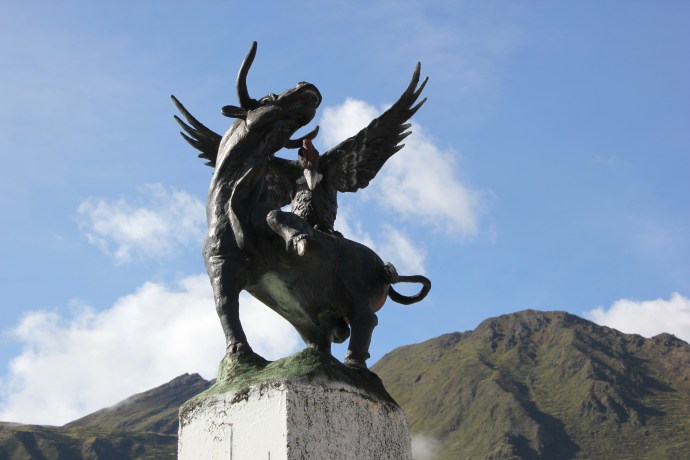
In the center of Marcopata, we saw a statue that pretty much captures the Highland spirit. The bull represents the Spaniards who colonized Peru. The condor tied to its back is the indigenous people, who claw and fight to be released from bondage – literally drawing blood.

These proud descendants of the Inca Empire are going to need every shred of that irrepressible spirit today to resist the triple threat of mining companies, urbanization, and climate change. Almost one-third of the country’s 30 million inhabitants now lives in Lima, yet you know it must kill something inside these proud people to leave their mountains and ancient traditions to descend to the arid pull of the city.

Heifer’s projects are mostly in the high central plateau, where it is developing programs that support the Highlanders’ traditional pursuits of raising alpaca and llama, growing potatoes, and making handicrafts – working with communities to make these pursuits economically viable, entrepreneurial, and sustainable.

Which means that more children can grow up with a future in the countryside they love, and preserve the land and traditions that are under siege. 

I can’t wait to share those stories… just as soon as I can breathe properly again. It’s gonna be epic!

Categories: Agriculture, Animals, Heifer International, Hunger, Peru, Photography, Poverty, Travel | Tags: , , , , , , , , , , , , , , | 20 Comments

A fishful of dollars.

Every last tilapia is precious.

Valentin Abe

What you don’t know about tilapia could fill a hatchery. Trust me on this.

When I went to Valentin Abe’s new, solar-powered, mega-cool Caribbean Harvest hatchery in the Central Plateau of Haiti, I was taking notes as fast as my fat little digits could write, and I still only got half of everything this awesome guy from the Ivory Coast (and Fulbright scholar at Auburn University… and one of Time‘s 100 most influential people in the world) told us about how farm fishing can transform the lives of the poor.

Brooders brooding.

Tilapia farming starts with a bunch of brooders (doesn’t everything??) – whose genetic lineage can be traced back to the Nile. With oxygen pumped through the water that is sourced from the nearby river (filtered and cleansed), the brooders can breed at 4 months and will reproduce every six weeks (as long as you remove the baby fish so the mommies aren’t distracted).  The female lays her eggs, the male fertilizes them, then mom incubates the eggs in her mouth (up to 2000 of them) for 4 days, then releases them, although they are still transparent and can’t be seen.

Little ones (tens of thousands of 'em)

Tilapia like togetherness: 600/cubic meter.

At 7 days of age, however, the babies become visible and instinctively head for the sides of the tank – where they can be removed with a fine mesh net in the cool of the early morning or late afternoon. The babies will then be transferred to separate tanks that hold 20,000 fish each, where they are fed, oxygenated and grown to 1/2″ long in about a month. At this point, the “fingerlings” are transferred in oxygenated plastic bags to nearby Lake Peligre where they are kept in cages owned by individual fishermen who will feed them three times a day for about 4 months.

When these babies get to be a pound apiece, each fishermen can sell his crop of 2000 tilapia for $2.40/pound (with $1.10 of that going to  expenses) — for a profit of about $2500 per harvest. And that, my friend, is the beautiful rainbow at the end of this long tilapia road.  It’s why Clinton Global Initiative has invested hundreds of thousands of dollars in the hatchery, Partners in Health is ordering all the tilapia for its brand-new hospital in Mirebalais from Caribbean Harvest farmers, Solar Electric Light Fund has installed the beautifully reliable, sophisticated solar system, and Heifer International is donating the $450 cages to Peligre fishermen.

Beautiful Lake Peligre

Because once this operation gets up and running (it just came on line last month), it has the potential to produce 40,000 fingerlings a month —  which would be a game-changer for the poor communities around Lake Peligre and the surrounding Central Plateau.Despite the fact that this is an island, Haitians eat only 4.4 pounds of fish a year (contrasted to the global average of 35 pounds) and the country imports $26 million of cod annually from Taiwan. The beauty of farming tilapia locally is that while it improves the protein-starved diet of Haitians, it also provides an income to farmers and fisherman living around the lake — and supports the schools in villages like Sylguerre that we were lucky enough to visit with Valentin Abe to see the school and witness tilapia farming in action.

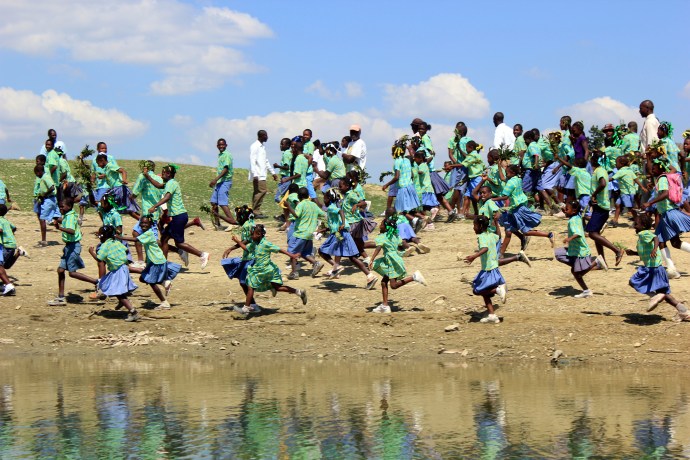
The schoolchildren were all waiting for us to dock ..over there.

Quick ... over here!

We can beat that stupid boat...

And we're all over here now .. Welcome!

Around the lake, 8 destitute schools with no government support are struggling to survive –with the help of Partners in Health and two teachers leading the Community Action for Education and Development around Lake Peligre(ACEDLP). Tilapia farming is an idea that can be scaled up quickly, produce sustainable profits, and enable the people to support their schools and get their children a good education.

"Now I don't have to choose which of my children I send to school."

The plan is for each fisherman to receive one free gift of 2000 tilapia fingerlings from Caribbean Harvest (and its sponsors) and a cage from Heifer International. After harvest, he will reinvest part of his proceeds in another crop of fingerlings, and then on the third harvest, put aside money to pass along the gift of a new cage to another farmer (Valentin estimates each farmer can harvest 3 crops of tilapia a year.)

There are still some kinks to be worked out: Abe found that 1/2″ tilapia babies survive better than the 2″ older ones during transfer, and the farmers have to perfect their feeding and distribution to prevent the fingerlings from perishing and get them to market while they’re fresh. But the potential is totally there for a sea change in the fishing industry of Haiti … with the beautiful Lake Peligre children on the line.

I’m in!

Categories: Haiti, Heifer International, Hunger, Photography, Poverty, Travel | Tags: , , , , , , , , , , | 37 Comments

Blog at WordPress.com.