Farming

What’s the Buzz?

Photo used by permission from Maciej Czyzewski.

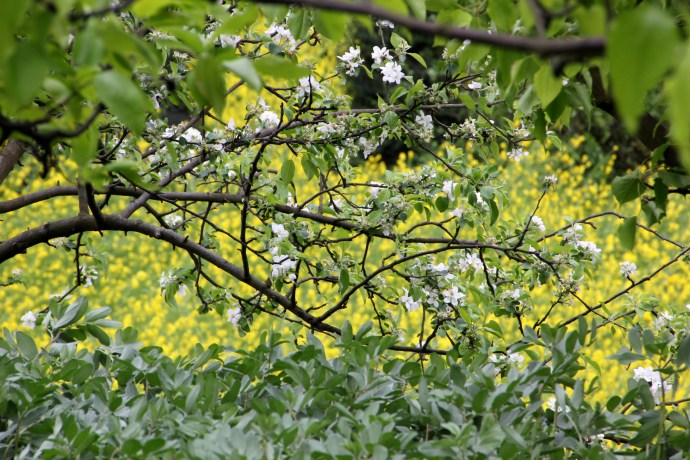
If I were a (queen) bee, I can tell you where I’d be hiving out: in the lush, green highlands around Vrancioaia, Romania.

Photo used by permission from Jon Sullivan

First of all, the place is packed with orchards of apples, plums, pears, huckleberries and wild cherries, flowers, acacia trees, and … yeah, pollen. Second, the people here know how to work with bees since there is a long rural tradition of beekeeping. And finally, since Heifer International has started a Sheep Bees & Trees Project to help support struggling farmers in the area, there’d be a million other bees around to adore me.

I love bees. Of all the animals that Heifer gives away, I’m probably most intrigued by these creatures, because they have the most complex social behavior of almost any species on earth (except the species that deep-fries Snickers, holds beauty pageants, and develops hedge funds).

So when we got the opportunity to visit bee charmer Claudia Vatra in Vrancioaia (see map), I was totally jazzed. Claudia started her hives with some intense training and 1,000 bees from Heifer, (supplemented by Google notes from her university-going daughters), and she now has 5 hives but is aiming to cultivate 30.

Each hive produces 15-25 liters of honey a year, depending on the weather (bees don’t like it too rainy, as it washes away all the good pollen), and she sells her honey locally for about $5 a liter. According to Claudia, once you’ve established the hive, it doesn’t take more than a few hours a day to check on the baby bees, smoke the hive to kill viruses if the bees are getting sick, and put in supplements to help the bees grow.
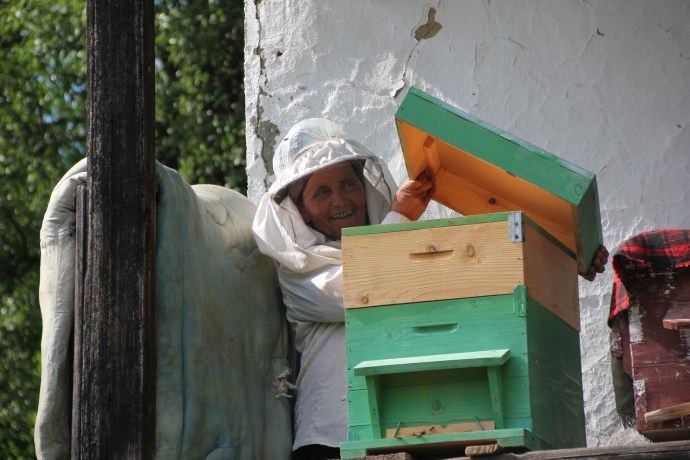
Claudia harvests her honey three times a year: once after the acacia trees bloom, once after the linden (lime) trees bloom, and the last after the flowers bloom. When I asked how bees make honey, things got a bit more complicated.
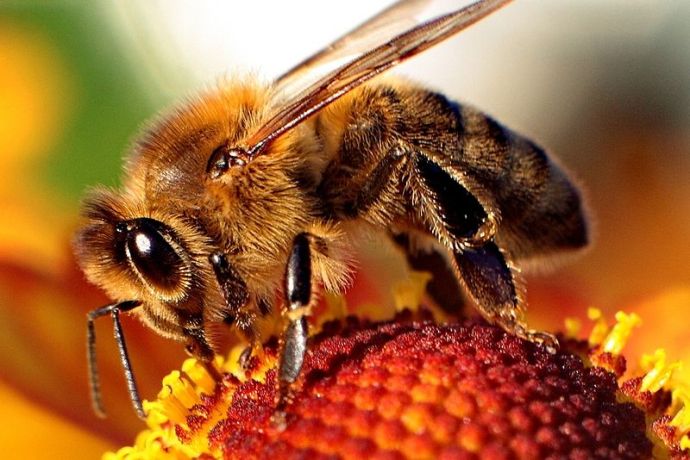
Apparently, the hive consists of 7 classifications of bees but generally they break down to queens, who produce eggs (2,000 a day, every spring) after having orgiastic sex with a passel of drones… drones who are males without stingers and who die after mating… and worker bees who are non-reproducing females that live a few short weeks and do all the real work.

For the first 10 days of their lives, the female worker bees clean the hive and feed the larvae. After this, they begin building comb cells. On days 16 through 20, a worker receives nectar and pollen from older workers and stores it. After the 20th day, a worker leaves the hive and spends the remainder of its life as a forager. The population of a healthy hive in mid-summer can average between 40,000 and 80,000 bees who go find the nectar, come back and dance vigorously to tell the other workers where the nectar is, collect the nectar and chew it up with an enzyme, then place the resulting honey in the comb.” (Wikipedia)

What they’re after …

Although there is only one queen per hive, new virgin queens develop in comb cells as a backup replacement, but Claudia told me the queen stings all her daughters to death before they can become a threat. Then when she gets too old, the whole hive stings her to death and crowns a new queen. Wow, makes Wall Street look like Mayberry!

Claudia instructing Laura in bee lore.

I was actually afraid to get too close to the hives and all that mother/daughter conflict, so Heifer’s trusty Laura Manciu crept in and took the close-ups. Claudia then took us inside her real house, treated us to some cherry bounce (I suspect alcohol is what gives it its bounce), and insisted we take home some of her gorgeous Romanian honey. No problemmo!

Claudia has already trained and passed along three hives full of bees to her neighbors, plans to learn how to harvest the lucrative bee pollen, and is collecting the beeswax for candles. At the age of 52, she is a font of energy and full of plans for her bees: exactly the outcome Heifer desired, since beekeeping is perfect for older farmers who can’t keep up with the physical demands of regular farming (although Claudia and Ion are still doing that as well).

The real queen bee!

And luckily, Vrancioaia will continue to be a sweet spot for honey-making. Heifer has donated 162,000 acacia trees (acacia honey is the gold standard) to 800 families for reforestation to mitigate the loss of moisture, soil erosion, and provide land stability in this earthquake-prone region. With all the Passing on the Gift requirements, this Sheep Bees & Trees Project will ultimately benefit 1,872 families in this poor rural area.
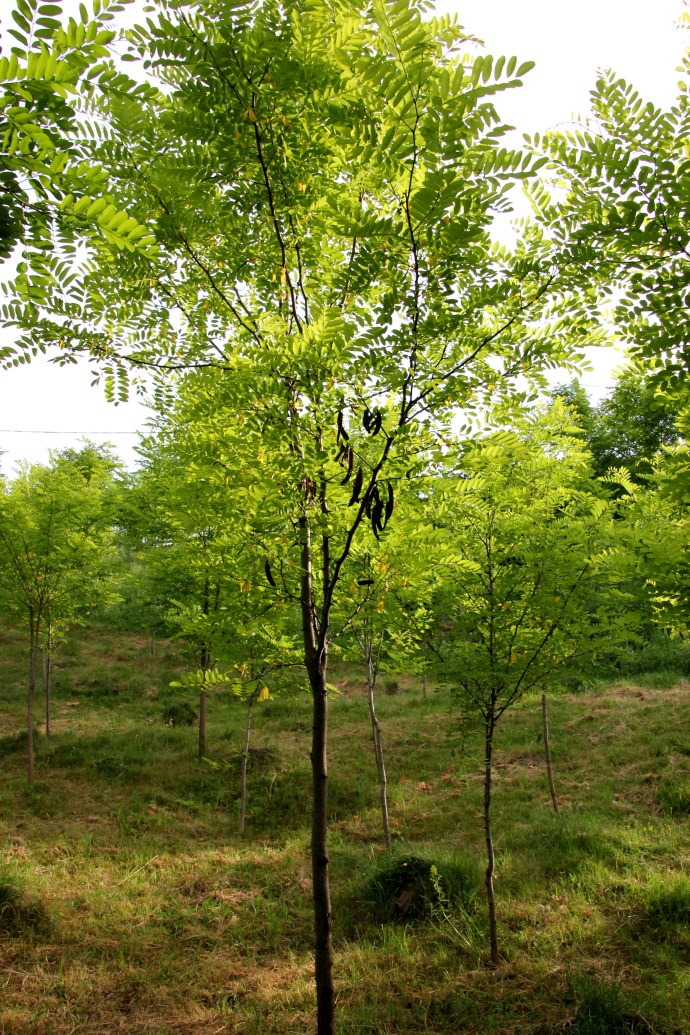
162,000 of these babies were planted on land donated by the local administration.

Having been unnerved by stories about bee colony-collapse and pollinators under peril, I was wildly happy to see this beekeeping project and be able to report back to all my Heifer friends who have bought bees! I’ve also safely hidden my private  stash of Claudia honey from my husband and children – so I don’t have to sting them to death.

Claudia’s (and her bees’) glorious honey.

Sweet!
Categories: Animals, Environment, Farming, Heifer International, Inspiration, Photography, Romania, Travel | Tags: , , , , , , , , , , , , , , , , , , , , , | 16 Comments

A big, hairy tale of survival.

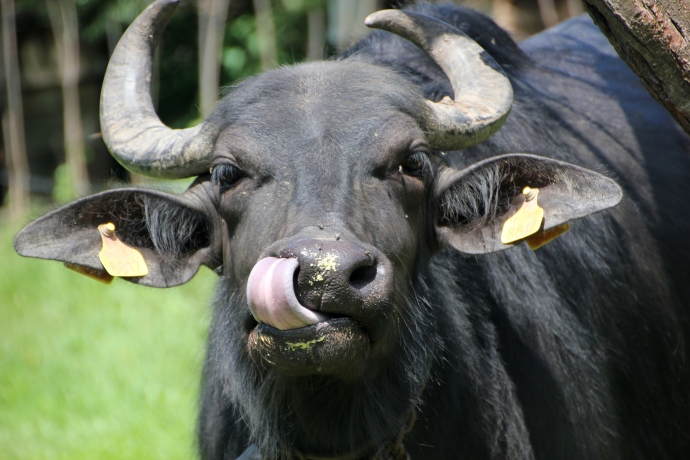
The original WB.

Water buffalo aren’t the only species struggling to make a comeback in the beautiful rolling hills of Aschileu, Transylvania. The 1,841 poor farmers who live in these five verdant villages and were shoved off their lands under Communist rule are also fighting to regain a foothold in the local economy. Now thanks to Heifer’s first water buffalo project in Romania, the two may well help each other over the hump.

At 78, Anna remembers feeding the Germans, then the Russians, then the Communists, then losing her land and all her animals. But now she’s got a new water buffalo to call her own…

Water buffalo have been raised in this area since they were first introduced by the Turks during the Ottoman invasion in the 15th century. Called the “poor man’s cow,” a water buffalo thrives on even poor fodder, rarely gets sick, makes a terrific draft animal, and will produce 5-10 liters/day of very rich, healthy milk that can be made into delicious cheese, sour cream and yogurt. (And Romanians are nuts about dairy.)

However, after the fall of Communism in 1989, farmers were encouraged to raise cows and the numbers of water buffalo dropped perilously by 80%, threatening the breed’s survival. To promote biodiversity, income generation and better nutrition; offer an alternative to strict EU standards that limit the sale of cow’s milk; and encourage peace & understanding between neighbors in the Hungarian Mera village and Romanian Aschileu village, Heifer started the Revitalization of Water Buffalo project last year, giving 36 water buffalo and trainings to needy Romanian families (who will Pass on the Gift to another 36 Hungarian families in Mera).

About half of Ion & Felicia’s children/grandchildren.

One of the first recipients of a water buffalo was Ion, Felicia and their nine children. Ion is one of 10 orphans whose mother died and were then abandoned by their father and left to raise each other in the village. Today, those 10 brothers are mostly illiterate and work as laboring farmers and shepherds, but each has managed to build a home, establish loving families, and amass a brood of livestock. Their self-sufficiency and dignity were palpable, despite how thin and wan Felicia looked ( and raising 9 children and 3 grandchildren, who wouldn’t be?)

Ion & Felicia

As we climbed into the hills in a horse-drawn cart to visit the goats, cows and water buffalo herds that Ion tends on communal pastures, the views became more and more stunning and I felt more and more like I was in some modern version of The Sound of Music.

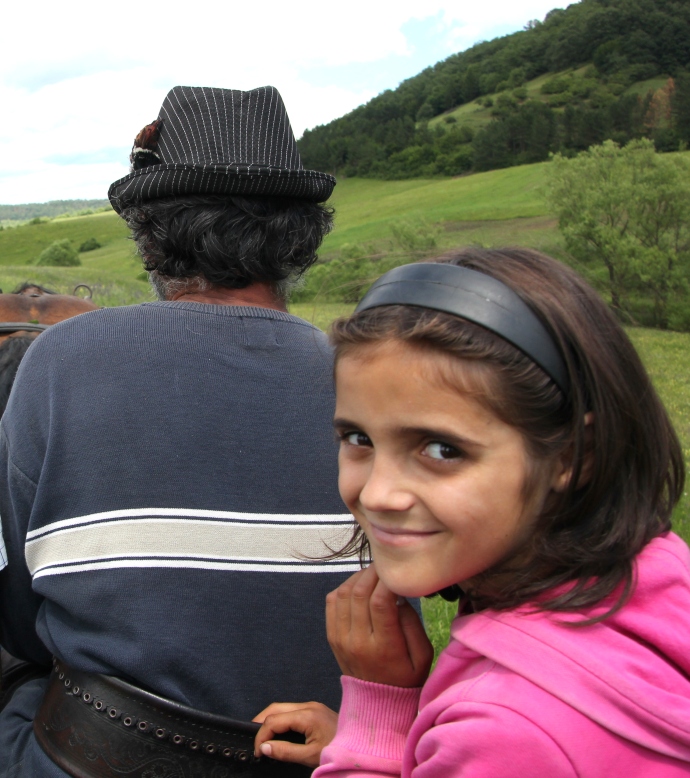
Lordana, Ion’s daughter, kept turning around to grin at me, her fingers tucked into her father’s thickly-tooled shepherd’s belt as we lurched across stream beds, and I kept thinking “What a hard life. What a beautiful life.”

With village milk collection centers and cooling tanks in place, and an ever-increasing demand for high-butterfat, high-protein, low- cholesterol buffalo milk, hopefully life here will become a lot less hard and a lot more healthy.

The lovely Miss Lordana.

And the hills will be alive with the (very loud) sound of water buffalo… once more.

Categories: Animals, Farming, Heifer International, Photography, Poverty, Romania, Travel | Tags: , , , , , , , , , , , , , | 21 Comments

Feeling sheepish in Lepsa.

The day we went to see the sheepfolds of Lepsa, Romania was my favorite day ever (til tomorrow). The impossible-to-spell-or-pronounce region of Vrancioaia is located between the Black Sea and Transylvania, on the junction of two tectonic plates and is prone to earth-quakes, has salty soil from when it used to be under the ocean, and is retouched-calendar-photo perfect.

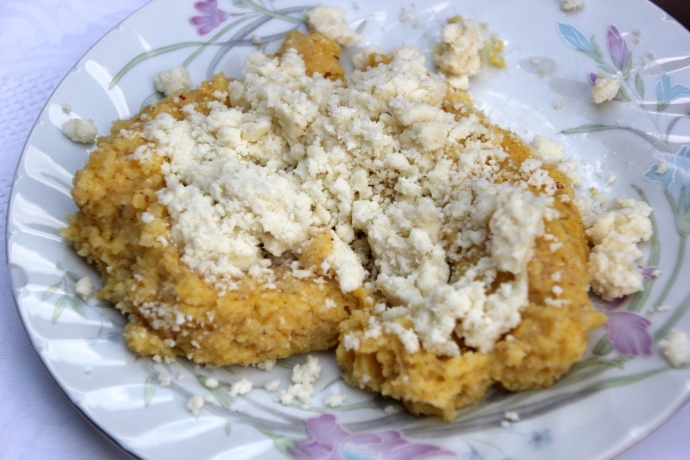
It’s not bread, it’s cottage cheese.

For centuries, this has been sheep-breeding & cheese-making country but with anemic production of the local sheep breed and new cheese standards imposed by the EU (Romania became a member in 2007 and had five years to get up to speed) that traditional way of life is fading fast. People can’t make a living on the farm, and young people are fleeing to Europe and the cities to find jobs.

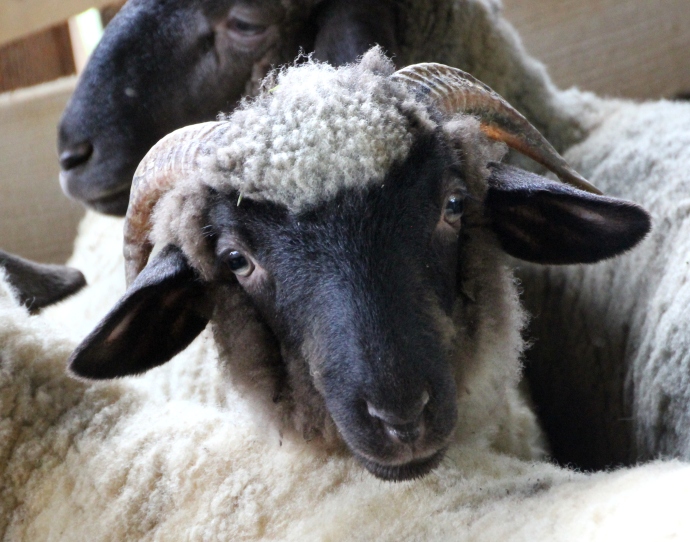
So Heifer and the 2700-member Mountain Farmers Federation have joined forces to help these sheep-breeders transition to a free market economy. The plan is to revitalize the Red-face Tigaia breed with Black-face meat rams and fresh Red-faced ewes … and train farmers to meet new hygienic standards of cheese production.

It sounds good on paper, but you really don’t get it ‘til you see the sheepfold in action — and then it’s like something right out of Laura Ingalls Wilder’s books, complete with hay harvested with scythes and fashioned into fat haystacks that will last through the long, hard winter.

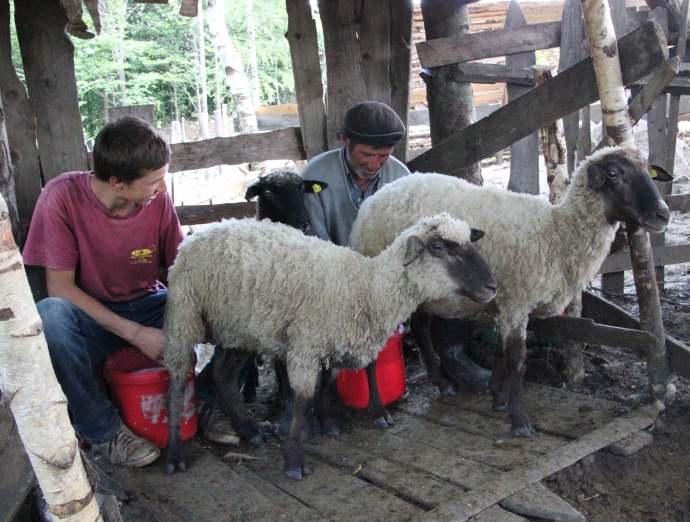
From April til October each year, Ion (John) and Dorica Cobzaru live up in the sheepfold with a few other shepherds and seven big dogs, taking care of their own sheep and 100 of their neighbors’ goats and sheep. They rise at 4:30 am, milk the flock at 6 am, take the herd out to pasture and then make the sheep cheese (there is no electricity to refrigerate the milk so it has to be immediately boiled and made into cheese). The flock will produce 8 kilos of cheese each milking: (at noon and 8 pm), and in between there is hay to be harvested, sheep to be shorn, and animals to be herded and fed. During the night, the shepherds make big fires to keep away wolves, bears and wild boars, the seven dogs sleep around the perimeter of the herd, and John sleeps outside to keep guard against the wily wolves.

For their hours of labor, the shepherds will keep 3 kilos out of every 10 kilos of sheep cheese they make, and middlemen regularly come to the sheepfold on horseback to pick up the freshly made, immensely popular cheese to sell in the local markets.

Chubby little lamb.

With Heifer’s gift of 10 new sheep and 1 new ram to each of 50 families in the valley (plus the support of the local veterinarian and town mayor), the project is producing bigger, fatter lambs that are far more profitable for the farmer. Ewes can get pregnant sometime before their second year and will have 2-3 babies a year for about 8 years. Male lambs are sold at 2-3 months and the fatter and sweeter they are (black-faced lambs are reputedly delicious), the more income they’ll bring to the farmer.

And with that income, the farmers can work together (never use the word “collectively” in post-communist Romania) to improve hygiene standards in making sheep cheese, establish better routes to market for wool, leather, milk and lamb, and make Lepsa a place where a farmer can make a living.

Like a leading man out of a Bernardo Bertolucci movie, John loves the rural life.

John went to Italy three times to work before he decided, “If I’m going to be poor, I might as well be poor in my own country.” His son Adrien, 21, just returned from picking strawberries in Italy and is happy to be back in the fold.

Adrien Cobzaru

With the new sheep from Heifer and a new sense of hope in the valley, maybe all the farmer boys of Lepsa can grow up to be prosperous in their own country.

Categories: Animals, Farming, Heifer International, Photography, Romania, Travel | Tags: , , , , , , , , , , , , , , , , | 23 Comments

Til the cows come home.

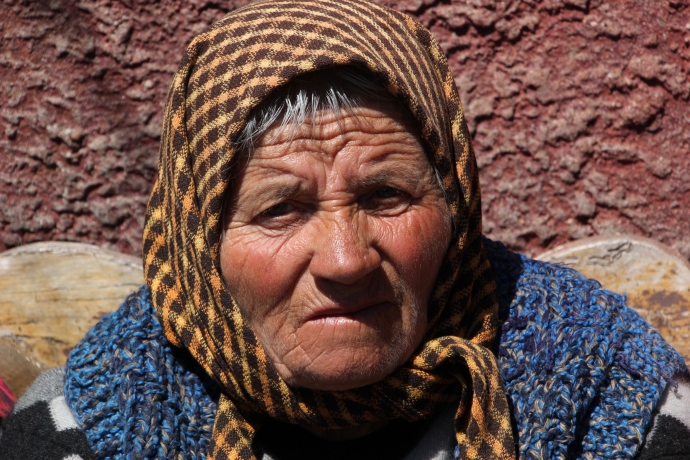
Rural Romania is so beautiful, it can be hard to see the poverty that is staring you right in the face. But make no mistake, it’s there in almost every village; in the orphanages that take in 80,000 to 100,000 abandoned and orphaned children every year; and in the deep lines etched in the faces of farmers who possess a few hectares of land, maybe one horse, a small house, and work like crazy through 5 months of summer to survive the 7 long months of Transylvanian winter, with virtually no way to get ahead or make an income.

Gheorghe Coldea, Rasca farmer.

So Heifer International, Rotary and Bóthar , a wonderful Irish charity working in Eastern Europe and Africa, decided that things would start to change for these Romanian farmers when cows fly… literally.

Now that’s what I call a jetway!

Following the success of their predecessor program, Farmers Feed the Children, Heifer & Bothar established Milk for Orphans and air-lifted into Romania 140 pregnant pure-bred Friesian cows (famous for producing copious amounts of milk and beef). These heifers were distributed to the poorest members of rural communities that lie in the hills around Transylvania’s capital of Cluj-Napoca last November and this May.

Right at home in Rasca.

These farmers will raise the heifers and pass on the first female offspring to another impoverished family. In addition to feeding their own families and having milk to sell for income, the farmers will also provide fresh 300 liters of fresh milk, yogurt, sour cream and cottage cheese to institutionalized orphans and disabled children, whose state food allowance is about $2.50 a day. Ultimately, the program will benefit more than 1,000 children every year.

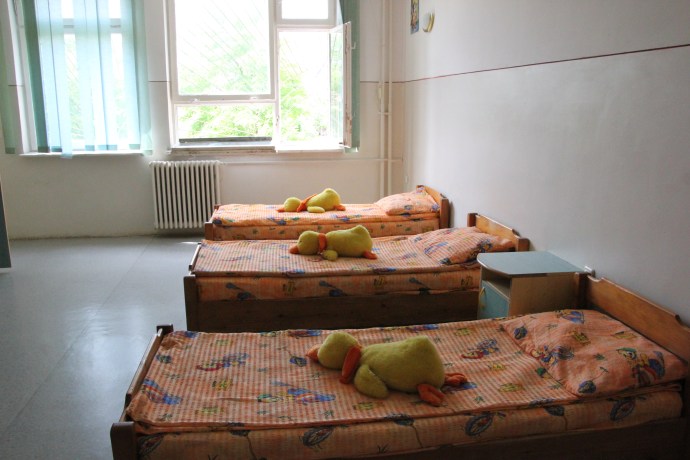
An orphanage for disabled children in Cluj.

A rare picture of Gina indoors.

What a beautiful program to witness in action! In the village of Rasca, Gina Rosu  (one of 14 children raised in abject poverty) had big plans for her mama heifer and baby calf, and was using the milk income (Friesian cows produce about 20 liters of milk a day, compared to local cows’ 10 liters) to buy piglets, build a new concrete pig sty, and establish other sources of income.

Gina and her husband are unemployed but very hard-working  and totally focused on giving their two children a far better educational future than they had. (Though Gina has only an 8th grade education, she’s managed to teach herself English and Spanish.) And just like American parents, they are struggling with the teenage angst of their artistic daughter Anca, for whom they don’t have money to buy paints, and the high energy antics of son Johnny who’s a musician like his dad.

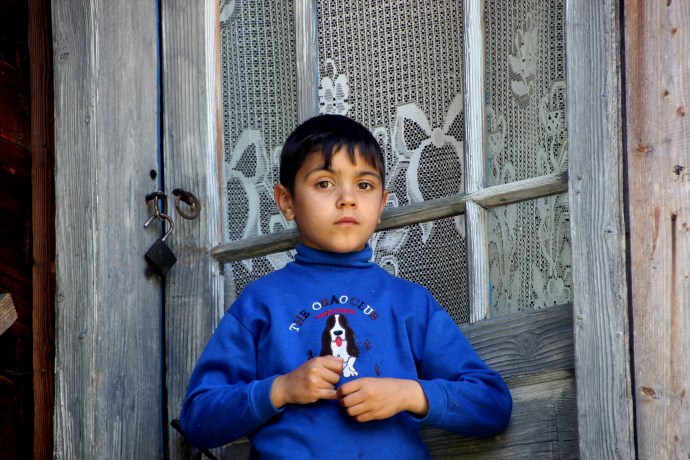
The real beneficiary of Gina’s heifer: young Johnny Rosu.

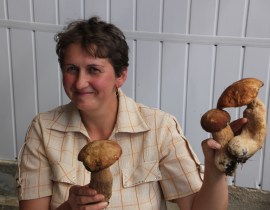
Angela and her amazing boletus mushrooms.

Angela is Rasca’s  Milk for Orphans community leader and her house and barns are spotless; clearly, she has a gift with cows and her home is the milk collection center for the village. She also buys the boletus mushrooms and arnica that everyone hunts in the hills surrounding the village to sell in the Cluj market. With Olimpio, community leader and Heifer-trained animal health worker, Angela is the go-to person for help with any animal issues in the village. In fact, while we were visiting, Olimpio got five calls for artificial insemination. (Once a cow secretes the fluid that tells you she’s in the mood, you have 8-10 hours to get her the goods. Clearly, we were like Michael Bolton for the female cows of Rasca.)

While clouds piled up in the Rasca sky, and Olimpio went to work making the way for more cute heifers, we went to visit the last family of 25-year old Lenuta and her husband Adrian.  They were the poorest couple we saw in Rasca.

Lenuta has a severe hearing problem and all the money from last year’s hay crop had been spent getting her a proper hearing aid so she could hear the voices of her children Natalia and Darius.

Natalia, Lenuta’s mom and baby Darius.

The family lives in a one-room house on Lenuta’s father’s land, but luckily their Irish cow had given birth to a female calf (that would be passed on) and Darius was flourishing on all the fresh milk.

Natalia and the new baby heifer.

In the one tidy room the family lived in, Lenuta laid out a lovely, modest meal for us but I was ashamed to eat their precious food, despite being touched by their hospitality. Everywhere we went in Romania, we were lavished with food – which made me realize how important it was to ask the beneficiary farmers to help feed the orphans. Allowing a poor recipient to become a generous donor is a transformative act of dignity and a powerful demonstration of competence.

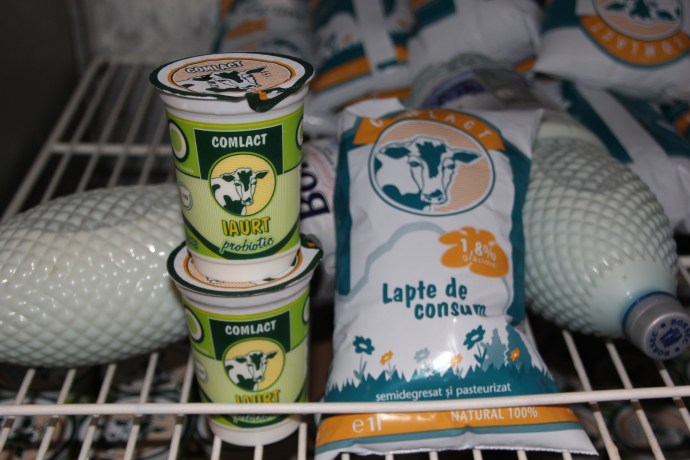
The refrigerator of the orphanage, packed with the bounty of Irish bovines and their farmer-owners.

And you can milk that for all its worth.

Categories: Animals, Farming, Food, Heifer International, Photography, Romania, Travel | Tags: , , , , , , , , , , , , | 19 Comments

Farewell, my lovely …

The new breed … smarter, better, prettier!

My last two days in China were spent visiting Heifer International projects in Jingu and Fuxing Village … towns that were hit hard by the disastrous 7.8 earthquake that tore a path of destruction 500 kilometers through the heart of Sichuan province on May 12, 2008. These rural communities raised livestock and fruit, but inside the collapsing barns and houses most of the livestock were killed – along with 68,000 people.

The rebuilding of the Earthquake- Affected area by the Chinese government has been intense, but the Lizhou Poverty Alleviation Bureau chose to work with Heifer for livestock replacement because of its reputation for long-term results. (Or as the Heifer China staff humbly told me, “Our strict standards, high expectations of our farmers, and precise reporting of results make us challenging to work with. But I think we got chosen because we have a reputation for changing people, communities, and the government entities we work with for good.”)

Yang Shengxue, a master breeder & his wife Wuchang Lian in their newly renovated pig barn in Jingu.

The project started in March 2010  in the two villages (and six neighboring communities) with the establishment of 26 Self Help Groups consisting of about 20 families each. They met weekly to begin trainings in animal husbandry; breeding; group savings; animal barn improvement; Heifer concepts like the 12 Cornerstones in cooperation, sharing and gender equality; and value chain marketing.

Only then—after six months’ work – did the 505 families in Lizhou receive their animals. Some chose chickens, some pigs – depending on the land they had to raise crops and the labor required. But by the end of 2011, those original 505 families had recruited 505 more families to form new SHGs, passed on their trainings, and are getting ready to pass on the gift of animals in June of this year.

A captivating local pig!

And what a gift!! The pigs, in particular, are beauties.

The new breed of sows provided by Heifer are more shapely than the local stock (these are the words of the villagers, but I’m not taking sides as I kind of got attached to the local babe on your left), they grow heavier faster with more meat and less fat, and when they do reproduce, the sows have 13-16 babies in a litter. Unfortunately, there have been some fertility issues with the new breed and Heifer vet techs are working to encourage the farmers to feed the sows carefully with only raw food, give vaccinations, and keep their barns clean and hygienic to promote pregnancy.

Oh, Mama!

One of the indomitable ladies of Fuxing.

In Fuxing I met with the only all-women’s Self Help Group, as most of the men have left to work in the city, their teenagers are away at boarding school, and the women have been left behind to farm and raise animals.

Organic forage is best.

Communally, the women can support one another, meeting once a week to share their stories, discuss animal problems (for instance, when a pig develops a weak hind leg, you don’t just wait for it to die, you treat it with meds and stop feeding it so much protein and no cooked food…good to know!!). The women also work together to maintain the new road into town, clean the village, and build reservoirs to harvest water to get them through the 2-month drought period when they used to have to carry water up to the fields in buckets.

The villages are beautiful – blanketed with yellow fields of rapeseed (for oil), orchards, and neat fields, but the women have despaired of their children moving back here. “Emotionally we want them to come back, but financially, we know they can’t survive here. Our children can’t get used to the hard farm work we do or handle the risk of a failed crop or lost animals.”

“They’ll have an easier, better life in the city,” another mother says.

… I’ll be waiting …

I ask the mothers if they want to move to the city and they laugh and say in unison, “Never. It’s hard here but we can’t get used to the air and the noise in the city. Maybe things will get better someday and our children will come back to the farm.”

I’ll leave you with this haunting song from the women of Fuxing (sorry it’s dark but we were inside by a fire)!

Next stop… Nepal!!

Categories: Agriculture, Animals, China, Farming, Heifer International, Photography, Travel, Women | Tags: , , , , , , , , , , , | 10 Comments

Blog at WordPress.com.