In 1976, Pream Sui was 19 years old, living in Anlong Sar, Cambodia under the Khmer Rouge. Because she was one of the “old people” –uneducated rural villagers who weren’t a threat—she wasn’t killed but placed in a youth group working in the fields. One of the guards noticed her, decided he wanted her for his own, and married her.
The “wedding” took place at the end of a workday with 12 other couples composed of guards and the village girls they’d chosen. The girls had no idea whom they were marrying but dared not refuse their captors. The ceremony lasted less than 5 minutes.
After her marriage, Sui continued to work in the fields, under the gun of her husband, but like all the other “wives,” she went to his cabin at night. In short order, she had 2 children but when Vietnam invaded Cambodia to drive out Pol Pot, her husband disappeared into the resistance and moved away. He came back a few times to visit Sui and the children, but by then he had another wife and when Sui got pregnant with her third baby, he left for good.
Now a happy grandmother, Sui’s bad memories are in the past.
To be a woman in Cambodia in the countryside raising three children alone was shameful and indescribably hard. “It’s difficult to tell you how I felt because I cried every day,” Sui says with an incongruous big smile. Somehow, she managed to farm her 3 hectares of land, raise her three children, marry off two daughters (and pay for the weddings) and is now a happy grandmother living with her eldest daughter, Chen Soueb.
“Now I appreciate all my mother’s hard work and the strength it took to raise us,” Soueb says.
Caught between poverty & family.
Soueb, 30, has four children—12, 11, 10 and 7 –and a story of abandonment of her own. About 4 years ago, her husband Heng Ha began illegally immigrating to nearby Thailand, like 75% of all the men in Anlong Sar village, Banteay Meanchey province. Disastrous floods had ruined the rice crop and drowned most of the animals, and the village men were desperate for an income. Ha decided to risk illegally going over the border to earn money working construction.
It takes 1 ½ days to make the trip into Thailand from Banteay, working through an underground network to avoid capture and getting thrown into a detention center. Once in Thailand, Ha had no way to contact his family and could only send money home through a money train that skimmed off 25%. Ha made his way home just twice a year, and every trip was laden with the risk of being thrown in jail. Soueb gave birth to her fourth child while Ha was in Thailand, and she feared that he would never come home – much like her own dad.
So when Soeub encountered Heifer’s “Community Empowerment Program” in her village – and attended the Family Focus cornerstone training with Ha– the couple figured that if they worked very hard at home, maybe they could make it together as a family.
Together at last – Ha & Soueb & their children.
For two years now, Ha has stayed home with the family and they’ve managed to make the same amount of money as when he worked in Thailand. Despite the devastating floods of last year, the 2 pigs they received from Heifer in 2011 have reproduced and provided them with income. They attended all Heifer’s animal husbandry courses and are also raising ducks and chickens, growing rice and grasses for income and feed, eating from their home garden, and most importantly, staying together.
Heifer’s impact in the whole village of Anlong Sar has been profound: increasing the number of home latrines from 10% to over 90%; boosting family income by 30%; improving food security with animals and home gardens; decreasing the incidence of malaria by 80%; and building solidarity among these women who are so warm and affectionate, they competed to hold my hand the entire time I was there (how much did I love that??)
Women from one of the four Self-Help Groups in Anlong Sar village with KK, Heifer’s country director.
Devoted teacher Eath Korm.
I saw more evidence of the strength of the community when we met Eath Korm, a disabled 21-year old who loved school but was denied entrance past middle school because his parents couldn’t manage the transportation (Korm can’t walk). However, a member of Anlong Sar’s Self-Help Group knew of Korm’s desire to teach and encouraged him to set up a tutorial service – and with the help of Heifer’s curriculum guides, literacy packets and Teaching Technology courses (the town has no books for the children to read, so they practice with the literacy handbooks), Korm is now tutoring an after-school class of 20 enthusiastic kids.
It’s a tiny village, Anlong Sar. There’s a long way to go before there is real literacy or decent education here, and the government hasn’t made much headway in meeting its responsibilities to these poor provinces. And yet … when you see darling Soueb and her family, or Korm on crutches before his eager students in the classroom, it’s hard not to see this as a leap forward in hope.
On my first day in Cambodia, we traveled to Battambang Province (loved saying that word) in the northwest region of the country. Except for the low bottom land that was almost entirely under water, everything in Battambang was high: poverty, illiteracy, HIV/AIDS, domestic violence, child malnutrition – as well as somehow, miraculously, the spirits of the women in Roka Village.
Heiferstarted a project here in October, 2009 with 9 self-help groups for women, and these ladies got right down to business. In a mere two years, they received 175 pigs, 1503 poultry, 5100 fingerling fish and 710 trees. They formed a project management committee and began saving funds ($5,641 to date.) And they inspired 8 more Self Help Groups to form in the community, passed on two generations of animals to other women, and increased women’s average income from 7000 R/day (less than $2) to 12,000 (that’s a whopping 70% bump).
2 chubby Roka pigs, waiting to be Passed On to another needy family.
Along the way, Heifer’s Roka project gave women like Chou Sarom a whole new lease on life – and that’s not mere quackery. In the neat house she shares with another family, in the shadow of a pagoda, Chou and her husband and four children (ages 24, 22, 21 and 10) have become duck raisers extraordinaire. Two years ago, Chou joined the group and received 12 ducks from a Self Help Group in another village. She’d never raised ducks (it’s more of a Vietnamese custom) but was determined to learn.
“I wanted to develop myself and become more independent,” Chou says, “so I went to all the trainings with our Community Animal Health Worker – and brought my whole family with me. “(Heifer trains four CAHW, one from each village to teach animal husbandry to the participants.)
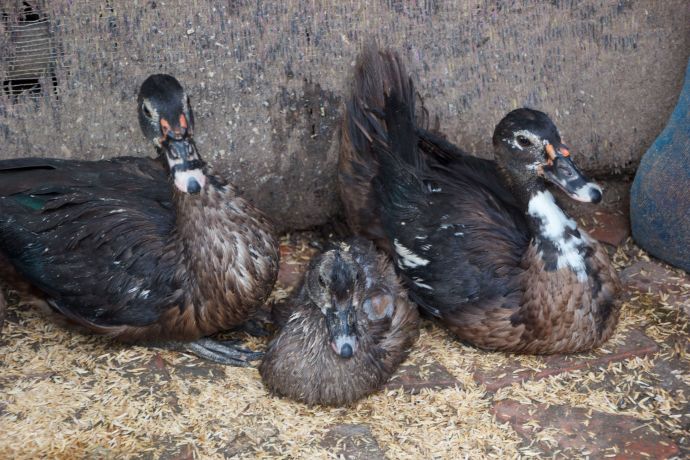
Chou and her children quickly learned the tricks of the duck trade: how to bring males and females quickly together–then separate them for optimal egg-laying. How to make a nice clean nest with rice husks. What ducks love to eat.. banana skins and rice bran. And how to keep the ducks nice, fat and clean, as Chou put it.
“I’m so happy that my ducks are really healthy, I sometimes just stand there and admire them,” Chou laughs. “My young son doesn’t even want to sell our ducks, they’re so cute – and if somebody buys them and doesn’t take care of them, he’ll go to their houses and tell them how to take better care of them.”
From her original gift of 12 ducks, Chou has passed on 12, sold thousands of eggs, and raised hundreds of ducks, chickens and guinea fowl – which she’s delighted to report lay 40 eggs after mating. The ducklings can be raised as fattening ducks (a 4-kilo male will bring $2.50) or the eggs can be sold for about 12 cents each, and Chou sells almost 200 eggs a month. (“I make income almost every day!” she says proudly.) Her husband, who also helps raise the ducks, wants to expand the business so right now they are building a bigger home for their duck brood.
Chou and her brood.
To say Chou is happy and proud of her capabilities is a serious understatement. She’s taken all the trainings to heart, and loves to talk about her achievements, tugging us into her home garden to admire her organic produce and fruit trees (she’s done a market analysis and is planting the most desirable mango), telling us that her son has followed her saving example and learned to save from the small allowance she’s given him – but he saves twice as much as she suggested so his nest egg has really grown. And most importantly, how hopeful she is for the future.
“I used to worry that there was no future here – but now I have one child who has finished university, I know I can make money, and I see all the neighbors working together.”
I saw that, too.
It looks small but it feels huge!
As we were leaving Roka, we stopped at the new women’s cooperative that the Self-Help Groups have built with their own savings. Here, members can buy seeds and fertilizer at far lower prices, aggregate their buying/selling power, and practice solidarity with other women farmers. The women were building the whole structure themselves but still had to raise $100 to finish the concrete floor. KK, Heifer’s country director, and I donated $50 – and their joy was so great, you would have thought we’d given a million.
The beautiful face of determination: lovely Son Sinath of the Roka Agricultural Women’s Cooperative.*
If you could have seen the enthusiasm, hope and triumph on their faces as we drove away, it was almost as if we had.
* You can read more about Son Sinath’s inspiring story by clicking here.
18 ½ years ago, Constance Bangire was working as a primary school teacher in the town of Masoro, east of Kigali, teaching second grade. She and her husband, who worked as an executive in a nearby mining company, had two young daughters and a baby son at home and two sons, aged 14 and 16, in secondary school. And then the genocide happened.
In those 100 days of horror, Constance’s husband and two sons were murdered. Her house was burned to the ground. And she and 24 genocide survivors took refuge in the school where she’d taught children to do their letters and color happy pictures.
The orphans’ records in the boulangerie.
I’m not sure what I would have done under those circumstances (my mind won’t even go there), but I’m fairly certain I wouldn’t have done what Constance did. Once the school reopened, she and 7 other women survivors decided to share their teaching salaries with other widows and orphans of the genocide, who literally had nothing to sustain themselves or their families—no homes, no livestock, no food.
Orphans waiting for bread outside the boulangerie in Masoro.
Each woman contributed $30/month to that fund and Constance came up with the idea of getting local women to make tablecloths and dresses they could sell. Then she went to the Minister of the Family and asked for goats and sheep to replace the slaughtered livestock, and she started writing proposals to international donor organizations, hoping they might support her efforts.
Genocide survivor, sewing since 1996…
In 1995, the Swiss-Italian NGO Insieme Per La Pace stepped in to help and L’Association Dushyigikirane was born. In its first 4 years, Constance focused on helping genocide survivors, but then she said she started feeling bad about only helping people from her tribe. “I received some trainings, I went to my Catholic church, I prayed a lot, and I learned to forgive.”
Orphan girls waiting for bread.
“Everyone was having problems, not just the survivors. All the animals had been killed, our bananas were taken, our land and crops were gone, and our husbands were either dead or in prison.”
“Before the genocide, Hutus and Tutsis were always together. But afterwards, people feared each other and were scared to be together. So I just brought them in the same room to work.”
Today, Constance’s organization employs almost 100 people (mostly women) and has built most of the town’s center.
The pretty new community center of Masoro.
There’s a thriving village bank that provides microfinance loans at 2% interest; new meeting hall; a boulangerie that distributes 2 loaves of bread twice a week to 961 orphans and pays their school fees with sales of its delicious corn cakes; a dress-making operation; local handicrafts cooperative; retail store; tilapia fish pond; fabric shop; sugar cane café; apiculture co-op; classes in literacy, finance, and adult education; a home-building project for 67 homeless people; basic provisions supplied to 82 old people – and of course, a Heifer project.
Once Constance heard in 2004 that Heifer might give her neighbors cows, she was on it. Because her local organization was so strong, L’Association Dushyigikirane received 32 cows over the past few years, and will be getting 36 additional pregnant heifers before the end of the year.
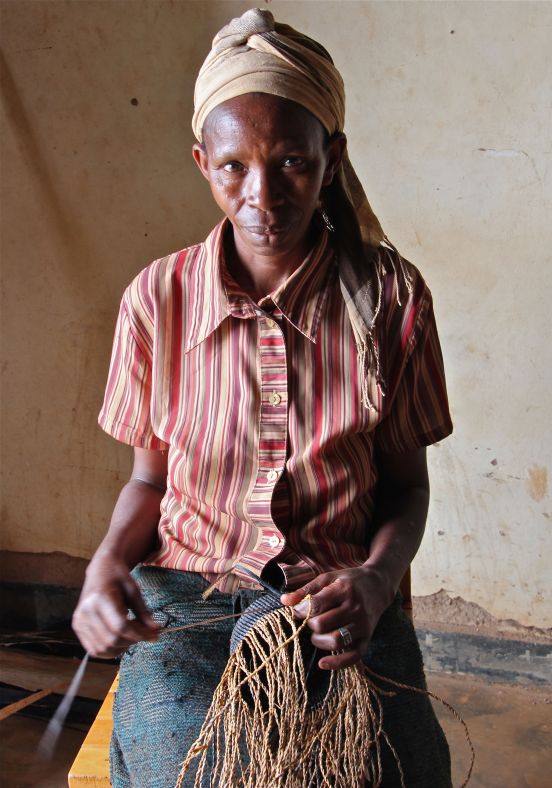
Agnes Akayezu has been working with Constance’s handicrafts organization for 10 years.
A Heifer-paid vet works with the village, as does an animal health care worker, to keep the animals healthy and producing milk. Constance is a big fan of Heifer but thinks her village should be getting a lot more animals. I’d be the last one to disagree.
Gabrielle Mjyonjyoh, one of Constance’s first village bank customers, with her savings passbook.
“I’m the Mother to everyone in Masoro,” Constance says matter-of-factly. “I try to see those who are in need and do something about it.”
The first thing you notice when you travel from southern Cameroon to the Far North is that suddenly, everyone seems a little bit taller and a whole lot thinner. The people of the Far North remind me of the Masai – long, impossibly lean, and elegant beyond description, with cheekbones that could cut glass.
A dried-up riverbed on the edge of Maroua (at night it’s awash in soccer games).
The second thing you notice is color – the total lack of it in this parched dun landscape aching for water at the end of the dry season, and the raucous surfeit of it in the robes, scarves and head coverings of the women. Even in the withering heat, they look amazing.
But the day I visited Mordok village outside Maroua, instead of blazing sun, we had cool, rainy weather. We were traveling with Heifer‘s aptly titled Animator, Robert Ndouwountang, a local organizer who speaks both French and the tribal language of Guiziga, and he is a force of nature all by himself. Robert has been responsible for training, implementing, overseeing and motivating Heifer’s project in Mordok since 2007, as part of Heifer‘s large umbrella project that will benefit 1,270 farm families of 10,160 people here in Cameroon’s Far North.
The Mordok group -actually 2 groups – is 100% women and the project’s goal is food security for the village. In this region with 38% malnutrition in children, and about 9 children per household (2-3 of them usually adopted from other families or relatives), that’s no small undertaking.
The reddish tint to this sweet girl’s hair is a sign of malnutrition. And she was tiny.
Yet with the gift of sheep and a few simple tools & trainings, life here has become markedly better.
Take the energy stove. Each woman built one using local clay in about 30 minutes (with the animator’s guidance), and now the firewood laboriously collected in the bush & hauled home lasts five days, instead of 1 ½. To prove that to her daughter, one woman did a side-by-side test and found the energy stove used 70% less firewood and cooks faster. (Plus, the women can cook outside during the 9-month dry season, shielding the whole family from dangerous indoor smoke.)
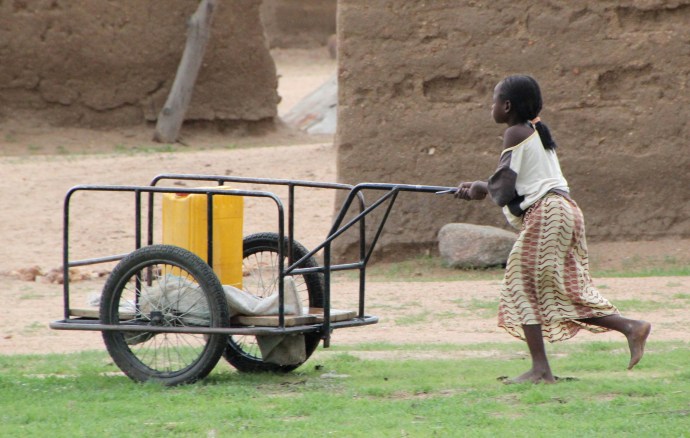
In the project, Mordok women were also given 18 handcarts, which makes carrying 20 liter bottles of water from the borehole a lot faster and easier (and gives girls time to go to school).
The sheep the women received from Heifer have not just added protein and income to families’ lives, their manure is collected to produce compost that has doubled the production of their fields. And by using retaining walls and terracing, as Robert has encouraged them to do, farmers are protecting the region’s soil from erosion and degradation and conserving precious water.
Women’s groups in several villages have even banded together to build water-tight storage facilities for their grains and onions, so they will last through the wet season, instead of counting on traditional handmade straw structures to keep out the rain and moisture. The impact of that improvement? An 80 kilo bag of onions that sells for 5000 francs ($10) at harvest time will bring in 120,000 ($240) at the end of the wet season. And these joint efforts are a direct result of the leadership and organizational trainings the women are putting into action.
And yet, life is still very difficult here. The children are too skinny, and some of the women looked so fragile. When I asked what the family eats in a typical day, the women say they have pap, or bui, (cooked grains) for breakfast. For lunch, it’s sauce and cous-cous, the ubiquitous fu-fu of cassava, yams or plantains, boiled and pounded into dough. And more cous-cous and sauce for dinner. Once a month, the family will have meat. And once a week, fruit.
That’s not a lot to go on, or grow on.
Yet somehow the women’s group here, organized since 1998, has found a way to give to others — passing on the gift of knowledge and animals to another women’s group – and they are happy that the gender trainings have encouraged their husbands to help out more around the household (women do 90% of the farming and 70% of the livestock care).
Even Village Chief Ezekiel shares some of the farm & home work with his wife Sali Damdam.
I loved this village of Mordok and its beautiful people, and I can’t stop worrying about how they’re doing.
No mother should ever have to see her children go hungry.
I challenged y’all to come up with some questions for me — about Cameroon or my idiosyncratic travel habits. And just like the champions you are, you didn’t disappoint. (Sorry if the answers are too long — I felt like this was my Dear Abby moment & I couldn’t help myself!)
Jeffrey/Genie: What are the toilet facilities like in each of the countries to which you have traveled?
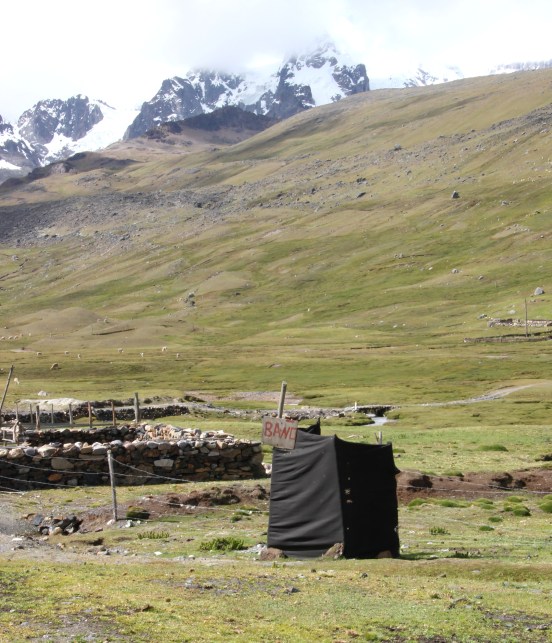
Way to start things off, Jeffrey/Genie! Toilets have been pretty consistently “challenging”… meaning something you would never accept in America, but can’t complain about when that’s the way people there live every day. In China and Nepal, toilets were usually a hole in the ground with two “footsteps” on either side – even in the airport. You learn to always, always carry toilet paper with you, but not to flush it as the sewers can’t handle it. In Haiti, a nightclub I went to had the weirdest toilet ever – it was four feet down in a dark tiled room with water running continuously all over the floor. In the Andes, our toilet was a simple hole in the ground and the “walls” only came up to your waist, but you were overlooking this magnificent mountain range and beautiful fields. Hard to object to that! In Cameroon, we almost never went to the bathroom in the villages but it was so hot, I could go all day without one… a real first! The one time I did have to go by the side of the road, I was so flummoxed (I couldn’t hide anywhere and I was so afraid the people in the house 50 yards away would see me and be really insulted), I went really fast and ending up peeing all over my skirt. TMI???
Pattie: How are you changing, in even the tiniest of ways, and what is one thing you wish you knew years ago about yourself/about the world?
Acceptance is beautiful.
I am now very aware when I’m being demanding and obnoxious, which doesn’t sound like monumental progress but it totally is. Ask my husband. I wish I knew years ago, on a deep visceral level, that when all your plans go out the window, there is usually a reason for it, and it’ll all turn out not just okay, but better. In other words – be flexible and trust the process (which translates into – don’t flip out and get demanding and obnoxious). It’s a beautiful circuitous thing.
EarthSkyOceanRedux: How many of the 200+ languages in Cameroon have you heard? The signs in one photo you posted look like what they call Camfranglais!
I love the signs in every country … priceless!
I heard about 9-10 languages in Cameroon and in your photo I suppose it is Camfranglais, a completely unintelligible form of pidgin English they speak in the South. It’s a mish-mash of tribal language, English and French – so you think you know what you’re hearing and then get left totally in the dust (where I spend most my time).
Ember:I would like to know what you think the hardest part of your Heifer travels has been so far. battling bureaucracy for visas? being a food wimp? leaving people behind?
Every once in a while I get adventurous: this was delicious bitter vegetable soup!
Being a food wimp isn’t hard; it’s who I am. It is hard to always be leaving somebody behind… whether it’s my very patient husband or darling daughter, or the people in the villages that I can’t bear to think I’ll never see again.
The Tibet visa debacle in China got me pretty unhinged, but most trips go pretty smoothly, so I can’t say that’s too stressful. And sometimes I feel like I just can’t face another 18 hour plane ride – but then I do, and it’s fine. It’s the price of entry to all these amazing places…. Really, the hardest part is feeling like I’m not doing enough to promote the blog & repay Heifer’s investment in my travel, because that’s money that could have gone into programs. But trying to promote a blog is an endless quest, and there’s never enough you can do, so I have to just do my best and let it go.
Martha: What is something you didn’t pack early on, but wished you had, and now never forget? Also, what small thing have you brought as a gift for those special circumstances when you want to thank someone you’ve met on your travels?
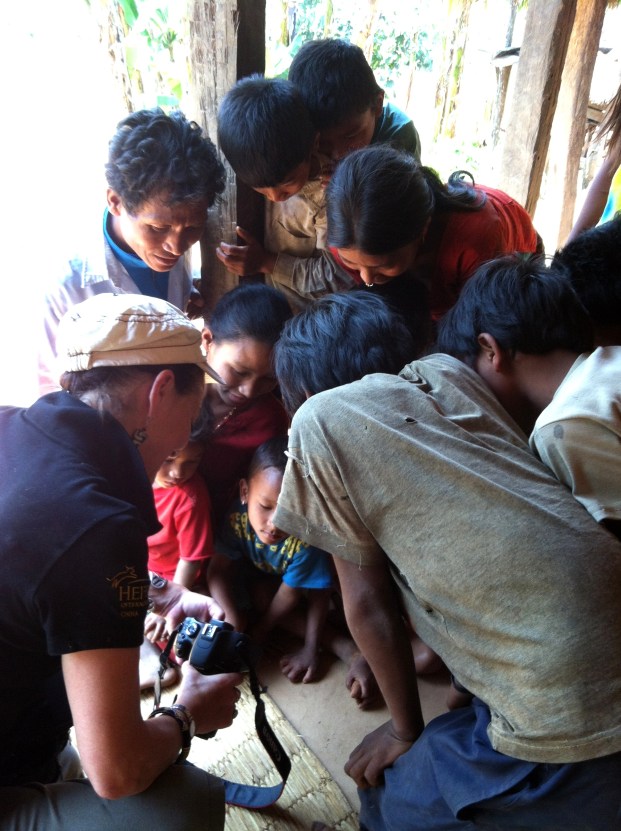
I never forget Immodium (for obvious reasons). I first brought pens, candy and crayons for the kids, but as it turned out that’s not such a great idea and Heifer doesn’t support it, as it ends up singling out an individual or group for special treatment and that breeds resentment and envy. I have given money for Heifer staff to develop prints from the DVDs I burn so the people in the villages can have a photo of themselves…. very often their first. I love the idea of that!
Sharing my shots in Agingare village, Nepal with the Chepang family.
Deb: I look at the barren north and look forward to hearing what plan was made. The fertile area appears to be great for farming. Do they send excess produce north to help feed the starving? Another bigger question, why is the north most populated?
The indomitable Tapita Bamiya and 3 of her 9 children in the Far North.
The Far North is largely Islamic and has a tradition of polygamous families (about 60-80%) and those families always have more children. It was completely typical in my visit for women to have 7-9 children; it’s their culture and the farm communities need lots of hands to do the work. They grow cassava, maize, and cotton in the Far North but since the dry seasons are getting longer, those stored crops have to last a loooong time. Heifer is working with communities on creating better storage facilities, but as far as I know, there is very little transfer of food from South to North –basically because the people in the Far North have no income with which to buy the food. (The average income is $220/year– that’s what they mean by “subsistence.”)
Kathryn: I find the heat hard to bear. Especially when there is no AC or sometimes even electricity. In those cases, what have you done to stay cool? And one more–what kind of “tool kit” do you travel with–if any–i.e. flashlight, medicines, comfort foods, batteries? In other words, what do you travel with “just in case?”
Luckily, most of the places we stay have AC, even though it intermittently goes out and/or creates a huge racket (see the video above). My emergency rations include ibuprofen, cough drops, vitamins, Advil PM (essential when you’ve GOT to get some sleep and you’re in a weird place), little baggies of dark M&Ms for sweet attacks, and sometimes a bottle of bourbon or gin from duty-free “just in case” I need a cocktail at the end of a long day. And I always have my headlamp so I can read without depending on that scourge of humanity: the dim, horrid compact fluorescent light.
Susan: What’s the single strangest thing you’ve seen either in Cameroon or on the whole voyage – either of the edible, or allegedly edible, variety, or anything else that you were taken aback by?
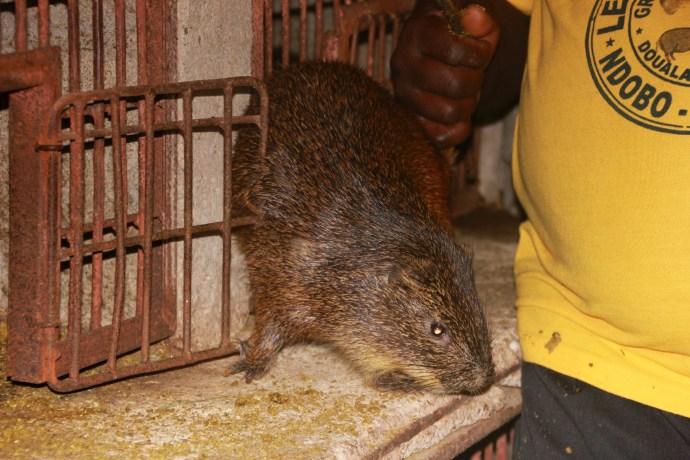
The Cane Rats (I always thought they were saying “king rats”) that they raise, sell, and eat in Cameroon … and believe me, I will be telling you a lot more about them. Rodents are my single greatest fear, so seeing this project was the most courageous thing I’ve made myself do this year.
Denise: How do you address the enormous inequality that you witness?
Profile of malnutrition.
I try to bear witness to it and not to feel ashamed of my enormous privilege and abundance (because what good does that do anybody?) In the villages, I try really hard to communicate my respect, compassion and desire to understand their world and their circumstances – and my intention to take that knowledge back and share it with others. Sometimes the poverty is overwhelming and terribly difficult to see, but if the people living in it have faith and hope, how can I have anything less?
Kim: Do they have any semblance of states or nation over there working together to build a united area? Trade, monies, supplies, etc.?
I’m not sure if your question is about Africa or Cameroon, but there are many pan-African organizations that are working to try to develop strategies to combat desertification, deforestation, climate change, hunger and poverty … but as you know, there is a lot of tension and conflict between African nations (like Western ones) and it’s not easy to work together, particularly when resources are so very limited.
Meredith: My question is; you are being well received, but how welcome are ‘foreign’ ideas in these various countries? Part of the cause of the poverty that ‘requires’ Heifer to be active is due to foreign interference, isn’t it? I am most certainly not downing the Heifer programs, which seem to be very tailored to the local needs, just wonder if eventually Heifer sees itself ‘out of a job’?
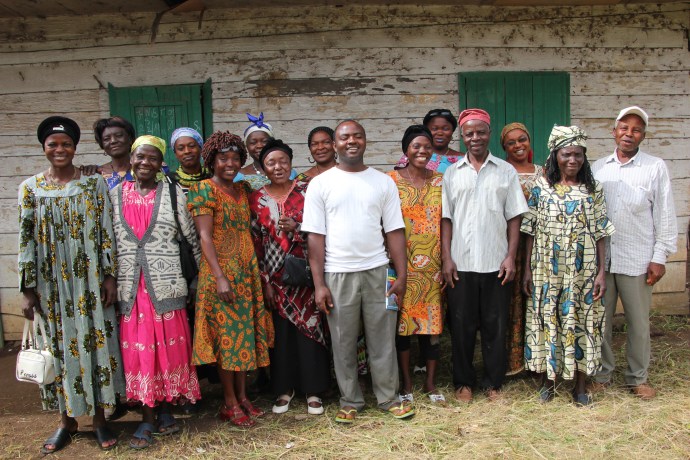
A local Groupe d’Initiative Commune (GIC) from Melong, Cameroon, organized since 2001.
You are totally right, Meredith, the legacy of colonialism and rapacious foreign companies are irrefutably part of the cause of global poverty. Yet most developing countries realize full well they need help and are eager for it; the problem is one of hierarchy and process. One of the beautiful things about Heifer is that it’s not a top-down organization but always works with organized local communities – and its programs come out of needs those communities expressly request. Even the animals given are not delegated; the communities themselves decide what livestock they want to raise. Also, Heifer staff around the world is about 98% native to the country – and the programs are further localized and run in collaboration with neighborhood groups (which in Cameroon mean the local tribes) and government offices. In truth, the biggest drawback Heifer faces is that while some NGOs give away everything (and then leave), Heifer requires people to participate in their own development, and that is a much higher bar. But of course, the ultimate dream for an anti-poverty organization is to put itself out of a job… we should be so lucky!
Emile: I am Cameroonian, and as you know the country has been poorly managed by the politicians, so what can the local people do to improve their lot? Heifer and KIVA are good initiatives and God knows we need all the help we can get but there must be something local that can be improved upon to alleviate poverty.
Whenever I think about the kids in Cameroon, I hope and pray like crazy that things will change faster so they’ll have a chance for a better future. Heifer’s programs in Cameroon (and everywhere) are very much on the local level, but there’s a new focus on scaling up, coordinating programs and creating cooperatives that will have a bigger impact. If we could double the productivity of the 678 million smallholder farmers around the world, they could feed the world.. and that is certainly Heifer’s goal. I hope you are inspired by the stories of the programs, coming right up!
Brenda: I’m a big believer that educating girls and helping women have productive employment is a key to ending poverty. Where have you seen significant efforts being made to engage women and girls as equal stakeholders and conversely, where does more focus need to be put on women’s involvement?
Women’s meeting, Mordok, Cameroon
Brenda, Heifer always focuses on women’s empowerment (many programs are 90% women) — because that’s the fastest way to lift a community, and women and children are the most vulnerable economically. In Nepal and Peru, I was particularly struck by the dynamic attitude of the women and how hard they were working for change. I’m always kind of horrified by the size of families in poor areas because it puts so much more pressure on the families’ resources, but statistics do show that the minute girls are educated and given opportunity, birth rates plummet…so the answer is to give the families the financial means to educate girls and in a generation, everything can change. Also, Heifer’s Gender Equality trainings (part of every project) are really transformative in getting men to share decision-making and work with their wives — and that’s a giant leap forward for womankind.
Sybil: What are the effects of climate change in Cameroon?
Queue for the water borehole at Barza Village in the Far North, Cameroon.
Just in case this picture doesn’t say a thousand words, I’ll be writing about beautiful, beleaguered Barza next week — it’s ground zero in climate change.
REALLY APPRECIATE YOUR QUESTIONS .. LET’S DO THIS AGAIN SOMETIME!


 For two years now, Ha has stayed home with the family and they’ve managed to make the same amount of money as when he worked in Thailand. Despite the devastating floods of last year, the 2 pigs they received from Heifer in 2011 have reproduced and provided them with income. They attended all Heifer’s animal husbandry courses and are also raising ducks and chickens, growing rice and grasses for income and feed, eating from their home garden, and most importantly, staying together.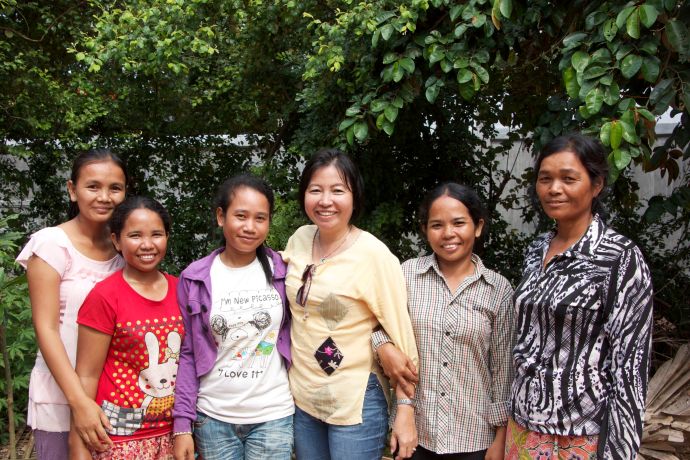

 It’s a tiny village, Anlong Sar. There’s a long way to go before there is real literacy or decent education here, and the government hasn’t made much headway in meeting its responsibilities to these poor provinces. And yet … when you see darling Soueb and her family, or Korm on crutches before his eager students in the classroom, it’s hard not to see this as a leap forward in hope.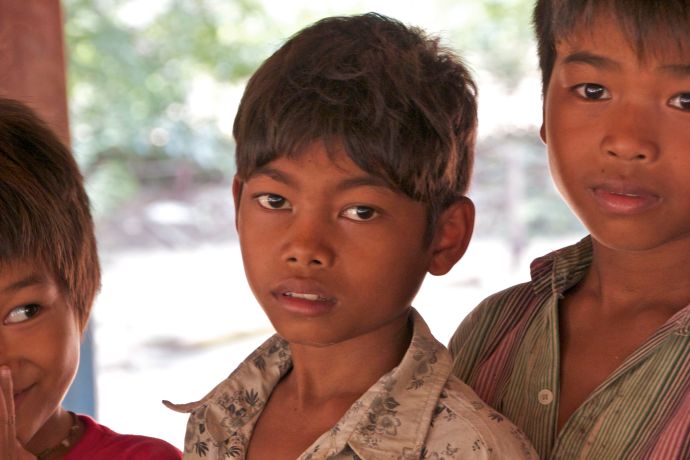

























 Heifer 12 x 12