Posts Tagged With: Heifer International

What it means to give.

After seven months into my journey with Heifer, I’ve seen a lot of Passing on the Gift ceremonies. Passing on the Gift (where people who have been given an animal are required to give the first-born female of that animal to another person in need) is at the very soul of Heifer. Not only does this double any gift Heifer (and you) makes – it also, and equally importantly, turns a person who has received charity into a charitable giver. Which is a remarkable, powerful transformation.

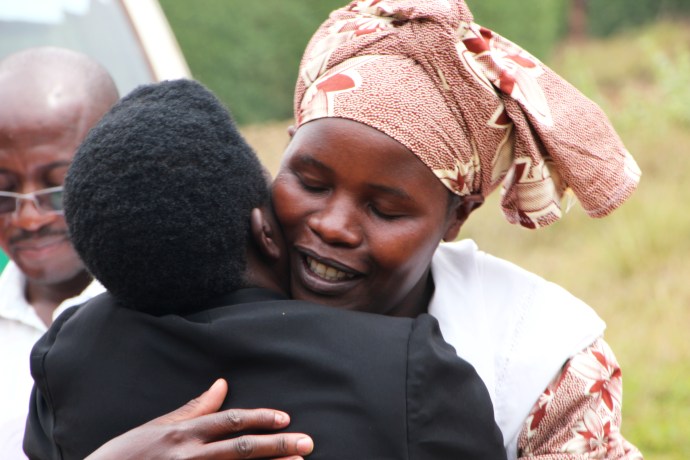
However… when you’ve seen a POG a dozen times, you may feel like you’ve seen it all before. And on my first day in Rwanda I was jet-lagged, worried about Lulu’s 200 mosquito bites, and just kind of going through the motions – until I downloaded my photos that night in my hotel, and saw the absolute beauty of this concept reflected in each face.
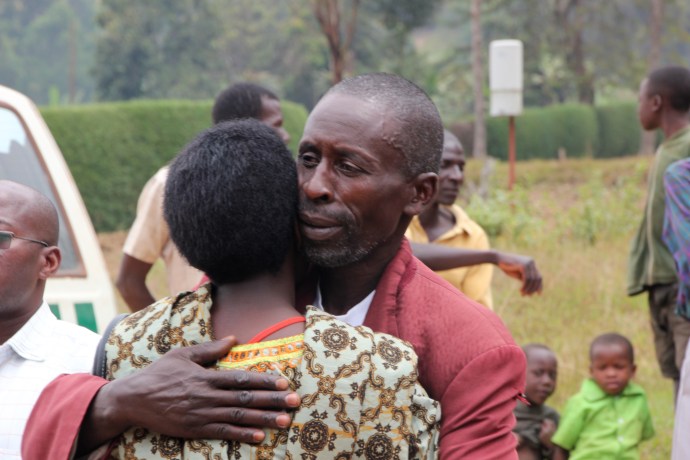
What I love the most is that you can’t tell who is the giver and who is the receiver.

Passing on the gift of a cow to another person takes on even more resonance in Rwanda, since this is a cow-loving society (they have many songs dedicated to cows, and I think I heard them all) and every aspect of society is laden with the memory of the genocide of 1994, when Hutus rose up against their Tutsi neighbors and slaughtered over 800,000 men, women and children in cold blood. Trying to rebuild community on that shattered foundation of savagery takes unbelievable discipline and compassion – which, oddly, is precisely what Passing on the Gift also demands.
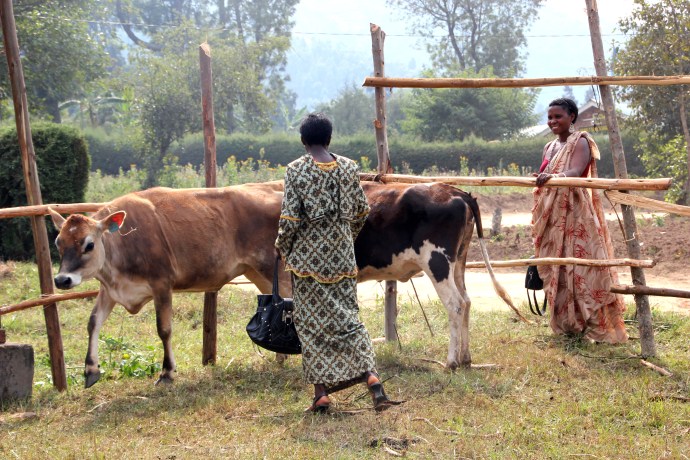
For a poor family to receive a huge asset like a cow and then to be required to give up its valuable first female baby is really hard– as is taking the time and effort to share what you were taught with the new family: how to build a shed for the animal, grow forage crops for it, keep it healthy and clean, milk it properly, and know when it’s ready to breed. But with the help of Heifer’s field techs, that is exactly what the people do.
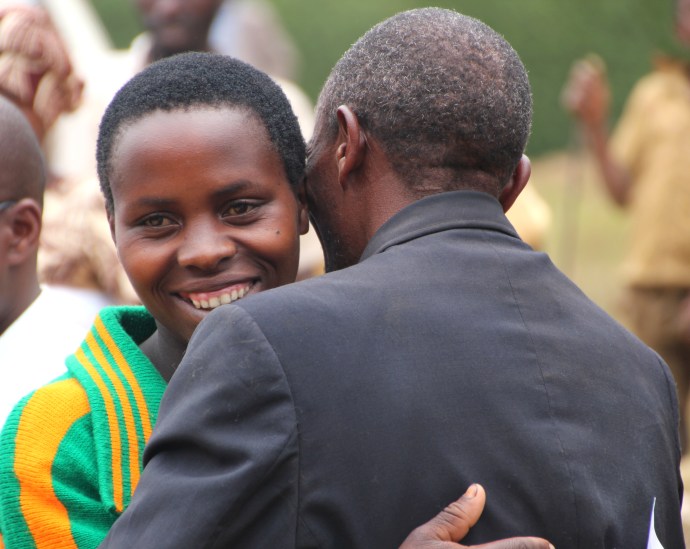
Today in the Northern Province, where some of the longest-lasting fighting occurred, the POG ceremony began and ended with everyone shouting this slogan:  “Have peace!” answered by “Unite in reconciliation and uproot the genocide ideology.”
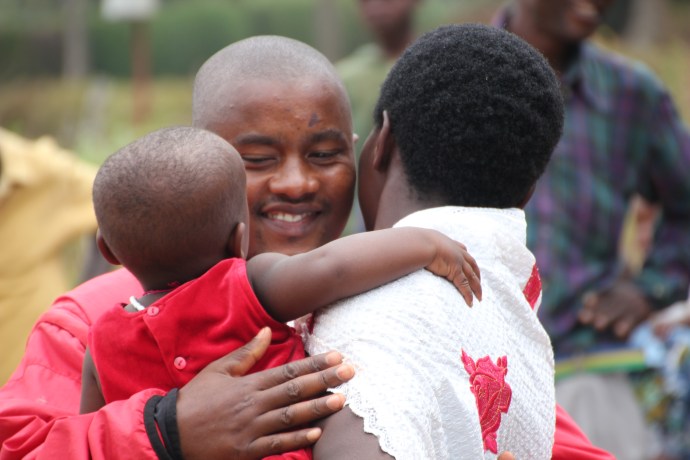
Each recipient then chose a white ticket with the number of a donated heifer, and went home with a cow that will give milk, reproduce and produce income, nutrition and assets for the family.

Waiting to choose the all-important ticket that means a new cow.

These neighbors, Tutsi and Hutu alike, will thus be bound together in friendship, responsibility and interdependence – all through the gift of a cow. And in Heifer’s Sustainable Dairy Enterprise project, this scenario is happening in 1,200 homes across the north and east Rwanda.

What the children see is giving, not division.

Town by town, and cow by cow…

Some heifers are a little easier to get home than others.

It’s such a beautiful thing to witness. I wish you could have been there –but watch this, and you’ll feel like you were!

Categories: Africa, Animals, Heifer International, Photography, Rwanda, Travel | Tags: , , , , , , , | 22 Comments

Good news/Bad news

BIG news, y’all — in the good and (only tiny bit) bad department!

First the good news: I’ve been selected as a Top 5 Finalist for Volunteer of the Year, Southern (Sweet Tea) Division in the 4th Annual CLASSY Awards, from a pool of 2,400 nominations for my work on this blog. The CLASSY Awards is the largest philanthropic awards ceremony in the country, celebrating the greatest charitable achievements by nonprofit organizations, socially conscious businesses, and individuals worldwide. (And yes, you are right: “Stay Classy, San Diego!” was Will Ferrell/Ron Burgundy’s snappy sign-off in Anchorman.) In 2011, nearly 2,000 organizations and volunteers were nominated for a CLASSY Award, and their collective efforts impacted the lives of more than 200,000,000 people in 71 countries worldwide. So that means I’m in very good/intimidating company!

The bad news? I’m obviously going to badger you to vote for me (hence this post) … but the GOOD news is, you only have to vote ONCE. If I’ve already badgered you on facebook, twitter, etc. I apologize profusely .. but this is a really big deal for Heifer and therefore, for all my beautiful Heifer peeps … so I gotta beg you to vote for me by July 26 (that’s this Thursday).

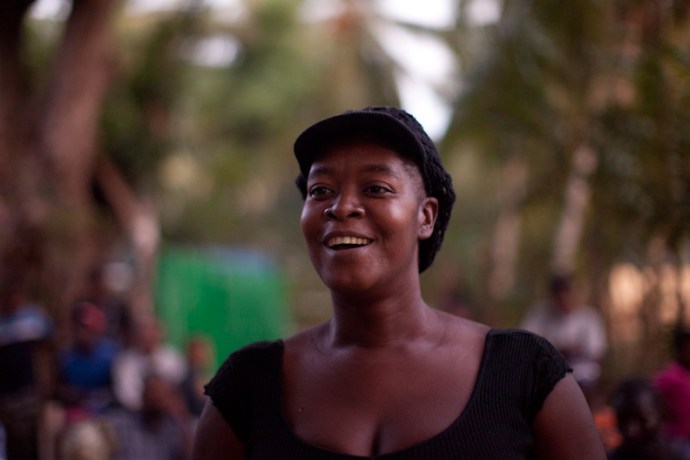
One of my beautiful Heifer peeps.

Click here http://www.stayclassy.org/classy-awards/vote to get to the site and follow the big, wonking (but actually simple) explanation below of how to vote (most important step is the FINAL one to log in to Facebook):

Thank you a million times over … I really appreciate your vote!!
*If you don’t have a Facebook account, click on the option to open a StayClassy account and use that!

Categories: Heifer International, Inspiration, Photography, Travel | Tags: , , , , , | 24 Comments

Dead Hen Walking

After 16 years, Pauline’s favorite hen succumbed to Newcastle disease.

If you are a woman living in a village in the Far North of Cameroon, chances are you’ve been raising chickens since you were knee-high to a grasshopper. And chances are, every year in the cold dry months you’ve watched helplessly as your chickens stop eating, droop their wings, and begin listlessly walking in circles – then keel over and die. Despite the fact that these chickens account for most of your family’s income—and 16% of the country’s poultry—there’s been nothing you could do but watch your food & income perish.

Pauline & Madeline discuss their chicken losses.

This scourge of chickens is called Newcastle disease and although it’s been an affliction here in the Far North for years, little has been done to combat it. The day we visited Pauline Tcaday and Madeline Maylaou, two chicken farmers in Kar Hay, we saw the carnage first hand.

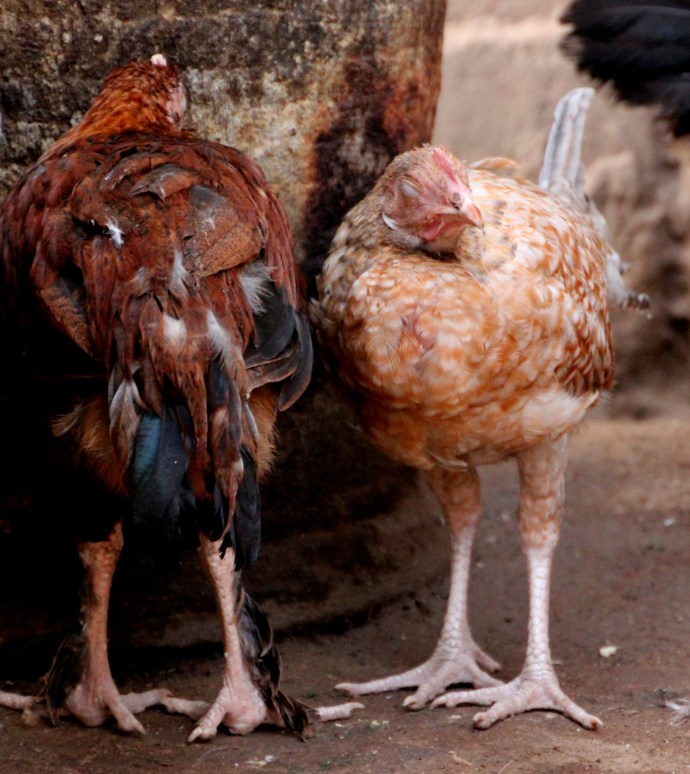
Two sick chicks, not long for this world.

Pauline’s flock of 100 birds had been totally healthy until she brought one new chicken home from the market. That chicken was infected and now her entire flock was dying. 53 of Madeline’s 56 chickens had perished in a single day. And almost overnight, the village population of 79,000 chickens had shrunk to 28,000 — a loss of about $170,000!

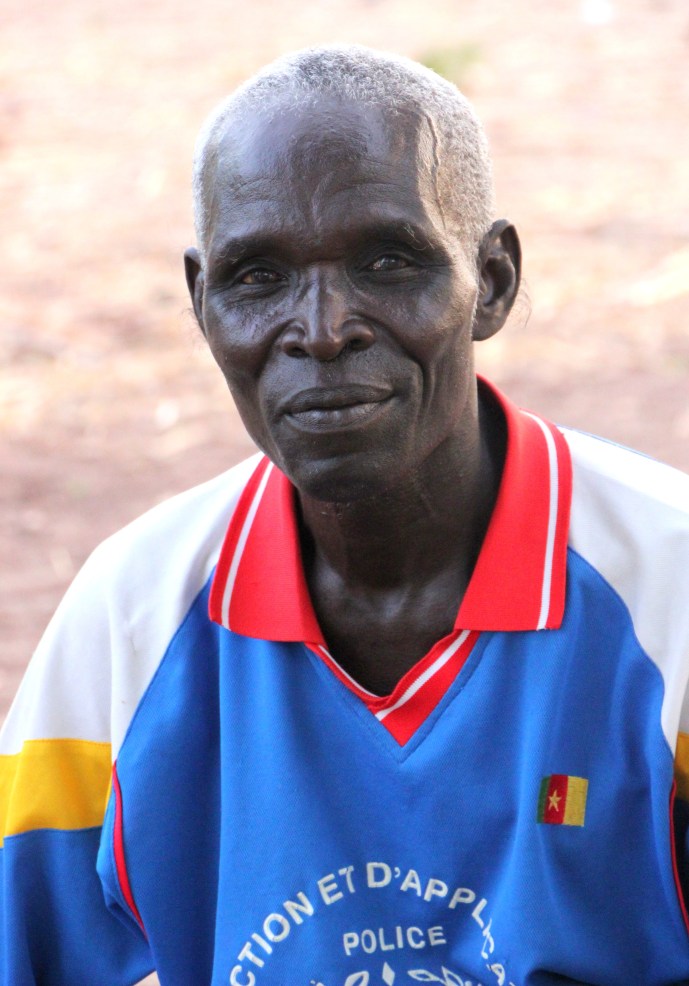
Norbert Mayla, chicken farmer of Kar Hay, tries to make sense of the epidemic.

Luckily, a plan is in action that will help 9,000 rural farm families like Pauline’s save their chickens– and the vital income & nutrition they represent. Heifer International, in collaboration with GALVMed(a non-profit global provider of livestock vaccines), and MINEPIA (Cameroon’s Ministry of Livestock, Fisheries and Animal Industries) has started a pilot program in 40 rural villages to vaccinate 490,000 chickens against Newcastle disease – and it’s brilliant on about 5 different levels.

First, it’s a sophisticated, well-coordinated, thoughtful campaign based on research and epidemiology. The vaccine is highly effective in protecting against the disease and if every chicken were treated, Newcastle’s could effectively be wiped out in a few years. That’s not just chicken pot-pie thinking; it’s a potential reality.

The desired outcome..

But initiating a program this ambitious has been anything but simple. Heifer and team had to figure out the cold chain to keep the vaccine viable (in a country where electricity is spotty); adjust the dosage size so a vial could be administered in a single day; and find dependable, experienced people to see the program through.

Wyang Agah, Kar Hay’s AHCW.

Eight Animal Health Care Workers with diplomas in animal husbandry were hired and provided with 4 motorcycles to reach the 40 far-flung villages, and 4 solar refrigerators to keep the vaccine at its essential cool temperature in their vet stores.

The AHCW supervise the Village Vaccinators, two per village, who are local residents, literate, and have been trained to administer the vaccine to the chickens (by eyedrop). The Vaccinators have been given new bikes and insulated cooler boxes that will keep the vaccine fresh while they travel from the vet store to their villages.

Everybody’s excited about the new program (and the new Vaccinator bikes)!

They’re off and running…

The vaccine costs 50 francs (10 cents), administered 3 times a year. So for 30 cents annually, farmers can protect a chicken that will fetch $3-$5 in the market. What’s more, the 50-franc fee covers the price of the vaccine, the salary of the AHCW, and the Vaccinators – meaning the program is immediately self-sustaining, and everyone involved has a strong motivation to make it a success. And in late May this year, vaccinations began.

For farmers in the Far North, the stakes couldn’t be higher. Not only does chicken income pay for school tuition, health care and clothes, animal protein is already in perilously short supply, while the population is projected to grow by almost 30% in the next 5 years. With 38% of the children in the Far North currently malnourished, a strong, steady supply of chicken that the people could both eat and sell would be nothing short of a miracle.

Madeline’s feeling hopeful!

When I asked Pauline and Madeline if their families ate their chickens’ eggs or sold them, they burst out laughing. “We don’t eat eggs, we don’t sell eggs,” they said ruefully. “We don’t even eat our chickens. We’re poor and we have to sell them.”

But hopefully, those days are numbered.

Categories: Cameroon, Heifer International, Hunger, Photography, Poverty, Travel | Tags: , , , , , , , , , , , , , | 23 Comments

Cows, fudge & women in Haiti.

Our Heifer International trip to Petit Goave got off to a petit late start, because we overstayed at the town of Degand. Which meant by the time we pulled into the lush rural community of Petit Goave, the sun was getting low in the sky and we faced one last hurdle: a watery crossing.

Heave-ho!

Sona Chambers, ace Atlanta fundraiser and bon vivant, was in the front seat and cautioned Hervil Cherubin, Haiti Country Manger/driver extraordinaire, that the four-wheel drive wasn’t in gear. Dave Anderson, crackerjack international photographer and videographer, and I were in the back, minding our own business but secretly hoping for some action. We got our wish, as the minute we plowed hub-deep into the mud, it was pretty clear we were stuck solid. Pierre Ferrari, Heifer CEO in the car behind us, plunged in to the rescue and we were expeditiously pushed out by six farmers with a lot of muscle.

Dirty, muddy and happy, we traipsed into lovely Petit Goave where the community awaited us.  By now the light was seriously fading and the Heifer folks wanted to get us back on the road before nightfall. But since we were the late ones, we unanimously decided that all the beneficiaries should have a chance to speak, just as planned. And so they did.

Petit Goave is a beautiful place, blessed with plentiful water reminding me, once again, that water means life. This corner of Haiti, with its tradition of dairy cows, is also famous for the fudge (douce macoss in Creole) that I wrote about in my last post.With a candy industry nearby, the more milk Petit Goave farmers can produce, the more income they can generate from fudge-makers.

To take advantage of that opportunity, over the years, Heifer has given this community the gift of 50 cows & 2 bulls; 5,000 plantain plants; 600 buckets of bean seeds; 150 buckets of corn seed and 12,000 forage plants to feed the animals—as well as emergency food supplies after the earthquake. These gifts, which have been passed on to other families and thus multiplied, have made a profound difference in the life of the community, as we were reminded of by the people who stood to greet us.

How great does Emmanuel Jean's wife Jacque look after 9 children? (Dave Anderson photo)

Eddy Exantus, with 6 children, was able to send all of his kids  (not just the boys) to school with income from selling milk. Francois Revel, a bachelor, used his milk income to finish high school, then was trained by Heifer as a vet agent – giving him additional income while he keeps the community animals healthy. Emmanuel Jean has 9 children and been able to send them all to school, thanks to the milk money earned with his Heifer cow. And finally, a woman stepped up: Margareth Doscar, President of the Petit Goave Women’s Group and a single mother of 4.

Margareth Doscar photo by Dave Anderson.

Kimberly and I snapped to attention as she thanked us and wished us courage, then asked for more training in food processing and micro-loans to finance small businesses of the 45 women entrepreneurs in Petit Goave.

Kimberly, by Dave Anderson

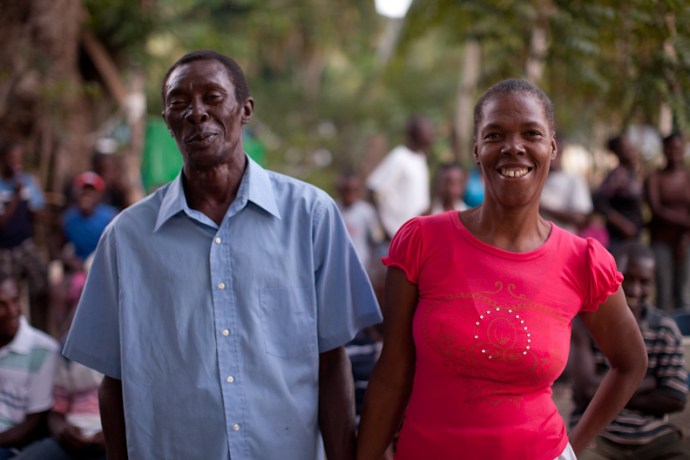
As the light of female solidarity dawned on us (and the sun set for real) Kimberly asked for the wives of the men who’d spoken to come up & be recognized….and before you could say “Gloria Steinem,” there was huge laughter, people excitedly pushing shy wives and mothers to the front, and tales of romance, kids, and 30-year marriages in the air.

I struggled to take notes in the pitch-black and people held up cell phones to illuminate faces, while Pierre talked Kimberly (also shy) into addressing the women, who crowded around her in quiet thoughtfulness.

Petit Goave women. (Dave Anderson photo)

“Women have always been the backbone of society, and we know how hard you are working, and how difficult these times have been for you,” she said, as Hervil translated into Creole. “I want you to know that the women in America and all over the world care about you, we support you, and we haven’t forgotten you and your families.”

In the dark we could hear lowing and bellowing of the 50 beautiful cows that had been tied up in the clearing. A quarter moon rose over the horizon. As we walked back to the trucks, surrounded by the talking, laughing people of Petit Goave, it was a Heifer moment. One you’d never forget.

Categories: Agriculture, Animals, Haiti, Heifer International, Photography, Travel, Women | Tags: , , , , , , , , , , , , , , | 18 Comments

The paradox of Haiti.

To be honest, I was a little nervous about going to Haiti, Month #2 in my 12-trips-in-12-months visiting Heifer International sites.  Not because I was scared something bad might happen to me, but because I was afraid I wouldn’t find anything good to say about the country.

Well, like most worrying, that was a waste of brain space.

3 big things to like about Haiti... girls going to school!

Despite Haiti’s mind-boggling set of challenges and truly appalling lack of infrastructure–which was the case even before the earthquake of January 12, 2010– the country is beautiful (really!) the people are irresistibly gregarious, gorgeous and dignified, and there’s more life packed in one square mile of this country than in some entire states of the USA (you know who you are).

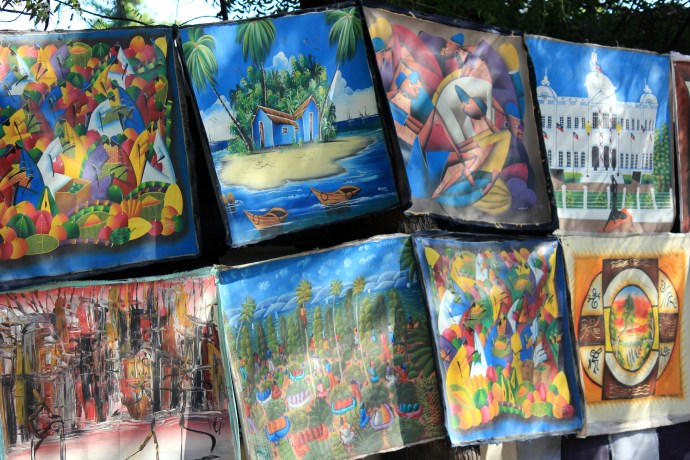
Art in the wind in Port au Prince

Plus, the projects Heifer is undertaking in Haiti are amazing and on a scale that the organization has never undertaken before…which I seriously can’t wait to tell you about.

But I’m not going to be too Pollyanna here. Some of the things I saw here made me ashamed to witness them.

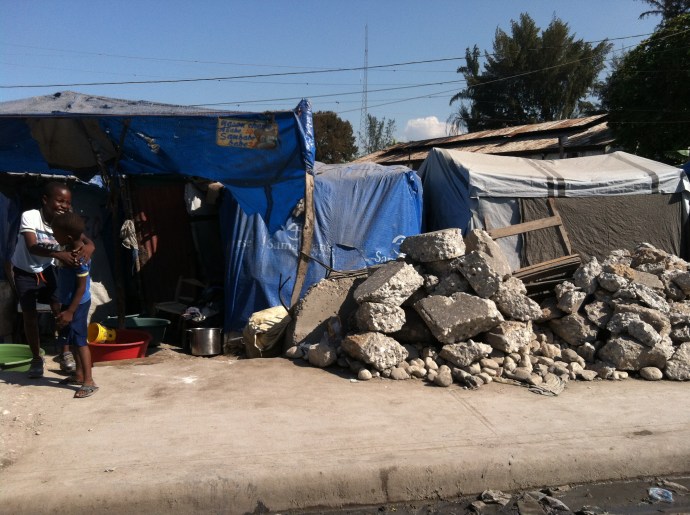
Tent children

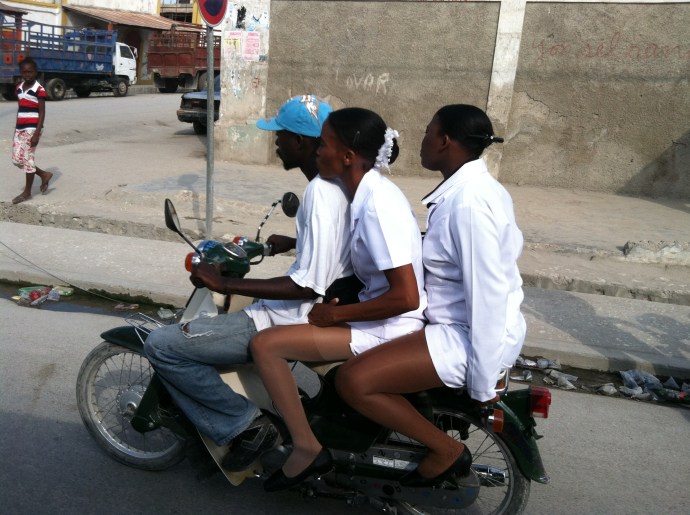
When I was taking a photo of a huge pile of trash randomly on fire by the side of a garbage-choked watery culvert running through one of PAP’s more notorious slums, a Haitian man sternly shook his head, as if to rebuke me for trying to capture the utter desolation of that scene. I didn’t take the photo – but the odd thing was, what I really wanted to show was that walking right beside the blazing garbage, beautiful women in clean, ironed dresses passed men in dress shirts and neat trousers– all going to work, going to market, carrying on.That refusal to bow to the indignity of living in conditions that should be crippling is incredibly inspiring. The tap-taps of Haiti alone stole my heart, with names like “Patience” “Eternal Capable” and the slightly unnerving “Blood of Jesus.”Tiny children toting big gallons of water up steep hillsides stop to smile and wave. In villages where people scarcely have enough to eat, you’ll hear songs of praise wafting up from an unseen church. And everywhere – everywhere! – people are working incessantly to improve themselves and their country—which makes you want to do anything you can to empower them to write a better script for their future.

Unfortunately, “doing anything you can” is not a prescriptive or particularly helpful instinct in Haiti. Or as Paul Farmer of Partners in Health put it succinctly, “Doing good is never simple.” While over 50% of American households –and the rest of the world–donated $1.2 billion to relief organizations after the earthquake, 2 years later debris still clogs the streets of PAP, tent cities of unimaginable squalor still house more than 250,000 homeless (but it was 1.5 million 12 months ago!), and the unemployment rate is well over 50%.What Haiti needs now are a decent infrastructure, functioning government, income-generating jobs, and the ability to feed itself (like it was starting to do 20 years ago, before a flood of cheap American imports crushed the life out of Haiti’s smallholder farmers).Heifer’s powerful new projects in Haiti are all about addressing the last two imperatives of jobs & agriculture with integrity and vision.  But… I have to write about that tomorrow.

Today, after 7 straight days of bone-crushing rides smushed in the back of a Land Cruiser, I’m taking the afternoon off– although that is a relative term, as we still have 5 hours to Cap Haitien and somehow the resolutely cheerful Ewaldy has convinced me we should take the bad back road so I can see more of the “bon paysage.”

Eternal Capable – that’s Haiti (and hopefully me)!

Categories: Agriculture, Haiti, Heifer International, Hunger, Photography, Poverty, Travel | Tags: , , , , , , , , , | 49 Comments

Blog at WordPress.com.