Animals

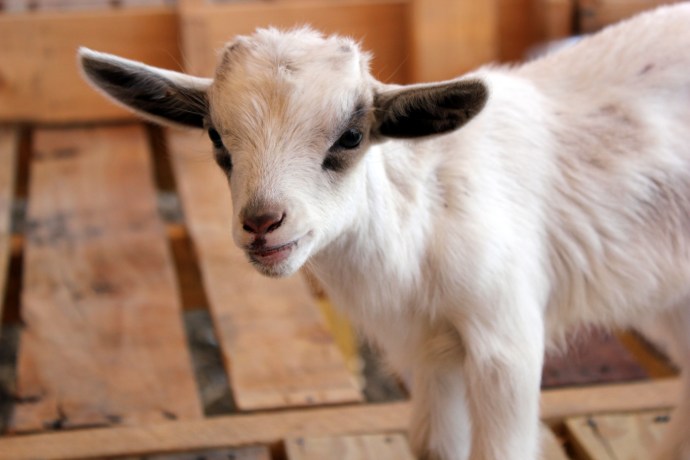
Staring at goats.

On my first day in Haiti, I made the not-so-brilliant deduction that traveling with Heifer CEO Pierre Ferrari and his adorable wife Kimberly Youngblood; Heifer VP/Director of the Americas Oscar Castaneda; and Heifer Haiti Country Manager Hervil Cherubin, put me in a whole new league.
A band? Just for me??

Instead of sidling into town relatively unnoticed (except for being blindingly white), I was now part of fancy celebrations and major attention. Like our first stop: the opening of Heifer’s big new Goat Breeding Center in Montrouis (pronounced Mont-wee) on the beautiful northern coast of Haiti, which represents the first step in Heifer’s $18.7 million plan to ignite Haiti’s rural economic recovery.

When you’re trying to make some developmental headway in the confounding conundrum that is Haiti, the prospect can be so daunting, it’s hard to know where to start. But often, the most obvious place is staring you right in the face.And that is exactly where Heifer International is putting its stake in the ground: with the basic development tools of animals, food, and farms through its new REACH program (Rural Entrepreneurs for Agricultural Cooperation in Haiti). When you look at the numbers, it makes all the sense in the world. Out of about one million small farms in Haiti, 85% raise poultry, 65% have goats, 55% cattle, and 35% pigs. Yet, those efforts are not coordinated, the stock is poor, and markets are far-flung and inaccessible to farmers.

MST, Tet Kole & Heifer -- Heads Together!

So Heifer partnered with Tèt Kole Ti Peyizan Ayisyen (Heads Together Small Producers of Haiti), the oldest peasant group in Haiti born covertly in 1970 during the Duvalier dictatorship, and with MST Landless Workers’ Movement of Brazil, to build this 270- square meter, 180-goat breeding center and 10,000-chick poultry center, along with a water-capturing system from a source 5.5 kilometers away.

The Neutra House/Chicken Breeding Center

The centers are beautiful (built with recycled pallets!) but the really gorgeous thing is what they represent for the future: A better breed of goats and chickens that can incrementally improve livestock bloodlines. The coordinated training of Community Animal Health workers who can teach other farmers to grow forage crops, fruit trees, compost, and breed their animals in the healthiest, most productive way. And the development of value chains to bring farmers together to establish new markets and increase their incomes by 100%.

Heifer’s ambitious plan is to select the most successful and entrepreneurial farmers (at least 30% of them women) from these training programs and provide them with the animals and business acumen to start 100 goat and 50 pig breeding centers throughout Haiti, with an ultimate reach of improving the lives of 20,250 farming households. Now that’s reproduction at its finest!Still, there’s a long way to go before Haiti comes anywhere close to being able to feed itself. Even before the  $31 million of agricultural damage in the 2010 quake, and the 70% loss of its crops in the 2008 hurricane season, Haiti was importing 51% of its food, at a crushing expense to its 9 million people. Heifer needs to raise $13 million to make this program a reality, and then there are five years of hard rowing ahead.
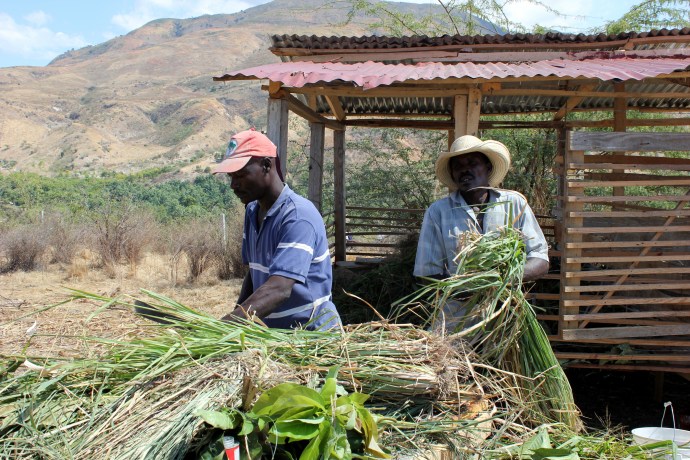
Even feeding animals is a challenge in Haiti.

But to paraphrase Robert Frost & the Nine Inch Nails, the only way out is through.

As I was standing on the top of the Montrouis cliff overlooking the ocean, listening to the wind and hearing the bleating of goats, imagining the magic of water soon transforming dry grasses into crops, that prospect didn’t seem so bleak.

Women from Montrouis

Not really bleak at all.
Categories: Agriculture, Animals, Haiti, Photography, Travel | Tags: , , , , , , , , , , , , , , , , , , , | 27 Comments

Re-Gifting, Heifer style.

As Heifer‘s Byron Lopez, Vivian Martinez and I pulled into the beautiful village of Quilinco near Huehuetenango*, Guatemala, I realized we were late. For once, it wasn’t my fault (blame breakfast and a whole bunch of bad potholes) but I was horrified to see 30 gorgeously-attired mothers & children and weather-beaten farmers in immaculate white hats patiently waiting for us in the beautiful turquoise central meeting place that was cheerfully festooned with flowers, hanging stalks of braided corn, and a pine-needle strewn floor.

Future farmer of Quilinco

This was my first HeiferPassing on the Gift” ceremony and I was late. Dang it!

Passing on the Gift is the most Cornerstone-y of the 12 Heifer Cornerstones – and the thing that truly sets Heifer apart from other “giveaway” charities. When a poor family receives a Heifer animal (any animal – be it chick, goat, sheep, cow, water buffalo or bee), the first female offspring of that animal must be passed on to another needy family. This not only builds community solidarity, it ensures that the gift keeps on giving to more and more families – while it engenders self-respect, dignity, and a sense of responsibility to others (Oh, that we had a little more of that in the USA!)

This community of Quilincohas had a relationship with Heifer since 1984 – and remarkably, the Passing On tradition is still being Passed On. From 80 original families, Heifer gifts are now benefiting over 500 families…with no direct supervision for 8 years (although Heifer still provides some veterinary support, new animals to improve the stock, and community counsel).

Jesus

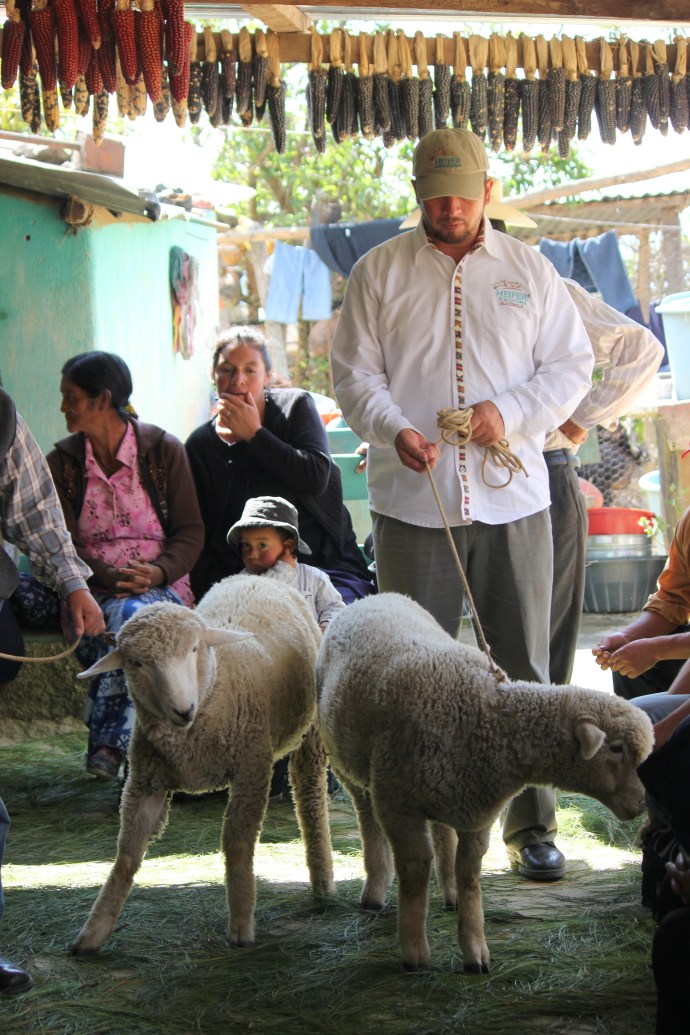
Today, we were witnessing THREE Passing On gifts. First was the gift of two stallions (I was envisioning Black Beauty – but no, these were sheep) from 4-time Award-Winning Sheep Breeder Jesus Garcia.  These two males would be shared by four families in two neighboring towns and used to impregnate the local mares.

Heifer's Byron Lopez prepares to pass on Jesus's prize sheep.

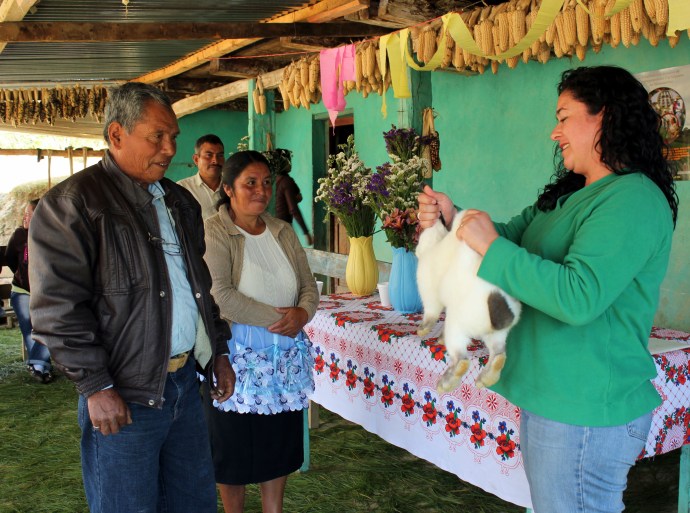
The second gift was a valuable Italian female rabbit that was robust, fat and juicy and would likewise be used judiciously to improve the local stock, given by Paula to Isabel.

Vivian passes on Julia's gift to Isabel.

The third gift was a campesino-to-campesino gift of a goat that would hopefully have at least 5 babies, improve the local stock (the price of prize stock is 5 times that of the local sheep) and enrich the lives and diets of the receiving family.

22 days old and already looking good!

The speeches preceeding the gifts recalled decades of community efforts to encourage people to contribute funds (sounds like any civic association anyplace on the planet), work together, and find common goals and common ground. With Heifer’s encouragement, Quilinco’s Mayan Mujeres had pooled their money and begun micro-lending programs to enable other women to buy animals and pass their offspring on. Their history of “working together with solidarity – the way you taught us — and not by ourselves” as Alberta Garcia recalled, has served them well.

The land of Quilinco is steep, foreboding, and back-breaking to farm, but the people there are determined to grow their own food, feed their own children, and prosper. Heifer’s great gift has been to give them the small help they need to succeed in that endeavor.

Celso & his dad, Juan Artemio

** I’M OFF TO HAITI TOMORROW … BUT STILL HAVE A FEW MORE SCINTILLATING POSTS FROM GUATEMALA… STAY TUNED!!

My Guatemalan walkabout.

Categories: Animals, Guatemala, Heifer International, Photography, Travel | Tags: , , , , , , , , , , , , , , , | 26 Comments

Animal magnetism in Happy Valley.

After the dust and dryness of Ixcan, it was pure pleasure to arrive in Cunen, a verdant valley in El Quiche, Guatemala where Heifer International has had a project since 2006. (Not only because Cunen is beautiful, but also because it meant we could get out of the car we’d been bouncing around in for 4 hours).

The inimitable, devoted Maria Cruz.

The Cunen project is the work of 3 local organizations with Heifer, and there to greet us was Maria Cruz, a lovely 36-year old Mayan woman who has been the Heifer technician, animal-whisperer, and trainer in this area for 10 years. Although the Cunen project has been “weaned” and is on a maintenance schedule, Maria still travels here once a month by bus to check on the animals, answer questions, and visit the homes of Heifer’s beneficiaries – of which there are 36 in this town (and over 500 in the project). In fact, she is so devoted to her work that when she was temporarily laid off due to a cutback in Heifer donations, as a result of our economic downturn (hint, hint), she still took day and night calls about animal fevers and diarrhea from the four villages she works in. Apparently, having animals is about as time-consuming and worrying as having children (except they’re more grateful and don’t talk back).

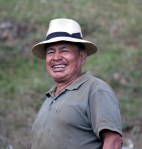
Don Serbando

Don Manuel

In Cunen, even after the Heifer project has ended, the gift still keeps on giving. The cow above was received by Don Serbando Vasquez, director of the local association, and had a female baby that was passed on to Don Manuel Vasquez (whose 7 children grew up drinking its milk), and that female just gave birth to the cutie-pie new baby above. Cows live for 15-18 years and will have 5-7 offspring in their 13 years of fertility, so Cunen will see several more new generations of Heifer heifers—each of which will benefit a new family. As we walked from farm to farm, we jumped over creeks bubbling down from the surrounding mountains, bringing plentiful water to the fields that were everywhere springing to life with alfalfa, beans, snow peas, onions, oats, snap peas, corn, and napia grass. Lemon, orange, papaya, avocado and lime trees grew in orchards, and sheep and goats happily munched on forage crops in the tidy Heifer sheds Maria had taught the farmers to build.

Under-goat sheds' poop & urine collector -- how clever!

These sheds allow the farmers to efficiently collect the animals’ manure and urine – so they can make rich compost for their fields. Heifer trainings promote organic farming to liberate farmers from having to buy expensive, often dangerous chemicals and to protect the environment. Basic composting is enhanced with the help of some crazy California red worms that eat through the manure like Pac-Men, reproduce like rabbits, and are also passed along with the gift of an animal to a new family.

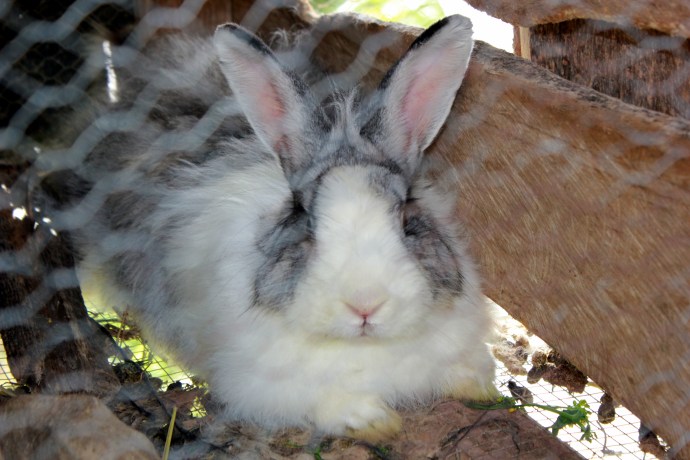
Speaking of rabbits, the Cunen families we visited also had plentiful pens of rabbits. These bunnies, like all the animals from Heifer, were bigger, better breeds that are chosen to improve the local stock, generation after generation. And because rabbits have 5-7 babies each litter and can have 7 pregnancies a year (yep, that’s 50 babies annually!) … that’s a lot of improvement really fast.

I'm fertile.. are you?

Andrea Canto-Camaha, Cunen farmer.

The people of Cunen were so likeable, friendly and eager to share their stories with us, it was hard to leave. Don Serbando gave us a parting speech, which he asked me to share with you:

We are very grateful to the Heifer donors. We know how much we have been helped and we don’t take it for granted. Because of the gifts you have given us, our children will grow up healthy and smart. We are living the Heifer dream.

It’s a dream that involves never-ending work and a boatload of struggle, but they have water. And animals. And hope.

It’s a happy valley.

Categories: Animals, Guatemala, Heifer International, Photography, Travel | Tags: , , , , , , , , , , , , , , | 21 Comments

Head in the clouds.

My first day visiting Heifer projects in Guatemala, we got high. Specifically, we drove up, up and up to the highlands of Alta Verapaz and into the cloud forest– which is the last refuge of Guatemala’s national bird, the resplendent quetzal, as well as hundreds of other bird species that are quickly disappearing from the earth.

Quetzal photo by Knut Eisermann.

Unfortunately, we didn’t quite get high enough to go to the 50+ villages past the end of the road that are served by Proeval Raxmu, Heifer’s partner project in Alta Verapaz, because, before I came, the folks were told, “A woman is coming from the North and she can’t walk.”

Hmmm – for the record, I can walk and love to – but I suspect the Heifer folks weren’t sure I was up for a 5-hour jaunt into the cloud forest. (I totally was.) But what I saw in Chicoj Village was more than enough to make me wish I could have spent days there.

Once it's gone, it's gone.

Despite the breathtaking beauty of the area, Alta Verapaz has a poverty rate of about 79%, and chronic malnutrition that affects about 52% of the poor farmers who live here. Deforestation of the cloud forest is happening at one of the highest rates in Latin America and is directly related to poverty. Trying to eke out a living on incredibly steep slopes at high altitude, farmers desperate for rich forest soil and firewood cut down the trees, burn off the rich forest mulch, and plant corn which further depletes the soil. What’s at risk is not just bird populations (Guatemala is home to about 700 bird species and millions of migratory birds from North America), but also life-giving water, since cutting down the trees also reduces rainfall. And that leads to fewer crops and less food.In response, this Heifer-supported program works to educate and motivate local farmers to farm more productively, grow more nutritious food, and protect their own forest. It’s a big, daunting job, but Proeval is totally up for it. Six years ago, they began working with 3 families in 1 village– and today they have passed along to more than 450 families the gift of turkeys, rabbits and sheep; red worms (for composting); fruit trees; forage crops (to feed the animals) and most importantly – campesino to campesino trainings in how to farm abundantly without damaging the cloud forest.

Going to a Proeval community meeting in Chicoj Village to see the project first-hand was like attending a big, wordy love-in. We met in Pedro’s simple, beautiful home where everybody–and I mean everybody–  had the chance to talk about what the project means to him or her.

Pedro's home, site of our community meeting.

Rudy, the veritable Johnny Appleseed of Raxmu, has been helping local farmers to plant some 800 plum, nectarine, peach and apple orchards for a dozen years and is a tireless promoter of the nutritional and income-producing capacity of fruit trees. He’s carried the stakes of trees on his back for 5 hours to give to farmers in the remote villages, taught them how to graft, compost and use bees to pollinate the trees, and never stopped singing the praises of fruit.

Efraim, a biological monitor whose job entails getting up at 4:30 a.m. to hear, see and count birds in the cloud forest, lives a two-hour walk high up in the mountains with his beautiful wife Rosaria and 3 little girls. He  told us how happy he was to be chosen as one of 3 trained monitors out of 30 applicants — while his wife explained he was gifted because he gave his heart to the forest. Efraim has trained intensively, can identify over 250 birds by sight, and has worked with some of the world’s foremost ornithologists who come to Guatemala and rely on his research. Because I come from a family of birdwatchers (and am singularly oblivious when it comes to finding a single bird in a tree) I was in awe of his cool, calm demeanor and obvious talent for the work.

Robert & Tara, tireless principals of Proeval (she is from Holland and he is American), spoke in Q’eqchi’, Spanish and English of the methods they’re passing on: using living and dead barriers to prevent erosion on the steep hillsides; combining animal manure & red worms to build a beautiful compost instead of using expensive, damaging chemicals; conserving water and soil; keeping animals healthy, hygienic and fertile; and growing a nutritious blend of crops that will better feed both the children and animals of Chicoj Village.

Flowers grown in living barriers to erosion can also be sold for income.

Together with Heifer International and the project participants, Proeval Raxmu’s mission is to use a double passing-on-of-gifts (each beneficiary family gives at least twice what they have received in animals, forage crops, and trainings to 2 other families) to restore ecological, environmental and human harmony to the people of this region. In fact, the Q’eqchi’ word “Raxmu” means fresh and cloudy weather, indicating a change to come. I felt the distinct winds of change in that room, in the palpable community solidarity and dignity of the families that surrounded me — and I felt their hope for the future. It was nothing short of intoxicating.

In the next two years, Heifer will give 800 Atla Verapaz families 6,700 rabbits, 4,364 turkeys and 360 super-cute sheep.

(And next post, I’ll get to the amazing Alta Verapaz WOMEN involved!)

Categories: Animals, Guatemala, Heifer International, Photography, Poverty, Travel | Tags: , , , , , , , , , , , , , , , , , , , , | 178 Comments

A few tender words about pigs…

I don’t know jack about raising animals – and I don’t think I’m alone. In fact, it can be said (and yes, dozens of people have said, in various terms of disparagement) that I am not an animal person at all.

You're serving WHAT for dinner?

But the great thing about visiting a Heifer International project is that you learn a boatload about animal husbandry, even if you don’t want to. And while that still may not make you feel swoony about cows, pigs, chickens and goats, it certainly gives you new respect for them. It also makes you realize how utterly removed that we westerners are from any and all sources of our food, despite our utter dependence on animals for life itself. In the developing world, you see on a daily basis how important animals are to communities and how closely people live with their animals. The symbiotic relationship between man and beast is tangible and immediate: we simply can’t live without each other.

Jocelyn gazing at her beautiful pig.

But let’s get back to the pork…In Uganda, pigs are valued for their meat, their manure, and their ability to produce other pigs – and lots of them. The mommy pig is a sow; the daddy pig is a boar – and piglets can become parents at an astonishing six months of age. Pretty much as soon as they’re weaned, they’re ready to roll. The gestation period for a pig is apparently as precise as a Rolex –and their litters are huge: a sow will often produce 10-15 piglets in one furrow. And they’ll produce at least five farrows in a lifetime. That’s some serious fertility.Almost as precious as piglets is pig poop …which can be used to fertilize banana plants, maize, coffee, potatoes, cassava, and all kinds of fruit trees. When you’re raising everything you eat, and there are no stores in the event you run out of Hot Pockets, a better crop isn’t just a luxury, it’s a lifeline. And poop makes a huge difference.

Heifer trainings teach farmers how to compost in six trenches: plant and food scraps are turned over and moved from one trench to the other over the course of weeks, until the sixth one produces beautiful composted soil, ready to be mixed with manure & used as fertilizer.

Now that's some fine pig-chow!

To produce this glorious rot, pigs eat banana peels, napia grass, elephant grass, food scraps and peels. The farmers must learn to plant and grow the food the pigs need to eat – which is another Heifer training. And farmers need to carefully cross-breed the pigs, so the pig stock remains strong and there isn’t an issue of in-breeding. The Heifer extension workers carefully chart the breeding and bring in boars from surrounding communities to protect the genetic integrity of the animals.

Beautiful pig-pen

It’s a complicated thing, raising pigs. Particularly when you have to do every single part of it yourself: build the shed, raise the plants to feed the animal, breed it, milk it, sell it, slaughter it, and use its poop to grow more food for your family (and for your animals).

Bringing home the bacon is both remarkably complex and utterly essential.

Even to my eyes, a pig is a beautiful thing.

Categories: Animals, Heifer International, Hunger, Photography, Travel, Uganda | Tags: , , , , , , , | 32 Comments

Blog at WordPress.com.